Key Takeaways
– SpaceX executed two Falcon 9 launches within 48 hours on March 13-14, 2026, deploying 54 Starlink satellites from opposite U.S. coasts—a milestone demonstrating unprecedented operational maturity in commercial spaceflight.
– Rocket reusability is the game-changer: Booster B1071 completed its 32nd flight, showcasing streamlined recovery processes that slash launch costs to approximately $67 million—far below competitors using expendable rockets.
– This accelerated launch cadence advances Starlink’s global internet coverage, directly benefiting remote areas with affordable high-speed connectivity, disrupting traditional telecommunications paradigms, and proving engineering breakthroughs for space enthusiasts.
– SpaceX’s 32 missions by mid-March 2026 outpace major competitors like ULA, Arianespace, and Roscosmos in cost efficiency, reliability, and launch frequency—signaling a fundamental shift in the aerospace market.
– The business implications are profound: Cost per kilogram to orbit drops to around $2,500, enabling scalable telecommunications infrastructure and competitive consumer pricing at approximately $100 monthly for Starlink service.

The 48-Hour Sprint That Changed Everything
Imagine running an airline where every plane could only fly once. After landing in Los Angeles, you’d scrap the Boeing 747 and build a new one for the next flight. Absurd, right? Yet that’s exactly how the space industry operated for decades—until SpaceX rewrote the playbook.
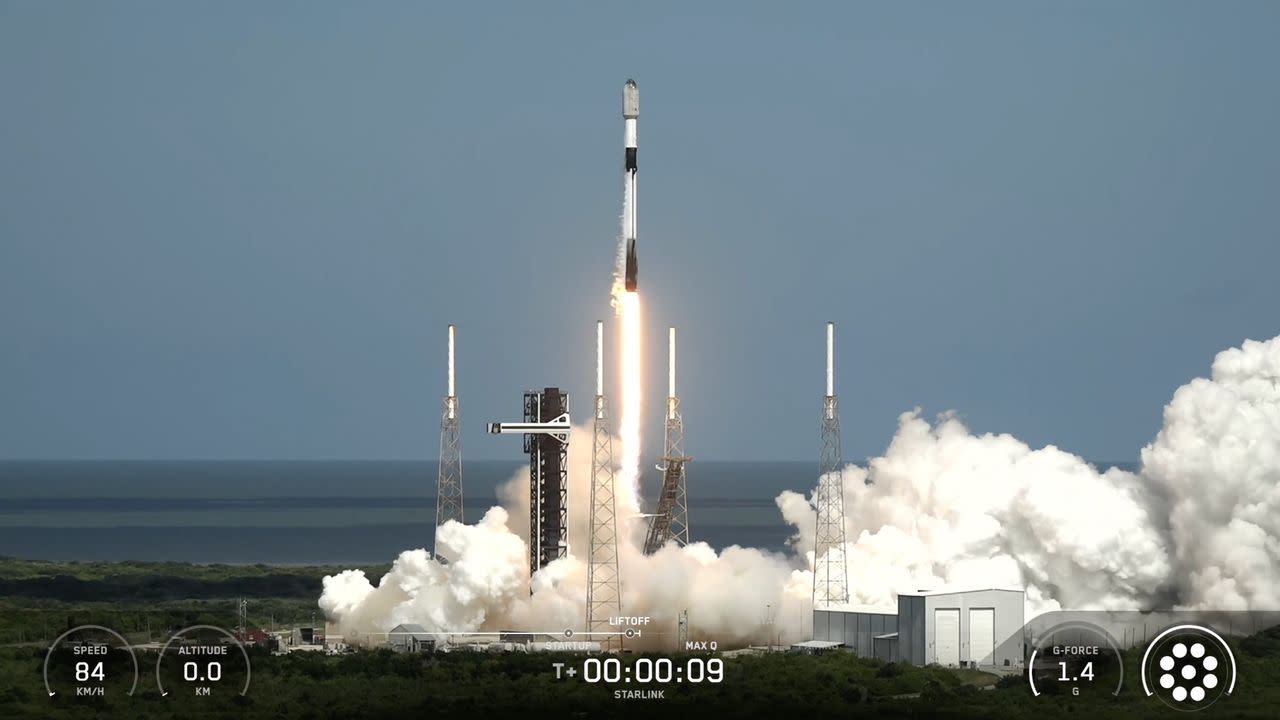
On March 13-14, 2026, SpaceX pulled off something that would make even the most seasoned aerospace executives pause. Two Falcon 9 rockets launched from opposite coasts within 48 hours, deploying 54 Starlink satellites and demonstrating a level of operational tempo that was science fiction just five years ago. This wasn’t a publicity stunt. It was a masterclass in logistics, engineering precision, and business strategy rolled into one spectacular show of force.
Let’s break down what actually happened during this remarkable window. On March 13 at 6:57 a.m. PDT, a Falcon 9 lifted off from Vandenberg Space Force Base in California. It carried 25 Starlink satellites (designated Group 17-31) and featured booster B1071—a workhorse on its 32nd flight. Eight and a half minutes later, that same booster touched down autonomously on the drone ship Of Course I Still Love You floating in the Pacific Ocean.
Less than 24 hours later, another Falcon 9 launched from Cape Canaveral Space Force Station in Florida. This rocket deployed 29 additional Starlink satellites before its booster, B1095, landed on the Atlantic-based drone ship Just Read the Instructions. Combined, these launches marked SpaceX’s 25th and 32nd Starlink missions of 2026, bringing the year’s satellite count to 674 and the active constellation to approximately 9,985 satellites.
Think about the coordination required here. Two launch sites, thousands of miles apart, executing complex missions with military precision. This is the aerospace equivalent of conducting simultaneous product launches in New York and San Francisco with zero margin for error. [Boeing 777X Efficiency Reference]

Why Rocket Reusability Is the Ultimate Competitive Advantage
Here’s where the magic happens—and where traditional competitors are left scrambling. SpaceX’s Falcon 9 first-stage boosters aren’t single-use products. They’re designed, engineered, and operated like commercial aircraft. Booster B1071’s 32 flights aren’t just impressive statistics; they represent a fundamental reimagining of space access economics.
Traditional rockets from competitors like ULA or Arianespace are expendable. Launch once, then into the ocean they go. It’s like buying a new delivery truck for every shipment—economically unsustainable and operationally limiting. SpaceX’s reusability model changes the math entirely.
The technical enablers behind this capability deserve attention. Autonomous drone ship recoveries minimize refurbishment needs and enable rapid turnaround times. Streamlined recovery and inspection processes mean boosters can fly again within weeks rather than requiring complete rebuilds. Ground support infrastructure across multiple launch sites supports high-frequency operations, moving SpaceX toward an airline-like operational tempo.
For business leaders, this translates directly: Lower capital expenditure per launch. Higher asset utilization. Scalable operations without proportional cost increases. These are the hallmarks of disruptive business models in any industry. [Boeing Apache Support Efficiency]

The Numbers That Tell the Real Story
Let’s talk dollars and sense. SpaceX’s internal estimates put their cost per launch at approximately $67 million. Meanwhile, competitors using expendable rockets face costs significantly higher—often exceeding $150–200 million per mission. That’s not a competitive disadvantage; it’s a market extinction event waiting to happen.
Cost per kilogram to orbit? SpaceX has driven this down to around $2,500. For context, the Space Shuttle era saw costs approaching $10,000–20,000 per kilogram. This isn’t incremental improvement. This is order-of-magnitude disruption that fundamentally alters what’s economically viable in space.
By mid-March 2026, SpaceX had completed 32 missions—already matching what some competitors manage in three to four years. The company’s 625th mission overall had achieved its 585th booster landing. These aren’t aspirational metrics. They’re operational realities creating an ever-widening competitive moat. [Lockheed Martin Business Lessons]

How This Stacks Up Against the Competition
The competitive landscape tells a sobering story for traditional aerospace players. Consider this comparison of annual launch rates:
SpaceX completed 32 total launches by mid-March 2026, with 25 dedicated to Starlink. That’s on pace for well over 100 annual launches. In contrast, ULA historically averages 8–10 launches yearly with expendable Vulcan/Centaur rockets. Arianespace manages 10–12 with their emerging Ariane 6 system. Roscosmos, despite its Soyuz-heavy manifest, achieves 20–25 launches with notably lower reliability metrics.
SpaceX’s growth trajectory shows exponential acceleration—from approximately one launch per week in 2021 to near-daily operations by 2026. This isn’t just about frequency. It’s about establishing operational rhythms and supply chain capabilities that competitors simply cannot match without fundamental business model transformation. [Chinaplas 2026 Innovation Reference]
For executives evaluating strategic partnerships or telecommunications infrastructure investments, these market dynamics signal where long-term value and reliability reside. Betting on legacy providers might feel safe, but the data suggests otherwise.

What This Means for Your Business and the Digital Economy
Now let’s connect this to real-world business impact. Whether you’re running a mid-sized enterprise, managing telecommunications infrastructure, or overseeing digital transformation initiatives, SpaceX’s Starlink deployment has direct implications for your operations.

For Remote and Underserved Markets
Traditional telecommunications infrastructure requires massive capital investment in physical cables, towers, and ground equipment. Reaching remote areas often proves economically unviable, creating the “digital divide” that leaves millions without reliable internet access. This isn’t just a social issue—it’s a massive untapped market opportunity.
Starlink’s low Earth orbit (LEO) satellite constellation solves this problem differently. Instead of running fiber optic cables to every remote location, satellites provide coverage from above. The March 13-14 launches added 54 satellites in 48 hours, significantly boosting network density for lower latency and higher speeds. For businesses operating in agriculture, mining, maritime shipping, or emergency services, this means reliable high-speed connectivity where none existed before. [Agricultural Drones for Precision Farming]
The economic model works too. At approximately $100 monthly for end-user service, Starlink offers competitive pricing that makes business cases viable for remote operations. Need to connect a mining site in Nevada, an agricultural operation in Montana, or a resort in rural Vermont? Starlink makes it feasible without multi-million-dollar infrastructure investments.

For Telecommunications Professionals and Industry Disruptors
If you’re in the telecommunications industry, this represents a paradigm shift from geostationary (GEO) satellites to LEO networks. GEO satellites orbit at approximately 22,000 miles altitude, creating inherent latency issues—the signal delay is noticeable in video calls and problematic for real-time applications. LEO satellites at around 340 miles altitude dramatically reduce this latency.
SpaceX isn’t just building a satellite network. They’re establishing a global telecommunications platform that bypasses traditional infrastructure entirely. For incumbent providers, this creates competitive pressure. For innovative telecom companies and MVNOs (Mobile Virtual Network Operators), it creates partnership opportunities to serve previously unreachable markets.
The strategic question for telecom executives: Are you building partnerships with next-generation providers, or are you defending legacy infrastructure with diminishing returns?

For Technology Enthusiasts and Innovation Leaders
The engineering breakthroughs demonstrated in these back-to-back launches extend far beyond Starlink. Booster B1071’s 32 flights prove that reusable orbital-class rockets aren’t experimental technology—they’re operational reality. This validation paves the way for SpaceX’s next-generation Starship system, designed for even more ambitious missions including cargo transport, satellite deployment, and eventually human spaceflight to Mars.
For business leaders focused on innovation, the lessons are transferable. SpaceX succeeded by questioning fundamental assumptions (rockets must be expendable), investing heavily in enabling technologies (autonomous landing systems), and iterating rapidly based on real-world data. These principles apply whether you’re developing AI applications, manufacturing processes, or supply chain optimization. [CES 2026 AI Trends]
The company’s approach to vertical integration—building most components in-house rather than relying on traditional aerospace supply chains—mirrors strategies deployed successfully in industries from automotive (Tesla) to cloud computing (Amazon Web Services).

The Strategic Implications of Operational Maturity
This 48-hour launch window signals something profound: SpaceX has achieved operational maturity unprecedented in aerospace history. The ability to execute complex missions from multiple sites with minimal turnaround time indicates robust systems, well-trained teams, and scalable processes.
What does operational maturity mean in practical terms? Predictability. Reliability. Scalability. These are the characteristics that transform experimental technologies into business-critical infrastructure. Companies can now plan connectivity rollouts with confidence, knowing launch schedules will be met and network expansion will continue at predictable rates.
For strategic planners and technology officers, this reduces risk significantly. Betting on Starlink for remote connectivity isn’t speculative—it’s supported by demonstrated capability and operational track record. The 585 successful booster landings provide statistical confidence that most industries would envy.

Economic Implications Beyond the Launch Pad
The broader economic implications deserve careful consideration. SpaceX’s high-cadence reusability model creates positive feedback loops across multiple sectors:
- Infrastructure Development: As Starlink coverage expands, previously uneconomic business opportunities become viable. Remote tourism, distributed manufacturing, telehealth services, and distance learning all become feasible in areas that lacked reliable connectivity.
- Market Competition: Lower barriers to space access enable new satellite operators, earth observation companies, and space-based services. This competition drives innovation and creates new business opportunities across the value chain.
- Labor and Skills: The growing commercial space sector demands engineers, technicians, data analysts, and business professionals—creating high-value employment and skills development opportunities.
- Global Connectivity Equity: Bridging the digital divide isn’t charity—it’s market expansion. Billions of potential customers in underserved regions represent massive economic opportunity for digital services, e-commerce, and education platforms.
For C-level executives, the question isn’t whether space-based connectivity will impact your industry. It’s how quickly you can capitalize on the opportunities it creates.

Why the Launch Cadence Matters More Than You Think
The acceleration from one launch per week in 2021 to near-daily operations by 2026 isn’t just impressive—it’s transformative. This pace enables SpaceX to respond to market demands, replace aging satellites, expand coverage areas, and iterate on technology faster than competitors can match.
Consider the strategic advantages of speed: Market responsiveness to address coverage gaps or capacity constraints. Technology iteration to incorporate improvements with each launch batch. Competitive positioning that makes it nearly impossible for rivals to catch up without similar reusability breakthroughs.
In business terms, SpaceX has created a “flywheel effect.” More launches mean more satellites. More satellites mean better service. Better service attracts more customers. More customers generate revenue to fund more launches. This self-reinforcing cycle is incredibly difficult to disrupt once established.

The Path Forward: From Starlink to Multiplanetary Infrastructure
While the immediate focus is Starlink constellation deployment, these operational capabilities serve larger ambitions. SpaceX’s stated goal of making humanity multiplanetary requires exactly this kind of routine, reliable space access. The Starlink business model funds development of Starship—the fully reusable heavy-lift vehicle designed for Mars missions.
For business leaders, this long-term thinking offers lessons. Today’s revenue streams (Starlink subscriptions) finance tomorrow’s breakthrough technologies (Starship). Short-term operational excellence (high-cadence launches) builds capabilities for long-term strategic objectives (space settlement). This alignment of business fundamentals with visionary goals creates resilient organizations.

What Decision-Makers Should Monitor Going Forward
As SpaceX continues ramping operations, several indicators deserve attention:
- Launch frequency trends: Is the cadence increasing further? Are they achieving truly daily launches?
- Service availability expansion: Which new markets gain Starlink coverage? What’s the customer acquisition rate?
- Competitor responses: How are traditional telecom and satellite operators adapting? Are partnerships or price wars emerging?
- Regulatory developments: How do governments worldwide respond to satellite constellations? What spectrum allocations and space traffic management rules evolve?
- Technology evolution: What improvements appear in newer satellite generations? How does Starship development progress?
These factors will shape competitive dynamics, market opportunities, and strategic options across telecommunications, technology, and space-adjacent industries.

The Bottom Line for Business Leaders
SpaceX’s back-to-back launches on March 13-14, 2026, represent far more than an engineering achievement. They demonstrate a viable business model for space infrastructure that creates opportunities while disrupting established markets. The combination of rocket reusability, operational maturity, and strategic vision positions SpaceX as a dominant force in global connectivity.
For telecommunications experts, this signals an industry in transformation—one where satellite-based networks compete directly with terrestrial infrastructure. For space enthusiasts and innovation leaders, it proves that ambitious technical goals can achieve commercial success when paired with rigorous execution. For residents and businesses in remote areas, it promises connectivity that was simply impossible with traditional economics.
The question facing business leaders isn’t whether space-based connectivity matters. It’s how your organization will adapt to a world where distance no longer dictates digital access, where competitive advantages flow to those who embrace new infrastructure paradigms, and where the pace of change accelerates with each successful launch.
The rockets may fly into space, but the implications land squarely in boardrooms, strategy sessions, and market analyses across every sector of the global economy. Those paying attention—and acting accordingly—will find themselves well-positioned for the connectivity revolution that’s quite literally launching as we speak.

FAQ
-
How does SpaceX’s launch cadence compare with other providers?
SpaceX has demonstrated near-daily launch capability, vastly outpacing traditional providers like ULA, Arianespace, and Roscosmos, who typically maintain less than a dozen launches annually. -
What is the main driver of SpaceX’s cost advantage?
The core driver is booster reusability, combined with streamlined ground operations. This reduces both capital and operational costs per mission. -
How does Starlink benefit businesses in remote areas?
Starlink provides reliable high-speed internet without the need for costly terrestrial infrastructure, unlocking digital opportunities in remote or previously unserved regions. -
Are there implications for the broader economy?
Absolutely. New business models, entrepreneurial opportunities, and expanded markets arise as connectivity barriers are lowered, especially for digital services and distance-enabled operations. -
What should industry leaders watch as satellite-based connectivity matures?
Watch for regulatory trends, global coverage expansion, technology advancements in next-gen satellites, rising competition, and adaptation strategies from legacy telecom companies.
See more at this link: https://citipen.com/starlink-satellites-explained/