Summary of Main Ideas
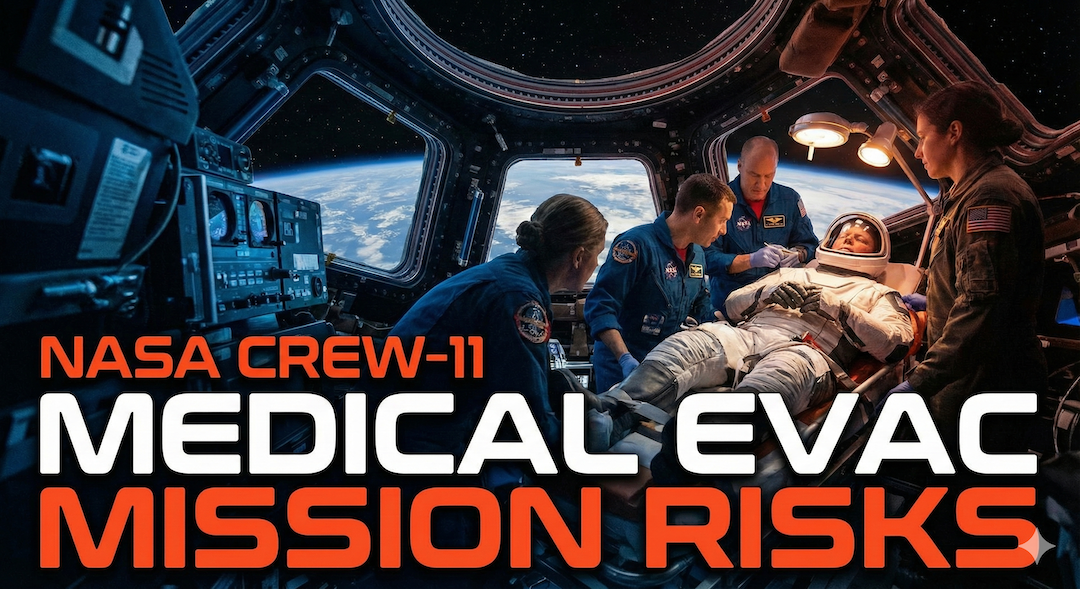
– NASA’s Crew-11 is returning from the International Space Station early due to a medical issue—the first medical evacuation in ISS history after 24+ years of continuous operations
– One of the four astronauts (Zena Cardman, Michael Fincke, Kimiya Yui, or Oleg Platonov) has a stable but significant medical condition that cannot be properly diagnosed or treated with current onboard equipment
– This is not an emergency deorbit, but a calculated, controlled early return using SpaceX’s Crew Dragon “Endeavour”
– The ISS will temporarily operate with just three crew members until Crew-12 arrives in mid-February
– Statistical models predicted this type of event would occur approximately once every three years, making it an expected scenario rather than an anomaly
– The situation offers valuable lessons in risk management, contingency planning, and operational continuity applicable to any enterprise
– Future space missions to the Moon and Mars will need significantly enhanced onboard medical capabilities, as quick returns to Earth won’t be possible

Picture this:
You’re running a critical operation 250 miles from your nearest resource center. Your team has been working flawlessly for six months. Then one morning, a key team member develops a health issue that your on-site medical kit can’t properly diagnose.
What do you do?
This isn’t a hypothetical business scenario. It’s exactly what NASA is facing right now with Crew-11 aboard the International Space Station. And it’s making space history—for the first time ever.

When “Business as Usual” Meets the Unexpected
On August 1, 2025, four astronauts launched to the ISS aboard SpaceX’s Crew Dragon “Endeavour.” Zena Cardman and Michael Fincke from NASA, Kimiya Yui from Japan’s JAXA, and Oleg Platonov from Russia’s Roscosmos. They were scheduled for a standard six-to-eight-month mission conducting experiments, maintaining systems, and upgrading equipment.
Everything proceeded according to plan—until it didn’t.
In early January, NASA scrubbed a scheduled spacewalk featuring Cardman and Fincke. The reason? A medical issue affecting one of the astronauts. Within days, NASA Administrator Jared Isaacman announced that Crew-11 would be coming home early—the first medical evacuation from the ISS in over two decades of continuous human presence in orbit.

The Diagnostic Dilemma: When Your Tools Aren’t Enough
NASA’s chief health and medical officer, Dr. James Polk, cut to the heart of the matter. The medical issue “cannot be optimally diagnosed or treated on ISS” with current onboard hardware. The astronaut is facing what Isaacman described as “a medical issue in the difficult areas of microgravity” combined with limitations in diagnostic capability.
Think about that for a moment. The ISS has medical equipment, a pharmacy, and crew trained in emergency medicine. They have continuous access to ground-based physicians and specialists via secure communications. Yet they still can’t adequately handle this particular condition.
What does this tell us? Even sophisticated remote operations have boundaries. Sometimes you need to bring your people back to the home office—or in this case, back to Earth.
The ISS medical kit includes diagnostic tools for vital signs, limited imaging capabilities, and lab tests. But it doesn’t have advanced MRI machines, comprehensive blood analysis labs, or specialist surgical facilities. For conditions requiring those resources, Earth-based care becomes the only viable option.

Decision-Making Under Uncertainty: The NASA Playbook
Here’s where it gets interesting for business leaders. How did NASA make this call?
First, they assessed risk versus reward. Crew-11 had already completed almost all mission objectives. They were nearing the end of their scheduled increment. The timing made this a relatively low-impact decision compared to aborting a mission in its early weeks.
Second, they evaluated available alternatives. Could they treat the condition onboard? Not optimally. Could they wait until the scheduled return date? Possibly, but the risk of diagnostic uncertainty and potential deterioration outweighed the benefits of staying longer.
Third, they considered downstream impacts. Would an early return cripple ISS operations? No. The station can function with a reduced crew, and Crew-12 is scheduled to launch in mid-February.
Isaacman was clear about the decision framework: “This is not an emergency de-orbit, though that capability exists and is trained for.” NASA chose a managed early return over an emergency evacuation. They’re not rushing. They’re being deliberate and systematic.
This is textbook contingency planning in action (see contingency planning here).

Operational Continuity: Running Lean But Not Grounded
When Crew-11 undocks, the ISS will temporarily host just three people: Christopher Williams from NASA, Sergey Kud-Sverchkov from Roscosmos, and Sergei Mikayev, also from Roscosmos.
Williams will be the only American onboard. Can one person handle all U.S. segment responsibilities?
According to NASA, absolutely. Williams is cross-trained to perform all necessary tasks. More importantly, NASA points out that ISS operations rely heavily on ground support—thousands of people in control centers monitoring systems, planning activities, and troubleshooting issues in real-time.
Sound familiar? It’s the same principle behind modern distributed operations. Your field team doesn’t need to handle everything independently when they have robust back-office support and automation handling routine tasks.
The canceled spacewalk—intended to upgrade power systems and prepare for new roll-out solar arrays—will simply be rescheduled to Crew-12 or a later mission. No critical operations are being abandoned, just re-phased.
NASA is examining whether to accelerate Crew-12’s mid-February launch, though it’s unlikely they’ll launch before Crew-11 returns. This creates a brief period of reduced staffing, but not operational degradation.
It’s a masterclass in maintaining business continuity during disruption see strategic business lessons.

The “Lifeboat” Strategy: Always Have an Exit Plan
Here’s a critical design principle worth borrowing: Every crew on the ISS always has a dedicated “lifeboat” spacecraft docked and ready.
For Crew-11, that’s the same Crew Dragon Endeavour they arrived in. For the three-person crew staying behind, that’s their Russian Soyuz capsule, which arrived on November 27.
In true emergencies—life-threatening trauma, stroke, severe decompression sickness—procedures exist for fast-track undocking and immediate deorbit within hours. Both Soyuz and Crew Dragon have this capability. NASA and its international partners train for these scenarios regularly.
In this case, they’re not exercising that extreme protocol. They’re using the scheduled return process, just accelerated. The spacecraft becomes both routine transportation and emergency evacuation vehicle.
This dual-purpose approach reduces complexity and cost while maintaining rapid response capability. Your business continuity tools should work the same way—useful for daily operations, ready for crisis response
see risk management lessons.

Risk Management Lessons: What NASA Knew Would Eventually Happen
Here’s the plot twist: NASA expected this.
Dr. Polk revealed that statistical modeling has long predicted a medical evacuation from ISS should occur approximately once every three years. The fact that this is the first such event in over 24 years of continuous ISS operations means NASA has been, in his words, “statistically lucky.”
Let that sink in. They built their entire medical risk management framework around the assumption this would happen. They trained for it. They planned for it. They accepted it as an inevitable operational reality.
When it finally occurred, they executed the plan.
How many businesses can say they’ve truly planned for their statistically likely crises? Not just the obvious ones, but the scenarios that probability says will eventually hit your operations?
NASA’s approach includes:
- Probabilistic risk modeling that quantifies likelihood of various medical scenarios
- Pre-positioned resources (the lifeboat spacecraft) ready for immediate use
- Cross-trained personnel who can maintain operations during disruption
- Decision protocols that balance risk, timing, and mission impact
- Regular training on emergency procedures so execution is smooth, not chaotic
This isn’t reactive crisis management. It’s proactive risk architecture
see strategic risk approaches.

The Privacy Paradox: Transparency vs. Confidentiality
One fascinating aspect of this situation is what NASA isn’t saying.
They haven’t identified which of the four Crew-11 members is affected. They haven’t disclosed the medical condition. They’re citing medical privacy—the same HIPAA regulations that protect your employees’ health information.
Yet they’re being remarkably transparent about the decision-making process, risk assessment, and operational impacts see here. They’re explaining the “why” and “how” without compromising the “who” and “what.”
For business leaders, this is a valuable template. When your organization faces a personnel issue that triggers operational changes, you can maintain individual privacy while still communicating clearly about business continuity, decision rationale, and stakeholder impacts.
NASA is threading this needle in real-time under intense public scrutiny.

Future Implications: When “Going Home” Isn’t an Option
This event has profound implications for the future of space exploration—and they’re worth considering even if your enterprise operates entirely on Earth.
NASA’s Artemis program aims to establish a permanent presence on the Moon. Mars missions are being planned for the 2030s. In those environments, a quick return to Earth won’t be possible.
A Moon-to-Earth emergency return takes several days. Mars-to-Earth? That’s months, and only during specific orbital windows.
The fact that current ISS medical capabilities have clear limitations—highlighted by this very event—means future missions must have dramatically enhanced onboard diagnostic and treatment options. Advanced imaging, surgical facilities, more comprehensive pharmaceuticals, perhaps even telemedicine with AI-assisted diagnosis.
The business parallel? As you expand operations into remote or challenging environments—whether that’s new geographic markets, digital-only customer service, or distributed remote teams—your support infrastructure needs to scale accordingly. For insight into how physical and technological advancements (including AI and autonomy) will affect operational infrastructure, see this article on future tech.
You can’t rely on “we’ll just bring them back to headquarters” as your fallback plan indefinitely. At some point, your remote operations need genuine autonomous capability.

The Precedent Factor: First Time Is Always Special
Make no mistake, this is a landmark event.
In 24+ years of ISS operations, through hundreds of crew rotations involving astronauts and cosmonauts from dozens of countries, this is the first time a medical condition has forced an early crew return.
Previous spaceflight history includes medical issues—space adaptation sickness, minor injuries, psychological challenges. There was even an inflight medical abort on a Soyuz mission in the 1980s. But no ISS crew has ever terminated their increment early specifically for medical reasons.
Until now.
This becomes a reference case for:
- Medical screening standards for long-duration missions
- Contingency planning refinements based on real-world execution
- Privacy versus transparency policies in crisis communications
- Risk communication practices that distinguish between emergency and controlled responses
- Insurance and liability frameworks for commercial space operations
For NASA, SpaceX, and international partners, this is a live test of systems and procedures that existed largely in theory. The learnings will shape space operations for decades.
In business terms, it’s your first major product recall, your first data breach response, your first leadership transition under pressure—the event that transforms theoretical plans into institutional knowledge.

What Happens Next: The Timeline Forward
As of now, NASA hasn’t announced exact undocking and splashdown dates. They’ve indicated updates will come “in the next few days.” The process is being methodically planned, not rushed.
Crew Dragon Endeavour will undock from ISS, complete deorbit burns, reenter Earth’s atmosphere, and splash down in the Atlantic or Gulf of Mexico—the standard profile used for all Commercial Crew Program returns.
The affected astronaut will receive immediate medical attention upon landing, transported to facilities capable of providing whatever diagnostics and treatment are needed.
The three remaining ISS crew members will continue operations until Crew-12’s arrival, currently targeted for mid-February but potentially accelerated slightly.
Life aboard the station continues. Science experiments keep running. Systems keep getting maintained. The mission persists, even as this one crew comes home early.
It’s a powerful reminder that resilient operations don’t depend on perfect conditions—they depend on good design, trained people, and the willingness to adapt when circumstances change.

The Bigger Picture: When Systems Work as Designed
Here’s the remarkable thing about this entire situation: Nothing broke.
No equipment failed. No procedures were violated. No one made a critical error. A medical condition emerged—as medical conditions sometimes do—and the system responded exactly as designed.
NASA identified the issue. They assessed the risk. They evaluated their options. They made a measured decision. They’re executing a planned-for contingency.
The astronaut remains stable. Operations continue. The mission adapts.
For an organization managing incredibly complex operations in one of the most challenging environments imaginable, this is what success looks like. Not perfect, uninterrupted operations forever. But graceful degradation and controlled response when reality deviates from the plan
see the strategic risk case study.
Your business will face its own “first medical evacuation from the ISS” moment—that statistically inevitable event that your models predicted but hasn’t happened yet. The question isn’t whether it will occur. The question is whether you’ll handle it with the same calm professionalism NASA is demonstrating right now.
Will your team be cross-trained? Will your contingency plans be practiced? Will your decision-makers have clear frameworks for assessing risk versus reward? Will your communication balance transparency with appropriate confidentiality?
Most importantly, will you have anticipated that the unexpected will happen, so when it does, you’re responding rather than scrambling?
NASA spent years preparing for this exact scenario. They trained for it knowing it would eventually occur. When it finally did, after 24 years of luck, they were ready.
That’s not just good space operations. That’s good business.
As Crew-11 prepares to come home earlier than planned, they’re writing a new chapter in spaceflight history. But they’re also providing a case study in crisis management, operational resilience, and decision-making under uncertainty that every enterprise leader should study.
Because someday, your organization will face its own moment when the plan needs to change, when risk calculations shift, when bringing your team home early is the right call.
Will you be ready?

FAQ
-
- Which astronaut is affected and what is the medical condition?
NASA has not disclosed the identity of the astronaut or the specifics of the medical condition to honor medical privacy.
- Which astronaut is affected and what is the medical condition?
-
- Is the ISS in danger or is this an emergency?
No. The station remains fully functional and is not in an emergency. This is a controlled, managed early return, not an emergency evacuation.
- Is the ISS in danger or is this an emergency?
-
- How often did NASA expect such a medical return to be needed?
Statistical models predicted one medical evacuation every three years. This is the first in more than 24 years of ISS operation.
- How often did NASA expect such a medical return to be needed?
-
- How long will the ISS run with three people?
About a month or less, until Crew-12 arrives (targeted mid-February). All core functions will continue.
- How long will the ISS run with three people?
-
- Will this affect future Moon and Mars missions?
Absolutely. It demonstrates that future missions need improved medical hardware and procedures for remote care, since “coming home” won’t be fast or always possible.
- Will this affect future Moon and Mars missions?
- What are the business and leadership lessons?
This event is a model for risk management, contingency planning, operational continuity, transparency, and crisis communications.
The key lesson: luck isn’t a strategy. Anticipate, plan, practice—and when the unexpected happens, execute calmly and confidently.