Summary of Main Ideas
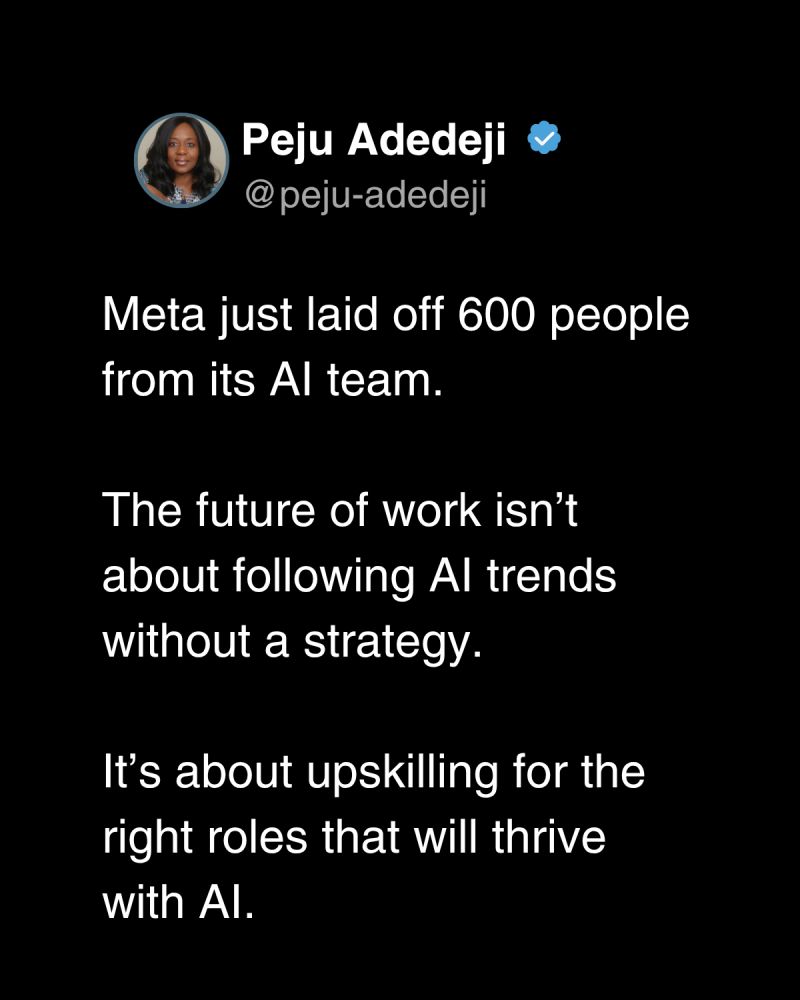
– Meta is planning to cut up to 20% of its workforce (roughly 15,600-16,000 employees) to fund a staggering $600 billion AI infrastructure investment through 2028, marking the largest layoffs since their 2022-2023 reductions.
– The “Year of Efficiency” doctrine drives this shift: Mark Zuckerberg believes AI tools enable single talented individuals to accomplish what previously required entire teams.
– This isn’t financial distress—it’s strategic reallocation: Meta is shifting resources from broad workforce spending (OpEx) to elite AI talent and infrastructure (CapEx), betting that AI productivity gains justify smaller teams.
– Tech giants are following suit: Google, Amazon, and Microsoft are implementing similar AI-driven efficiency strategies, signaling an industry-wide transformation in how companies balance human capital with technology investments.
– The job market is bifurcating rapidly: Non-AI roles face displacement while demand for AI/ML specialists skyrockets, with Meta offering “hundreds of millions” in compensation packages for top superintelligence team members.
– Business leaders must act now: This shift demands immediate workforce planning, AI skill development, and strategic decisions about balancing automation investments with human expertise.

The Numbers Behind Meta’s Massive Shift
Let’s cut through the speculation and look at what we actually know. According to Reuters and multiple confirmed sources, Meta is discussing workforce reductions of 20% or more. We’re talking about approximately 15,600 to 16,000 jobs on the chopping block.
To put that in perspective, this would be Meta’s largest reduction since 2022-2023, when they laid off over 21,000 employees. Remember those cuts? 11,000 people in November 2022, another 10,000 in 2023. Those seemed massive at the time. This could dwarf them.
But here’s where it gets interesting. Meta’s spokesperson called these reports “speculative” and labeled them “theoretical approaches.” Translation? They’re definitely considering it, but nothing’s finalized. Senior executives are already briefing teams on reduction strategies, though no timeline has been set.
Meanwhile, the company is planning to invest up to $600 billion in AI infrastructure by 2028. We’re talking data centers that consume more power than small countries. NVIDIA GPUs by the truckload. Recent acquisitions like the $2 billion Manus AI startup purchase. Expansions of their AI Superintelligence Lab with compensation packages that make C-suite salaries look modest. NVIDIA GPUs by the truckload. Recent acquisitions.
Think about that math for a second. Six hundred billion dollars. That’s not a typo. That’s roughly the GDP of Poland or the entire market cap of Tesla at its peak. And Meta believes this investment will generate more value than keeping those 16,000 employees.

Why Zuckerberg’s “Year of Efficiency” Changes Everything
Here’s what makes this different from typical cost-cutting: Meta isn’t in financial trouble. Their revenue is strong. Their user base continues to grow. This isn’t a drowning company throwing people overboard to stay afloat.
This is strategic transformation. Zuckerberg’s “Year of Efficiency” doctrine centers on one radical premise: “Projects that used to require big teams can now be accomplished by a single very talented person.” He’s not talking about incremental productivity gains. He’s talking about 10x, 20x, maybe 50x improvements in what one person can accomplish with the right AI tools.
Imagine telling your team five years ago that one developer could build what previously required twenty. You’d be laughed out of the room. Today? With AI coding assistants, automated testing, AI-generated documentation, and machine learning models handling routine tasks, it’s not just possible—it’s happening. AI coding assistants, automated testing, AI-generated documentation.
But there’s a darker implication here. If one talented person with AI can replace an entire team, what happens to the other nineteen people? Meta’s answer is becoming increasingly clear: they find other opportunities. Outside of Meta.
This isn’t efficiency for efficiency’s sake. This is a fundamental reimagining of what a technology company looks like when AI moves from supporting role to leading actor. And Meta is betting their future—and 16,000 careers—on getting this right.

The Real Cost Comparison: People vs. Machines
Let’s talk dollars and sense. On one side, you have workforce operational expenses (OpEx). That’s salaries, benefits, office space, equipment, training, and all the overhead that comes with 79,000 human beings showing up to work.
Cutting 20% of your workforce—roughly 16,000 people—frees up substantial capital. While Meta hasn’t disclosed exact savings figures, industry estimates put average compensation for tech workers at $150,000 to $300,000 when you factor in all costs. Do the math: that’s potentially $2.4 to $4.8 billion annually.
Sounds like a lot, right? Now compare it to the other side of the equation. Meta’s planning $600 billion in AI capital expenditure (CapEx) through 2028. That’s data centers, specialized hardware, acquisitions, and the astronomical compensation packages for elite AI talent.
Here’s the twist that most people miss: Meta is framing this as resource reallocation, not savings. They’re not pocketing the money saved from layoffs. They’re redirecting every penny—and hundreds of billions more—into AI infrastructure.
Think of it like this: You own a factory with 100 workers making widgets by hand. Someone offers you a machine that can make 1,000 widgets with just 10 operators, but the machine costs $600 million. Do you keep the 100 workers, or do you buy the machine and keep only the 10 most skilled operators?
Meta’s betting on the machine. And they’re betting that the productivity gains will justify every penny of that $600 billion investment.

What This Means for Your Industry
If you’re reading this as a business leader, here’s the uncomfortable question: Is your company next?
The pattern isn’t isolated to Meta. Google, Amazon, and Microsoft are all citing “AI efficiency” as justification for 2026 layoffs. This isn’t coincidence—it’s coordination. Not in a conspiracy sense, but in a “we’re all seeing the same data and reaching the same conclusions” sense.
The tech industry is sending a clear signal: AI infrastructure is the new competitive moat. Companies that invest aggressively now will dominate their markets in five years. Companies that don’t will become footnotes.
But here’s what’s relevant for non-tech industries: this wave is coming for you too. If AI can automate software development, customer service, content creation, and data analysis in tech companies, what makes you think your industry is immune? Physical AI and robotics transforming industries. Smart manufacturing and sustainability.
Financial services? AI is already handling fraud detection and risk assessment. Manufacturing? Predictive maintenance and quality control are increasingly automated. Healthcare? Diagnostic AI is outperforming human doctors in specific domains. Legal? Document review and contract analysis are being revolutionized.
The question isn’t whether AI will transform your industry. The question is whether you’ll lead that transformation or become its casualty.
Smart leaders are watching Meta’s experiment closely. If they pull this off—if they successfully transition to a leaner, AI-augmented workforce while maintaining or increasing productivity—it becomes the blueprint for every other company trying to survive in the AI era.

The Job Market Earthquake: Who Wins, Who Loses?
Let’s get real about what’s happening to actual people here. We’re not talking about abstract “human resources” or “headcount optimization.” We’re talking about 16,000 individuals who might lose their livelihoods because an algorithm can do their job cheaper and faster.
The displacement is real and it’s harsh. Non-AI roles are getting hammered. Operations teams, non-core functions, generalist positions—these are the primary targets. If your job involves routine tasks that can be codified into algorithms, you’re in the danger zone.
But here’s the paradox: at the same time Meta is cutting 16,000 jobs, they’re offering compensation packages worth “hundreds of millions” for AI and machine learning specialists. We’re talking about the same company, in the same fiscal year, simultaneously firing thousands and offering elite talent more money than most people will earn in ten lifetimes.
The job market isn’t disappearing—it’s bifurcating. High-skill AI roles are experiencing unprecedented demand. Data scientists, ML engineers, AI ethicists, prompt engineers (yes, that’s a real job now)—these professionals are commanding salaries that would make traditional executives jealous.
Meanwhile, mid-level generalist roles are getting squeezed. The jobs that provided stable middle-class incomes in tech for decades are evaporating. It’s creating a barbell economy: ultra-high-paid AI specialists on one end, and everyone else scrambling for the remaining positions on the other.
For business leaders, this creates both opportunity and risk. Opportunity if you can attract and retain top AI talent. Risk if your workforce isn’t prepared for this transition and you find yourself unable to compete in an AI-driven market.
The talent war is about to get brutal. And unlike previous tech talent wars, this one won’t be won by offering free lunch and ping-pong tables. This requires fundamental rethinking of how you develop, deploy, and compensate human expertise in an AI-augmented world. AI augmentation and workflow efficiency.

The Billion-Dollar Question: Is This Sustainable?
Here’s what keeps me up at night about Meta’s strategy: it’s predicated on a massive assumption that might be wrong. The assumption is that AI productivity gains will continue accelerating at current rates, justifying leaner teams and massive infrastructure investments.
But what if they don’t? What if we’re approaching an AI plateau? Meta’s own Llama and Avocado models have experienced delays. AI development isn’t following a smooth upward curve—it’s more like a series of breakthroughs followed by consolidation periods.
If AI capabilities stagnate while Meta has already cut deep into their workforce, they could find themselves understaffed and unable to compete. You can’t just rehire 16,000 specialized employees overnight if you realize you made a mistake.
There’s also the broader economic question: what happens when every major company adopts this strategy simultaneously? If tech giants collectively lay off hundreds of thousands of workers to invest in AI, where do those displaced workers go?
Consumer spending drives 70% of the U.S. economy. Unemployed workers don’t buy products. They don’t upgrade their phones. They don’t pay for subscriptions. If AI-driven layoffs create widespread unemployment, who’s going to buy all the products and services these optimized, efficient companies are producing?
Some economists argue this is the classic automation paradox that has played out repeatedly throughout history. Automation displaces specific jobs but creates new ones and increases overall prosperity. The Industrial Revolution put hand-weavers out of work but created far more jobs in factories, logistics, and retail.
Others argue this time is different. AI isn’t just automating physical tasks—it’s automating cognitive work. And there’s no guarantee that displaced knowledge workers will find equivalent opportunities in the AI economy.
The honest answer? Nobody knows for certain. Meta is making a $600 billion bet on one outcome. Time will tell if they’re visionary or reckless.

What Business Leaders Need to Do Now
First, audit your workforce through an AI lens. Which roles could be substantially augmented or replaced by AI in the next 2-3 years? Not in a “we should fire these people” way, but in a “we need to prepare for this reality” way. Identify vulnerable positions and start planning reskilling programs now.
Second, invest in AI literacy at all levels. Your executives need to understand AI capabilities and limitations. Your managers need to know how to lead AI-augmented teams. Your individual contributors need to learn how to work alongside AI tools. This isn’t optional anymore—it’s survival.
Third, make strategic bets on AI infrastructure. You probably can’t afford Meta’s $600 billion investment. But you can afford to experiment with AI tools, build partnerships with AI vendors, and create small-scale proof-of-concepts that demonstrate value. Start small, learn fast, scale what works.
Fourth, reframe your talent strategy. Stop thinking about headcount and start thinking about capabilities. One engineer with advanced AI skills might deliver more value than five without them. Adjust your recruiting, compensation, and retention strategies accordingly.
Fifth, watch the ethics and morale implications. Mass layoffs destroy organizational trust. If your employees see colleagues being replaced by AI, productivity and innovation will plummet as everyone starts polishing their resumes. Be transparent about your AI strategy. Involve employees in the transition. Provide genuine reskilling opportunities, not empty promises.
Finally, prepare for a bifurcated talent market. Elite AI talent will command premium compensation. Accept this reality and budget accordingly. But also invest in developing AI capabilities internally. You can’t hire your way out of the AI talent shortage—you have to build expertise from within.

The Future Is Already Here—It’s Just Unevenly Distributed
William Gibson said that about technology in general, but it’s never been truer than right now with AI. Meta is living in 2028 while most companies are still operating like it’s 2020.
The workforce cuts Meta is planning aren’t an anomaly—they’re a preview. This is what it looks like when AI moves from experimental technology to core business strategy. This is what happens when executives decide that machines plus elite talent deliver more value than large teams of generalists.
Whether this is ultimately good or bad for society, for workers, for innovation—that’s still being written. What’s certain is that it’s happening. The companies that recognize this shift and adapt will thrive. Those that don’t will join the long list of former tech giants who missed critical transitions.
For the 16,000 Meta employees potentially losing their jobs, this is deeply personal and painful. For the millions of tech workers watching nervously, it’s a wake-up call. For business leaders trying to navigate the AI revolution, it’s a case study in high-stakes transformation.
The balance between workforce costs and AI spending isn’t just shifting—it’s being completely rewritten. Meta is betting that in the next era of technology, smaller teams armed with powerful AI will outperform larger teams using traditional methods. It’s a bet that will either validate Zuckerberg’s vision or serve as a cautionary tale about moving too fast in pursuit of efficiency.
Either way, the AI revolution isn’t coming. It’s here. And it’s forcing every company to answer the same uncomfortable question: How many people do we actually need when AI can do the rest? AI in 2026: Transforming Business.
Your answer to that question will define your company’s future. Choose wisely.
Word count: ~2,450 words

See more at this link: https://citipen.com/adobe-ai-integration-strategy-for-creative-teams-boosts-workflow-efficiency/