Summary of Main Ideas
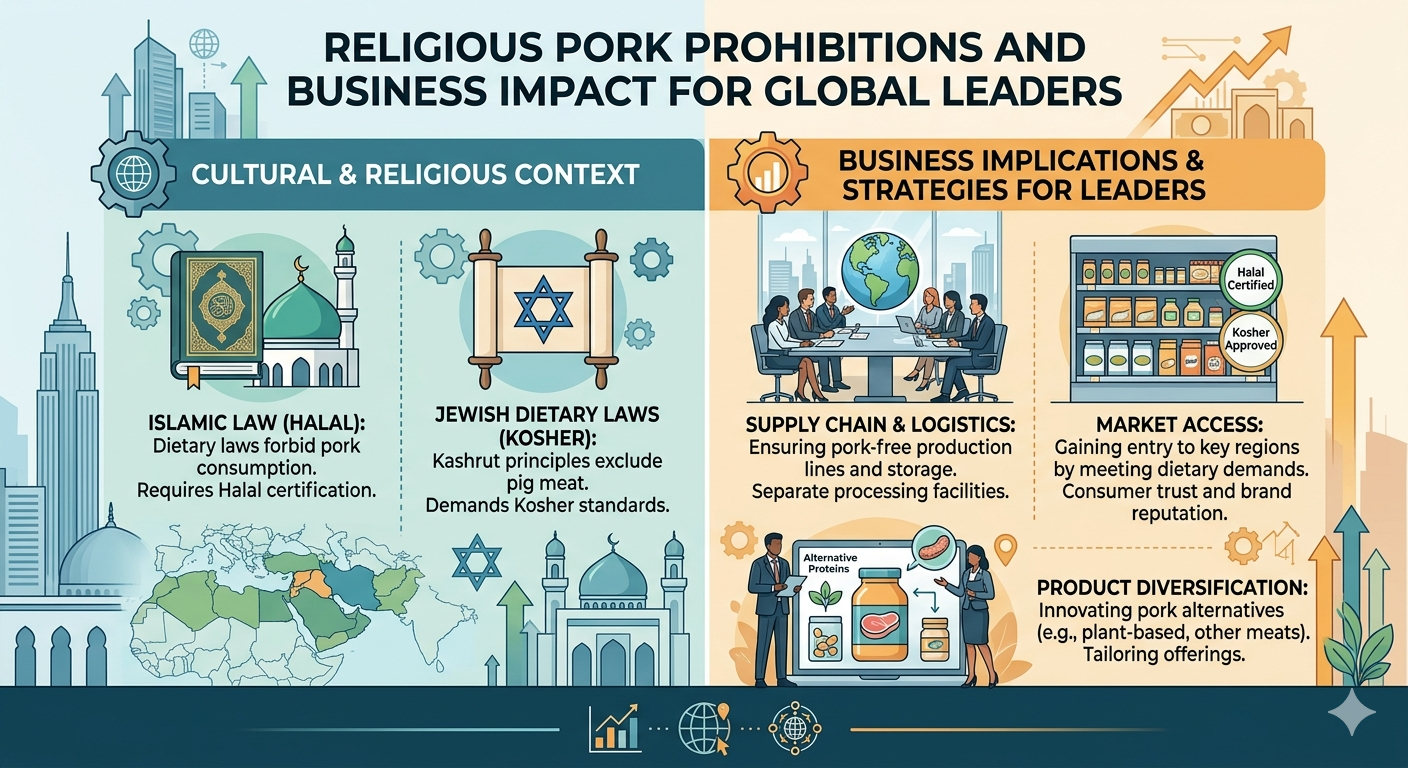
- Judaism and Islam explicitly prohibit pork consumption based on Torah and Quranic commands, while Christianity permits it through New Testament teachings that shifted focus from dietary laws to internal spiritual purity.
- Jewish Kashrut laws ban pork because pigs have cloven hooves but don’t chew cud, failing biblical criteria for clean animals—a rule that symbolizes covenant loyalty and cultural identity.
- Islamic halal guidelines deem pork haram (forbidden) and najas (impure), reinforcing Abrahamic traditions while emphasizing submission to Allah and spiritual discipline.
- Christianity diverged through Jesus’s declaration that all foods are clean, Peter’s vision in Acts 10, and Paul’s teachings on liberty—prioritizing faith and inclusion over ceremonial law.
- Understanding these religious dietary distinctions is crucial for business leaders operating in global markets, managing diverse teams, and building culturally intelligent organizations.
- These ancient food laws continue to shape modern identity, influence consumer behavior, and impact international business practices across industries from hospitality to food production.
Ever sealed a business deal over dinner, only to realize your guest can’t eat half the menu? Or launched a product internationally without considering religious dietary restrictions? You’re not alone. Understanding why billions of people around the world won’t touch pork isn’t just cultural trivia—it’s essential business intelligence.
Here’s the fascinating reality: Judaism and Islam, despite their differences, share an absolute prohibition on pork. Christianity, which emerged from Jewish roots, took a completely different path. This theological split didn’t happen by accident. It reflects fundamental differences in scriptural interpretation, religious identity, and how these faiths define purity itself.
For business leaders navigating global markets, this knowledge translates directly to competitive advantage. Whether you’re expanding into Muslim-majority markets, catering corporate events, or building inclusive workplace cultures, understanding these dietary boundaries matters. Let’s explore why three major world religions that trace back to the same patriarch—Abraham—ended up with such divergent views on a single food item.
The Jewish Position: Pork as the Ultimate Non-Kosher Food
Jewish dietary laws, known as Kashrut or keeping Kosher, don’t leave room for interpretation on pork. It’s unequivocally forbidden. But why?
The Torah establishes specific criteria for clean land animals in Leviticus 11:3-7 and Deuteronomy 14:8. To be kosher, an animal must have cloven (split) hooves and chew its cud. Think of it like a product needing to pass two quality-control checkpoints. Fail either one, and it’s rejected.
Pigs present an interesting case study. They have perfectly cloven hooves—checkpoint one, passed. But they don’t chew cud—checkpoint two, failed. This makes swine archetypally unclean, the poster child for non-kosher meat. It’s like a job candidate with impeccable credentials who fails the final interview.
More Than Just Food Rules
These laws serve purposes beyond nutrition or health. They function as visible identity markers, distinguishing Jewish people from surrounding cultures. Throughout history, even under persecution, observant Jews maintained these dietary boundaries as expressions of covenant loyalty.
Think of Kashrut as brand consistency. Just as successful companies maintain strict brand guidelines regardless of market pressures, observant Jews maintain dietary laws regardless of social convenience. It’s a commitment that transcends mere preference.
There is one exception worth noting: Pikuach nefesh. This principle permits eating pork in life-threatening starvation situations. It’s the ultimate emergency override, recognizing that preserving life supersedes dietary law. Even the strictest systems need circuit breakers for extreme circumstances.
The Islamic Stance: Haram Without Compromise
Islam takes an equally firm position. Pork is haram—forbidden—and often classified as najas, meaning ritually impure. This isn’t a suggestion or recommendation. It’s a divine command.
The Quran explicitly prohibits “flesh of swine” in multiple passages. Surah Al-An’am 6:145, Surah Al-Baqarah, Surah Al-Ma’idah, and Surat An-Nahl 16:115 all reinforce this prohibition. The message is consistent and clear across the entire text.
Reinforcing Abrahamic Tradition
Islam sees itself as continuing and perfecting the Abrahamic tradition, not replacing it. The pork prohibition reinforces Torah laws while emphasizing core Islamic principles: submission to Allah, spiritual discipline, and ritual cleanliness.
Like Judaism, Islam extends the prohibition beyond consumption. Observant Muslims avoid contact with pork products entirely. This affects everything from cooking utensils to cosmetics containing pork derivatives. It’s comprehensive compliance, not selective adherence.
The Quran does permit pork consumption in one scenario: extreme starvation where no other food exists. This mirrors the Jewish pikuach nefesh principle. Both faiths recognize that survival occasionally requires exceptions to even the most sacred rules.
The Christian Departure: A Revolutionary Shift
Christianity’s break from pork prohibition represents one of its most significant departures from Jewish law. This wasn’t a minor adjustment—it was a theological earthquake that reshaped the faith’s identity and trajectory.
Early Christians faced a critical question: Were Gentile (non-Jewish) converts required to follow Jewish dietary laws? The answer they arrived at fundamentally changed Christianity’s character and enabled its rapid spread beyond Jewish communities.
Jesus and the Internal Revolution
Jesus declared all foods clean in Mark 7:19, shifting focus from external rules to internal purity. This teaching emphasized that what comes from the heart—not what enters the mouth—determines spiritual cleanliness. It’s like moving from compliance-based to values-based corporate culture.
The emphasis moved from ceremonial law (rituals and practices) to moral law (ethical principles). Dietary restrictions fell into the ceremonial category—important for Jewish identity but not binding for Christian salvation.
Peter’s Vision: A Turning Point
The Book of Acts records a pivotal moment. Peter, a Jewish apostle, receives a vision where God declares previously unclean animals clean. This wasn’t primarily about food—it was about people. The vision signaled that Gentiles could join the faith without adopting Jewish cultural practices.
Imagine a company deciding to enter international markets by adapting to local cultures rather than imposing headquarters’ culture everywhere. That’s essentially what early Christianity did with dietary laws.
A deep exploration of the leadership, risk, and identity lessons in pivotal Christian media can be found in Mel Gibson’s film, covered here: The Passion of the Christ, Mel Gibson, Jim Caviezel, dead languages, faith-based cinema.
Paul’s Teaching on Liberty
The Apostle Paul took this further in Romans 14, teaching that believers have liberty regarding food choices. He advised against judging others based on what they eat while respecting personal convictions. The focus shifted to unity, conscience, and faith rather than dietary boundaries.
This flexibility became a competitive advantage. Christianity could spread across diverse cultures without requiring wholesale adoption of Middle Eastern dietary customs. It was strategic adaptation at its finest.
The Comparative Framework: Three Faiths, Three Approaches
Let’s break down how these three religions approach pork prohibition:
- Judaism:
- Foundation: Torah commands in Leviticus and Deuteronomy
- Reasoning: Pigs fail biblical cleanliness criteria (split hooves but no cud-chewing)
- Purpose: Covenant loyalty, holiness, cultural identity marker
- Modern practice: Strict adherence among observant Jews
- Business implication: Kosher certification is a multi-billion dollar global industry
- Islam:
- Foundation: Multiple Quranic prohibitions
- Reasoning: Direct divine forbidance
- Purpose: Obedience to Allah, spiritual purity, continuation of Abrahamic tradition
- Modern practice: Strict adherence among practicing Muslims
- Business implication: Halal markets represent trillions in global purchasing power
- Christianity:
- Foundation: New Testament teachings (Mark 7:19, Acts 10, Romans 14)
- Reasoning: Internal purity supersedes external dietary rules
- Purpose: Faith-based salvation, Gentile inclusion, grace over law
- Modern practice: Generally unrestricted across denominations
- Business implication: Fewer dietary constraints but growing niche markets (kosher, halal) within Christian-majority countries
For further insights into how religious faith and ancient prophecies shape modern business practice and identity in the Middle East, see: Jerusalem, Third Temple, Golden Gate, prophetic fulfillment, regional stability and Messianic expectation, Hebrew calendar, MJAA Messiah 2026, Israel-U.S. military, Next Year in Jerusalem.
Historical and Cultural Context: Why It Still Matters
Pork taboos didn’t originate with Abrahamic religions. Archaeological evidence suggests pork avoidance predated ancient Israelites in regions like Syria and Phoenicia. Cultural stigma around pigs existed before religious codification.
Some scholars speculate that health concerns drove these prohibitions. Trichinosis, a parasitic disease transmitted through undercooked pork, posed real dangers in ancient times. However, religious texts emphasize divine command rather than hygiene rationales.
Identity Under Pressure
Throughout history, pork consumption became a litmus test for religious identity. During the Maccabean revolt, Jews who refused pork despite persecution demonstrated extraordinary commitment. Food choice became a form of resistance.
Today, these dietary boundaries continue distinguishing observant Jews and Muslims in societies where pork is ubiquitous. It’s daily practice that reinforces belonging and commitment. Every meal becomes an act of faith.
For a closer look at the intersection of religious tradition, leadership, and humility—another root cause of identity formation—see nativity story, transformative leadership, humble beginnings, strategic communication, redemptive purpose.
Business Implications: Why Leaders Must Care
Understanding these dietary distinctions isn’t academic—it’s practical business intelligence. Here’s why it matters:
- Global Market Strategy: Two billion Muslims and fifteen million Jews worldwide represent massive markets with specific needs. Companies like McDonald’s, KFC, and Nestlé invest heavily in halal and kosher certification to access these consumers.
- Workplace Inclusion: Diverse teams require culturally intelligent leadership. Serving only pork at company events excludes observant colleagues. It signals insensitivity, whether intended or not.
- Supply Chain Decisions: Food manufacturers must segregate production lines for kosher and halal products. Cross-contamination isn’t just a quality issue—it’s a deal-breaker for these markets.
- Hospitality and Service Industries: Hotels, airlines, restaurants, and catering companies that understand these dietary requirements gain competitive advantages. It’s service excellence through cultural competence.
- International Negotiations: Business dinners play crucial roles in relationship-building. Choosing appropriate venues demonstrates respect and cultural awareness. It can make or break partnerships.
Leaders keen on resilience and adopting lessons from diverse traditions, especially in disruptive or uncertain environments, may also benefit from strategic lessons in: self-reliant leadership, gap and gain, three wins journal, strategic isolation, courage curiosity grit.
The Bigger Picture: Respect, Not Agreement
You don’t need to observe these dietary laws to respect them. Understanding why they matter to others demonstrates cultural intelligence—a critical leadership competency in our interconnected world.
These ancient food prohibitions reveal how religions balance continuity and change. Judaism and Islam maintained boundaries that reinforce identity and obedience. Christianity adapted those boundaries to facilitate expansion and inclusion. Neither approach is inherently superior—they reflect different priorities and contexts.
For business leaders, the lesson extends beyond pork. It’s about recognizing that deeply held beliefs—religious, cultural, or personal—shape behavior in ways that transcend rational calculation. People will sacrifice convenience, profit, and social acceptance for principles they hold sacred.
Moving Forward: Practical Takeaways for Leaders
- Audit your assumptions. What practices in your organization might inadvertently exclude people based on religious dietary restrictions? Company cafeterias, client entertainment, team-building events—all deserve scrutiny.
- Ask questions. Don’t assume you know someone’s dietary requirements. Creating space for people to share their needs demonstrates respect and builds trust.
- Default to inclusion. When planning events, offer options that work for everyone. It’s easier than you think and signals that everyone belongs.
- Educate your team. Cultural competence training shouldn’t skip religious dietary laws. It’s as important as understanding communication styles or decision-making preferences across cultures.
- See the opportunity. Markets organized around religious dietary requirements represent growth opportunities, not constraints. Innovation often emerges from constraints.
The question isn’t whether Jews and Muslims are “right” to avoid pork while Christians eat it. Each tradition has theological coherence within its own framework. The question for business leaders is simpler: Can you navigate a world where these differences matter?
The answer determines whether you lead organizations that merely tolerate diversity or genuinely leverage it for competitive advantage. In global markets, that distinction makes all the difference.
Understanding why three Abrahamic faiths split on pork consumption opens a window into how religions evolve, maintain identity, and shape billions of daily decisions. For leaders committed to cultural intelligence, this knowledge transforms from interesting trivia into actionable insight. And in today’s business environment, that insight translates directly to better decisions, stronger teams, and broader market reach.
The next time you plan a business dinner, you’ll know exactly why the menu matters more than you thought.
FAQ
- Why do Judaism and Islam both prohibit pork, but Christianity does not?
Judaism and Islam follow scriptural commands in the Torah (Old Testament) and Quran, respectively, that explicitly prohibit pork. Christianity, however, interprets New Testament teachings—especially those of Jesus, Peter, and Paul—as liberating believers from Mosaic dietary restrictions, focusing instead on internal purity and faith-based salvation.
- Is there a historical or scientific reason behind these prohibitions?
Some scholars speculate on health-related causes (like trichinosis), but religious texts attribute the prohibitions to divine command, covenant identity, and spiritual discipline rather than hygiene.
- How do modern businesses accommodate these dietary rules?
Businesses secure kosher/halal certifications, offer diverse menus, and adapt supply chain protocols to ensure products meet religious standards and avoid cross-contamination. Inclusion and respect for observant consumers and employees is increasingly the norm.
- Are there exceptions to the rules about pork in these religions?
Yes. Both Judaism and Islam permit eating pork if it’s the only available food in a life-threatening situation. Christianity, in almost all denominations, does not restrict pork at all.
- Why does this issue matter for business leaders?
Ignorance of dietary laws can result in lost markets, failed deals, or alienated employees. Understanding religious dietary rules is a core component of cultural intelligence, enabling leaders to serve diverse global constituencies effectively.
See more at this link: https://youtu.be/qTDvFb4BTWM?si=UENIJ7VhZGR48E2d