Summary of Main Ideas
• The canonical Gospels contain an 18-year gap in Jesus’s life, from age 12 to 30, with virtually no documented details about this formative period.
• The Ethiopian Bible includes 81 books (versus 66 in Protestant Bibles), preserving ancient texts like the Book of Enoch and Kebra Nagast, offering unique perspectives from early Christianity.
• Despite popular YouTube claims, the Ethiopian Bible does not actually reveal Jesus’s missing years—these narratives blend oral traditions with modern speculation.
• Various theories about Jesus’s lost years range from travels to India and Egypt to quiet carpentry work in Nazareth, but none have credible historical verification.
• This historical mystery offers valuable lessons for business leaders about managing incomplete data, avoiding speculation traps, and making sound decisions despite information gaps.
• Understanding how different Christian canons formed reveals important insights about organizational diversity, preservation of knowledge, and the danger of assuming one perspective holds all answers.

The Great Historical Gap: What We Know and Don’t Know
The canonical Gospels—Matthew, Mark, Luke, and John—tell us about Jesus as a baby and then as a 12-year-old. Luke 2:41-52 describes the young Jesus debating temple teachers in Jerusalem, impressing scholars with his understanding. Then? Radio silence until age 30, when he emerges for baptism and begins his public ministry.
That’s 18 years completely unaccounted for in primary sources. Luke 2:52 offers only this: Jesus “advanced in wisdom and stature, and in favor with God and men.” Mark 6:3 hints he worked as a tektōn—a carpenter or builder—in Nazareth alongside Joseph. But that’s essentially it.
Think about this for a moment. We’re talking about nearly two decades of someone’s life. The years when most people develop their worldview, build their skills, form relationships, and discover their purpose. For one of history’s most influential figures, these years remain a mystery.
As a business leader, imagine trying to hire someone with an 18-year gap on their résumé. You’d have questions, right? Where were they? What were they doing? What skills did they develop?

Enter the Ethiopian Bible: A Different Perspective
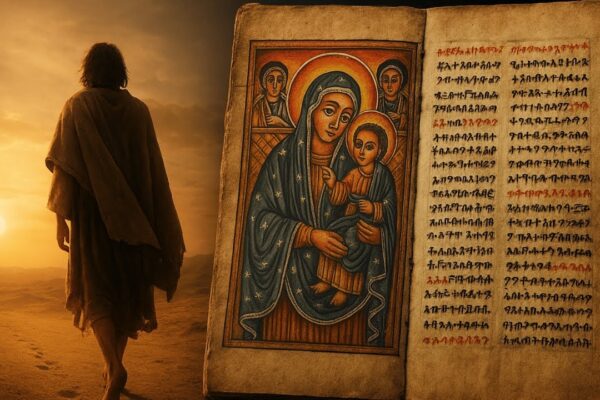
Now here’s where things get interesting. While most Western Christians know Bibles with 66 books (Protestant) or 73 books (Catholic), the Ethiopian Orthodox Tewahedo Church maintains an 81-book canon. This isn’t a typo—81 books, written in ancient Ge’ez, the liturgical language of Ethiopia.
The Ethiopian Bible preserves texts that disappeared from or were excluded from Western traditions:
• Book of Enoch: Ancient Jewish apocalyptic literature describing visions, angelic beings, and end-times prophecy
• Book of Jubilees: A chronological retelling of Genesis and Exodus with detailed calendars and historical interpretations
• Kebra Nagast: A 14th-century epic connecting King Solomon, the Queen of Sheba, and Ethiopia’s imperial lineage
• First Clement and others: Early Christian writings that didn’t make Western canons
This preservation happened because Ethiopia’s geographical isolation protected it from the standardization councils that shaped Western Christianity. While Roman and Byzantine authorities decided which books made the “official” cut, Ethiopian Christianity maintained its own trajectory. The result? A non-Roman Hellenistic perspective that enriches our understanding of early Christian diversity.
For more on how the Ethiopian Orthodox canon preserves ancient knowledge outside of Western channels and the wider significance of these extra-biblical texts, see here.
For business leaders, there’s a parallel here. Think about organizational knowledge management. How often does headquarters decide what information matters while regional offices preserve local wisdom that headquarters overlooks? The Ethiopian canon reminds us that valuable knowledge often exists outside mainstream channels.

The Viral Claim: Does Ethiopia Hold the Secret?
If you’ve scrolled through YouTube recently, you might have seen sensational titles: “Ethiopian Bible Reveals the Lost Teachings” or “18 Missing Years Finally Revealed!” These videos rack up millions of views. They promise answers to Christianity’s greatest biographical mystery. Some claim Jesus traveled through deserts, lived in exile, or performed childhood miracles like cursing a boy who bumped into him.
But here’s the truth: The Ethiopian Bible doesn’t actually fill the 18-year gap.
Scholarly consensus is clear on this point. While the Ethiopian canon includes fascinating texts absent from Western Bibles, none provide biographical details about Jesus between ages 12 and 30. The Book of Enoch discusses ancient history and apocalyptic visions—but not Jesus’s adolescence. The Kebra Nagast focuses on Solomon and Sheba—not Jesus’s young adult years. (See this deep dive for more.)
So where do these YouTube narratives come from? They blend several sources: oral traditions, apocryphal infancy gospels (like the Infancy Gospel of Thomas), and modern speculative storytelling. The result is compelling content that satisfies human curiosity but lacks historical verification.
As a business leader, this should sound familiar. How many times have you seen compelling presentations that blend fact, speculation, and wishful thinking? How often does viral content prioritize engagement over accuracy? The Ethiopian Bible mystery teaches us to distinguish between what sounds good and what evidence supports.

The Theories: From Plausible to Fantastic
When reliable data disappears, theories rush in to fill the void. The missing 18 years have spawned numerous explanations, each with varying credibility:
Theory 1: The India/Tibet Journey
This popular theory suggests Jesus traveled to India and Tibet, studying with Hindu and Buddhist masters. Nicolas Notovitch popularized this idea in 1894 with his book The Unknown Life of Jesus Christ, claiming he’d found Tibetan manuscripts describing Jesus’s Eastern travels.
The evidence? Essentially nonexistent. Scholars debunked Notovitch’s claims as forgery. No ancient texts confirm this narrative. Yet the theory persists because it’s exciting and fits modern interfaith sensibilities.
Theory 2: Egyptian Mystery Schools
Some theorists extend the known infancy exile to Egypt (Matthew 2:13-15) into Jesus’s later years. Perhaps he studied ancient Egyptian wisdom and mystery teachings?
Again, speculation without supporting evidence. We know the family fled to Egypt when Jesus was young, but nothing suggests he returned for extended esoteric training.
Theory 3: The Essene Community
This hypothesis places Jesus among the Essenes, ascetic Jews linked to the Dead Sea Scrolls at Qumran. It’s more plausible than Eastern travels—geographically feasible and consistent with Jewish context.
But it remains hypothetical. No primary sources place Jesus at Qumran. It’s an educated guess based on proximity and theological similarities.
Theory 4: Britain and Tin Trading
One of the more esoteric legends claims Jesus visited Britain with Joseph of Arimathea, possibly connected to tin trading routes. This appears in various British folklore traditions but has zero historical support.
Theory 5: The Nazareth Carpenter
Here’s the strongest scholarly position: Jesus lived quietly in Nazareth, working as a builder with his family. He grew up in an ordinary Jewish household, learned a trade, and prepared for his later ministry through normal human development.
This aligns with Gospel hints (Mark 6:3), fits the cultural context, and requires no extraordinary assumptions. Sometimes the simplest explanation is correct.
For a close investigation into how these types of claims (and misinformation in general) circulate around the Ethiopian canon and what business leaders can learn about critical information sourcing, see this article.

Business Lessons from Missing Data
As a CEO or manager, you can extract several valuable insights from this historical mystery:
1. Beware the Speculation Trap
When data disappears, human nature fills gaps with stories. The more compelling the narrative, the easier it spreads—regardless of evidence. In business, this manifests as market rumors, competitor intelligence based on assumptions, or strategic plans built on wishful thinking.
The discipline? Distinguish clearly between what you know, what you suspect, and what you’re guessing. Label your assumptions explicitly. Don’t let a good story substitute for solid data.
2. Multiple Canons, Multiple Perspectives
The Ethiopian Bible’s existence reminds us that different communities preserve different knowledge. Your organization probably has similar dynamics—different departments, regions, or teams maintaining unique insights that don’t make it into official reports.
Smart leaders create systems to capture diverse perspectives. What does your “Ethiopian canon” look like? What knowledge exists in your organization that headquarters doesn’t acknowledge?
For a case study on how the Book of Enoch specifically, as preserved in the Ethiopian Orthodox tradition, sheds light on the boundaries of shared knowledge and the dangers of speculation, see here.
3. Viral Doesn’t Mean Verified
YouTube videos about the Ethiopian Bible get millions of views while scholarly articles clarifying the facts reach thousands. Sound familiar? In business, sensational claims often spread faster than boring truth.
Build your organization’s immune system against viral misinformation. Teach your team to ask: “What’s the source? What’s the evidence? Who benefits from this narrative?”
4. Comfortable with Uncertainty
Perhaps the most important lesson: sometimes gaps remain gaps. The Gospels’ silence about Jesus’s 18 years might be intentional, emphasizing his ordinary human preparation over spectacular exploits. The writers focused on what mattered for their message.
In business, you’ll never have complete information. Waiting for perfect data means never moving. Great leaders make sound decisions despite uncertainty, knowing when they have “enough” information versus needing more.

The Canon Formation Story: Organizational Lessons
Understanding how different Christian canons formed offers fascinating parallels to organizational development. The Western Bible resulted from councils, debates, and standardization efforts—a top-down process involving bishops, emperors, and institutional authority.
The Ethiopian canon developed differently. Geographical isolation meant Ethiopian Christianity evolved independently, preserving texts that Western councils excluded. Neither approach is inherently superior; they reflect different organizational contexts and priorities.
In business terms, think about this: Do you run a highly standardized organization where headquarters controls all knowledge? Or do you allow regional variation and local preservation of wisdom? The Ethiopian experience suggests that isolation sometimes preserves valuable diversity that standardization erases.
The trade-off? Standardization ensures consistency and clarity. Everyone operates from the same playbook. But it can eliminate local adaptations, contextual knowledge, and alternative perspectives that might prove valuable later.
For a deeper dive into how the formation of the Ethiopian canon presents a different trajectory—and the lessons that imparts for leaders in business and faith—check out this resource.

What the Silence Tells Us
Mainstream biblical scholarship views the 18-year gap not as a problem to solve but as an intentional feature. The Gospel writers weren’t writing modern biographies with complete chronologies. They were crafting theological narratives focused on Jesus’s public ministry, death, and resurrection.
The missing years emphasize Jesus’s humanity—his ordinary preparation for extraordinary purpose. No magical training montage in exotic locations. Just normal human development, work, family, and community. When he emerged at age 30, he was ready not because of secret knowledge but because of lived experience and spiritual preparation.
For business leaders, there’s wisdom here. Your most valuable preparation often happens in ordinary circumstances—not flashy MBA programs or executive retreats, but daily practice, relationship-building, and learning from real-world challenges.
The CEO who spent years in unglamorous operational roles often outperforms the one who jumped straight to strategy. The manager who understands front-line work makes better decisions than the one who only knows executive theory. Sometimes the “missing years” of quiet competence-building matter more than the visible years of public performance.

The Human Need to Fill Gaps
Why do these theories about Jesus’s missing years persist despite lack of evidence? Because humans are narrative creatures. We’re uncomfortable with gaps in important stories. Our brains automatically fill blanks, create patterns, and construct explanations—even when evidence doesn’t support them.
This psychological tendency affects business constantly. Customer behavior that defies easy explanation gets retrofitted into neat narratives. Market changes get attributed to single causes when multiple factors interact. Competitor moves get interpreted through simplified strategic frameworks.
Recognizing this tendency doesn’t eliminate it, but awareness helps. When you catch yourself or your team constructing compelling narratives around limited data, pause. Ask: “Are we explaining what happened, or are we creating a story that makes us comfortable?”

Moving Forward with Incomplete Information
The Ethiopian Bible mystery—the claim that it reveals Jesus’s missing years—ultimately teaches us more by what it doesn’t contain than by what it does. The Ethiopian canon offers valuable perspectives on early Christianity. It preserves texts that enrich our understanding of Jewish and Christian thought. It demonstrates how different communities maintain different knowledge traditions.
For more background on why many sensational social media claims about the Ethiopian Bible and Jesus’s lost years are misleading, and the importance of distinguishing fact from fiction, visit this article.
But it doesn’t solve the 18-year mystery. And that’s okay.
As business leaders, you’ll constantly face incomplete information, competing narratives, and the temptation to embrace compelling stories over verified facts. The discipline you build—distinguishing evidence from speculation, preserving diverse perspectives, and making sound decisions despite uncertainty—determines your long-term success.
The next time you encounter a data gap in your organization, remember the missing 18 years. Ask yourself: What do we actually know? What are we assuming? What sources are we consulting? Are we falling for compelling narratives over verified facts?
Sometimes the gap teaches us more than the data ever could. The question isn’t whether you have complete information—you rarely will. The question is whether you can navigate wisely despite the gaps, learning from history’s mysteries while building your organization’s future on solid ground.
That’s a skill worth more than all the secret knowledge supposedly hidden in ancient texts combined.

FAQ
-
Does the Ethiopian Bible actually contain information about Jesus’s missing years?
No. While the Ethiopian Bible preserves unique ancient texts, none document Jesus’s activities or whereabouts between ages 12 and 30. The widely shared viral claims are based on speculation and misinterpretation. -
What makes the Ethiopian Bible different from Western Christian Bibles?
The Ethiopian Bible has 81 books (vs. 66 in the Protestant canon), including texts like the Book of Enoch, Book of Jubilees, and Kebra Nagast. These works survived in Ethiopia due to geographical and historical isolation from Western church councils. -
Why is there an 18-year gap in Jesus’s life in the canonical Gospels?
The Gospels focus on Jesus’s public ministry, teaching, crucifixion, and resurrection. The missing years likely reflect the authors’ priorities, not a lack of information to be solved. -
Are there any credible sources suggesting Jesus traveled to India, Egypt, or Britain during the missing years?
No primary, ancient sources verify these theories. Most such stories are nineteenth-century inventions or later folklore. Mainstream scholars consider them speculative at best. -
What business lessons can be learned from this historical mystery?
Leaders should recognize the risks of acting on speculation, the importance of capturing diverse perspectives (“multiple canons”), and the necessity of making decisions with incomplete data. Viral narratives may outpace facts, and discomfort with knowledge gaps can lead to misleading stories. -
Where can I learn more about the Ethiopian Bible and its unique canon?
Explore this in-depth guide for a full overview of texts, history, and their significance.
See more at this link: https://youtu.be/ZxRK9BILXys?si=GSC27PuSbu8u6nrd