Summary of Main Ideas
• The Gap Theory proposes a hidden world existed between Genesis 1:1 and 1:2—potentially millions of years before Adam.
• This pre-Adamic world was perfect, ruled by Lucifer, then destroyed by angelic rebellion, leaving Earth in ruin.
• The theory reconciles old-Earth geology (fossils, oil, coal) with a literal six-day creation for humanity approximately 6,000-10,000 years ago.
• Hebrew linguistics suggest Genesis 1:2 describes a ruined state (“tohu wabohu”), not original creation, implying a cataclysm erased history.
• Cross-referenced scriptures (Isaiah 14, Ezekiel 28, Jeremiah 4) describe Lucifer’s fall and Earth’s judgment before human existence.
• Scientific evidence—fossil records, geological strata—attributed to pre-Adamic life and catastrophe, not Noah’s Flood alone.
• Major theological debates persist: Does this theory contradict “death through sin”? Is there linguistic support for a gap?

What if everything you thought you knew about creation had a hidden chapter?
Not the Genesis story you learned, but something before it—something erased from common understanding.
Picture this: You’re reading a company’s annual report. The first line says, “In the beginning, the company was founded.” The second line? “The company was in ruins and chaos.” What happened between those sentences? That’s the million-dollar question theologians have wrestled with for centuries.

The Gap Nobody Talks About
Here’s what most people miss when reading Genesis. The very first verses contain what some scholars call the “Gap Theory”—also known as Ruin-Reconstruction Theory. Think of it as the deleted scenes from creation’s blockbuster film.
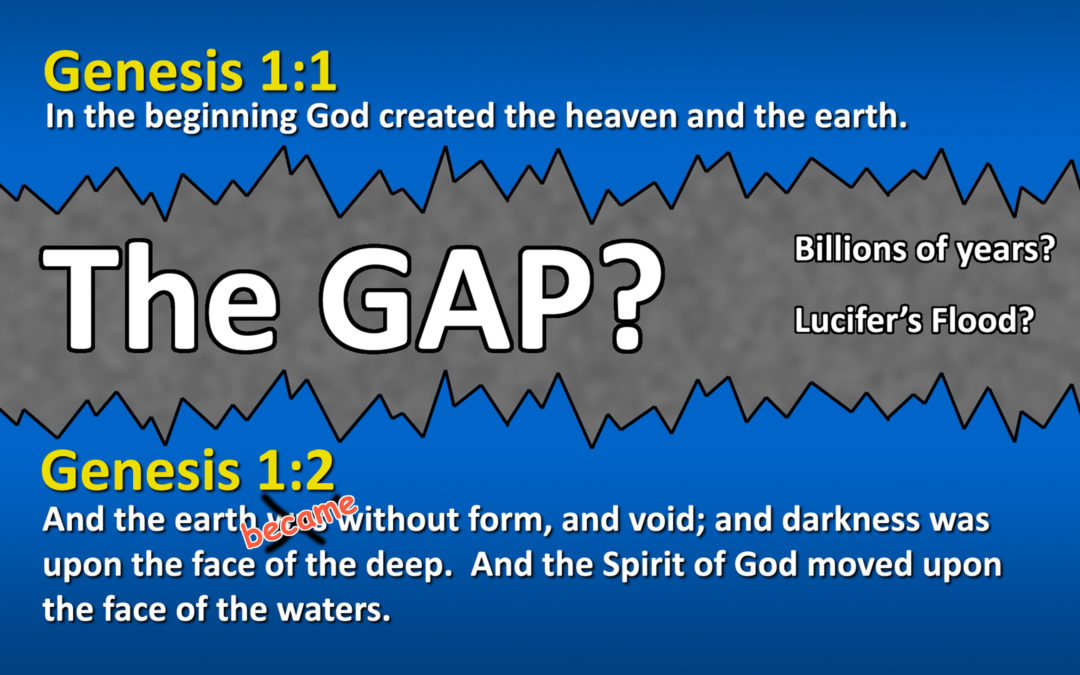
Genesis 1:1 states plainly: “In the beginning God created the heaven and the earth.” Perfect. Complete. Done. But then verse 2 drops a bombshell: “And the earth was without form, and void.”
Wait—what happened?
It’s like discovering your new company acquired another business with a troubled past. The paperwork says “established,” but the current state is chaos. Something clearly went down between those two statements.
The Gap Theory proposes a staggering possibility: millions or even billions of years existed between these verses. During that time, Earth hosted an entirely different world—one that was destroyed before Adam ever drew breath.

The Hidden Timeline Explained
Let’s break down this theory with the clarity of a project timeline. Think of it in phases:
Phase 1: The Original Creation (Genesis 1:1)
God creates Earth in perfection. We’re talking paradise-level quality. Angels witness this masterpiece being formed (Job 38:4-7 mentions them singing at Earth’s foundation). This wasn’t the six-day creation you know—this was the instantaneous birth of the universe.
Phase 2: The Angelic Era (The Gap)
Earth thrives under angelic administration. Lucifer, the highest-ranking angel, rules this pre-Adamic kingdom. Plants flourish, animals roam, and the planet produces what will eventually become fossil fuels. No humans exist yet—just angels and terrestrial life under celestial management.
Phase 3: The Catastrophe (The Hidden Event)
Lucifer rebels. Pride corrupts the perfect cherub. His insurrection triggers a cosmic war (Revelation 12:7-9). God’s judgment strikes Earth like a civilization-ending asteroid. The planet floods with darkness, ice, and chaos. Everything dies. The fallen angels get confined to Earth, creating what we call spiritual darkness.
Phase 4: The Ruin (Genesis 1:2)
Earth lies devastated for potentially millions of years. Frozen. Dark. A planetary graveyard. The Hebrew phrase “tohu wabohu” (without form and void) doesn’t describe original creation—it describes destruction’s aftermath. Like walking through an abandoned factory, you can tell something catastrophic happened here.
Phase 5: Reconstruction (Genesis 1:3-31)
God begins the six-day creation we know. But here’s the twist: the Hebrew word used is “asah” (to make or fashion), not “bara” (to create from nothing). God is restoring, reconstructing, repurposing what was ruined. This happens roughly 6,000-10,000 years ago, establishing the Adamic world—our world.

The Linguistic Case: Words Matter
If you’ve ever negotiated a contract, you know precision matters. One word changes everything. The same principle applies to Genesis.
In Genesis 1:1, the Hebrew word is “bara”—meaning to create something from absolute nothing. God spoke the universe into existence. Bang. Done.
But in the subsequent verses describing the six-day creation, the word shifts to “asah”—meaning to make, fashion, or restore from existing materials. It’s the difference between inventing the computer and reformatting a crashed hard drive.
The phrase “tohu wabohu” in Genesis 1:2 is critical. Translated as “without form and void,” this exact phrase appears again in Jeremiah 4:23-26, where it explicitly describes Earth under divine judgment. Jeremiah sees a vision of desolation—no light, no people, mountains shaking, cities ruined. Sound familiar?
This isn’t describing pristine raw materials. This is describing wreckage.

The Scriptural Evidence Trail
Like any good investigation, we need corroborating evidence. The Gap Theory doesn’t rely on Genesis alone. Multiple scriptures paint the same picture:
Isaiah 14:12-17 – Lucifer’s Resume
“How art thou fallen from heaven, O Lucifer, son of the morning!” This passage describes a being who weakened nations, ruled kingdoms, and made Earth a wilderness. When did Lucifer rule nations on Earth? Not during Adam’s time—there were no nations until much later. This points to a pre-Adamic civilization under his authority.
Ezekiel 28:12-19 – The Perfect Cherub Corrupted
Here we see a being described as the “seal of perfection,” walking in Eden, covered in precious stones, and serving as an anointed cherub. This Eden isn’t the garden Adam knew. This is an earlier Eden, destroyed by violence and sin, leaving the ground scorched.
Job 38:4-7 – Angels as Eyewitnesses
God asks Job, “Where were you when I laid the earth’s foundations… when the morning stars sang together, and all the angels shouted for joy?” Angels celebrated Earth’s initial creation. They were there before humanity—observers of a world we never saw.
Exodus 20:11 – The Six-Day Restoration
“For in six days the LORD made heaven and earth, the sea, and all that in them is.” Notice it says “made” (asah), not “created” (bara). God was working with something already there, reshaping a ruined planet into humanity’s home.

The Fossil Record Mystery Solved
Here’s where it gets interesting for the analytically minded. How do young-Earth believers (6,000-year timeline) explain dinosaur fossils dating back millions of years? How do old-Earth scientists reconcile their findings with biblical literalism?
The Gap Theory offers an elegant solution—think of it as a merger agreement that satisfies both parties.
The Pre-Adamic Explanation:
All fossils, coal deposits, oil reserves, and geological strata came from the pre-Adamic world. When Lucifer’s rebellion triggered global catastrophe, life died en masse. Layer upon layer of sediment buried these creatures over millions of years during the “gap.” The Grand Canyon’s strata? Evidence of pre-Adamic Earth. Dinosaur bones? Residents of the angelic age.
This means:
• The universe can be billions of years old (satisfying scientific dating methods)
• Human history remains young at roughly 6,000-10,000 years (satisfying biblical chronology)
• Fossil fuels literally come from a world before Adam (explaining their “ancient” composition)
Some proponents even suggest the catastrophe involved atomic-level destruction or collapsing atmospheric conditions (vapor canopies) that created ice ages and rapid fossilization. Whether you buy that is up to you, but it’s certainly creative problem-solving.

The Business Parallel: Hidden Liabilities
Let me give you a framework any CEO would understand. Imagine acquiring a company. The founder tells you, “I started this business from scratch.” You begin operations, but then discover:
• Massive debts nobody mentioned
• A previous business model that failed catastrophically
• Lawsuit remnants from former management
• Infrastructure damage from a past disaster
You didn’t cause these problems. They existed before your tenure. But you inherited the mess and must rebuild.
That’s essentially what Adam walked into. He started in a restored paradise, but Earth carried scars from a previous “administration” under Lucifer. The fossil record? Old liabilities. Satan’s presence in Eden as a serpent? A fired executive who still haunts the property.
Adam’s world was a fresh start on a planet with a dark past.

The Competing Theories: Which Framework Fits?
No theory exists in a vacuum. Let’s compare the Gap Theory against other creation models like competing business strategies:
| Creation Model | Earth’s Age | Fossil Explanation | Strengths | Weaknesses |
|---|---|---|---|---|
| Young Earth Creationism | ~6,000 years | Noah’s Flood created all fossils/strata | Straightforward biblical reading | Struggles with radiometric dating; requires rapid fossilization |
| Old Earth Creationism | Billions of years | Progressive creation over epochs | Aligns with scientific dating | “Days” in Genesis become metaphorical |
| Theistic Evolution | Billions of years | Standard evolutionary processes | Fully compatible with science | Requires non-literal Genesis; Adam becomes symbolic |
| Gap Theory | Old universe, young humanity | Pre-Adamic life and catastrophe | Reconciles science and literal Genesis | Adds elements not explicitly stated; debated linguistics |
Each model attempts to solve the same puzzle. The Gap Theory’s unique value proposition? It preserves biblical literalism while accommodating old-Earth evidence—a both/and solution rather than either/or.

The Major Objections: Devil’s Advocate Time
No good analysis ignores the criticisms. Let’s address them head-on.
Objection 1: Death Before Sin?
Romans 5:12 states death entered the world through Adam’s sin. But if animals died in the pre-Adamic cataclysm, doesn’t that contradict Scripture?
Gap Theory response: Paul’s passage refers to human death and spiritual death, not animal mortality. Animals aren’t covered by redemption. Their pre-Adamic deaths don’t violate Paul’s theology.
Objection 2: Linguistic Gymnastics?
Critics argue “tohu wabohu” simply means unformed, not ruined. The Hebrew word “was” in Genesis 1:2 doesn’t necessarily mean “became.”
Gap Theory response: Context matters. The same phrase in Jeremiah unambiguously means judgment-caused desolation. Why would God create something “formless and empty” when His nature produces order? Isaiah 45:18 says God “created it not in vain [tohu]”—He didn’t make Earth chaotic.
Objection 3: Reading Into the Text?
Many scholars accuse Gap theorists of eisegesis—inserting ideas that aren’t there—rather than exegesis—extracting what’s present.
Gap Theory response: All creation models interpret Genesis. Young Earth requires rapid fossilization. Old Earth requires metaphorical days. Theistic Evolution requires symbolic Adam. Gap Theory simply proposes a different interpretive framework based on linguistic and scriptural cross-references.
Objection 4: Where’s the Explicit Statement?
The Bible never directly says, “Between verses 1 and 2, millions of years passed.”
Gap Theory response: The Bible also doesn’t explicitly state the Trinity, yet Christians deduce it from scriptural evidence. Inference from multiple passages builds theological frameworks. Job, Isaiah, Ezekiel, and Jeremiah together paint a picture Genesis alone doesn’t complete.

The Historical Development: Who’s Behind This?
Ideas have pedigrees. The Gap Theory isn’t some fringe notion cooked up last Tuesday.
Early Jewish and Islamic scholars (like Halevi and Sabian traditions) hinted at pre-Adamic worlds. Isaac La Peyrère proposed pre-Adamite humans in 1655 (controversially suggesting Gentiles descended from them). Thomas Chalmers revived the concept in the 19th century as geology revealed Earth’s age. C.I. Scofield popularized it through his influential Reference Bible, making it mainstream among evangelicals.
Modern teachers like Chuck Missler championed it in the 20th century, giving it renewed attention. While currently a minority view, it’s hardly obscure—millions have encountered this interpretation.

Why This Matters for Leaders
You might be wondering: Why should a business professional care about ancient theological debates?
Because frameworks matter. How you interpret the past shapes how you understand the present and plan the future. Leaders constantly inherit situations they didn’t create—companies with legacy issues, teams with past conflicts, markets with historical baggage.
The Gap Theory teaches a valuable lesson: Sometimes you’re not starting from scratch. You’re reconstructing. You’re working with existing materials, some damaged, to create something new and better. That’s not weakness—that’s wisdom.
Understanding that Earth might carry scars from a pre-Adamic catastrophe also reframes our world. We’re not in the original creation. We’re in the restoration. And every restoration project faces challenges from the previous version.
Satan isn’t just evil for evil’s sake—he’s a deposed ruler fighting a guerrilla war on territory he once controlled. That context changes how you view spiritual conflict, leadership challenges, and even organizational resistance to change.

The Bottom Line: What Should You Believe?
Let’s be honest: I can’t definitively prove what happened before Genesis 1:2. Neither can Young Earth proponents prove rapid fossilization, nor can Old Earth advocates prove day-age theory. These are interpretive frameworks attempting to reconcile Scripture, science, and theology.
What the Gap Theory offers is a compelling narrative that:
• Explains geological evidence without dismissing it
• Preserves biblical literalism without scientific denial
• Provides context for Lucifer’s rebellion and presence on Earth
• Accounts for the linguistic peculiarities in Genesis 1-2
Is it perfect? No. Does it answer every question? Absolutely not. But it opens a fascinating window into possibilities often overlooked in Sunday school.
Whether you ultimately embrace this theory or not, it challenges you to think deeper about creation’s first chapters. It reminds you that ancient texts contain layers of meaning—that sometimes the most significant truths hide between the lines.
Just like in business, the backstory often explains the current situation. And if Earth truly has a hidden history—a creation God erased and then rebuilt—that backstory might be more epic than we ever imagined.
The question isn’t just what you believe about the Gap Theory. The question is: Are you curious enough to explore what’s hidden in plain sight? Because sometimes, the most important chapters are the ones nobody told you existed.

Frequently Asked Questions (FAQ)
Q: Does the Gap Theory deny the literal six-day creation?
No. The theory maintains a literal six-day reconstruction for Adamic humanity while positing a ruin and earlier life between Genesis 1:1 and 1:2.
Q: Where can I read more about the “tohu wabohu” debate?
The Hebrew phrase is discussed in depth in this Hebrew concordance reference. Many scholars compare Jeremiah 4:23-26 to Genesis 1:2 as evidence of the phrase’s catastrophic meaning.
Q: Who are some modern proponents of the Gap Theory?
Chuck Missler, C.I. Scofield, and Thomas Chalmers are well-known advocates. For more background, see this summary from Answers in Genesis (critical of the theory but comprehensive in its history).
Q: Does the Gap Theory have any scientific support?
While secular scientists follow strictly naturalistic models, the Gap Theory attempts to harmonize the billions-year-old fossil record with the biblical account. Skeptics can read a contrasting view at Reasons to Believe.
Q: Isn’t this just an attempt to “fit” science into the Bible?
That’s a frequent objection. For proponents, the key point is that the theory builds on “gaps” and linguistic clues in the text—not just modern pressure. But as always, interpretation is debated.
See more at this link: https://youtu.be/hB5gckCmTnc?si=5YibIvaJZWgt7dMp