Summary of Main Ideas
– The Ethiopian Orthodox Bible contains 81 books, including the *Conflict of Adam and Eve with Satan*, a 6th-century text not found in standard Protestant or Catholic canons
– This “lost book” details Adam and Eve’s harrowing life after Eden, including relentless attacks from Satan and profound revelations about humanity’s future
– The text reveals a “terrifying secret”: evil is not a one-time event but an ongoing spiritual warfare that persists until divine intervention
– Originally written in Ge’ez (Ethiopic), the manuscript traces back to Syriac-Arabic traditions and was popularized in English through S.C. Malan’s 1882 translation
– The narrative expands Genesis dramatically, covering the Cave of Treasures, Cain’s murder of Abel, the Nephilim, and prophecies about Christ’s future incarnation
– While scholars classify it as pseudepigraphical legend, the text offers profound insights into ancient understandings of temptation, resilience, and redemption

Ever wonder what happened to Adam and Eve after they left paradise?
Ever wonder what happened to Adam and Eve after they left paradise? The standard Bible gives us a few verses. But there’s another book—one preserved for centuries in Ethiopian monasteries—that tells a radically different story.
This isn’t your Sunday school version.
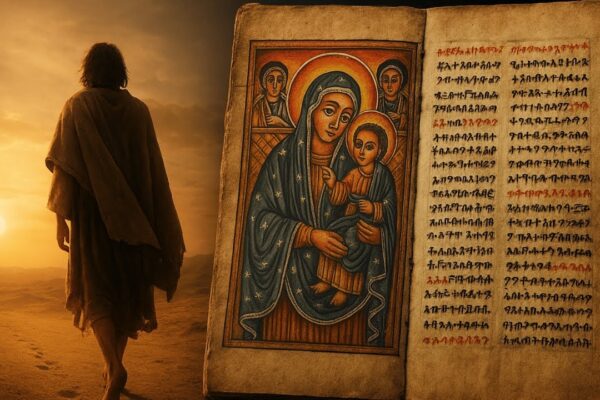
The Ethiopian Orthodox Tewahedo Church holds the distinction of maintaining the broadest biblical canon among Christian traditions. We’re talking 81 books here. Among these ancient texts sits something extraordinary: The Conflict of Adam and Eve with Satan, also known as the Lost Book of Adam and Eve.
Now, before you dismiss this as religious curiosity, consider this. The themes in this ancient manuscript—relentless adversity, persistent threats, the struggle to maintain hope in exile—resonate powerfully with modern leadership challenges. This 6th-century text offers unexpected wisdom for anyone navigating today’s complex business landscape.
Let’s dive into what makes this “lost book” so compelling.

What Exactly Is This Lost Book?
The Lost Book of Adam and Eve refers to The Conflict of Adam and Eve with Satan, an extracanonical Christian work that survived through Ge’ez manuscripts. Think of Ge’ez as the ancient language of Ethiopia—similar to how Latin functioned in medieval Europe.
This text didn’t originate in Ethiopia, though. It traveled a long road to get there.
The manuscript traces back through Old Arabic translations derived from Syriac sources like the Cave of Treasures. Scholars date the core narrative to the 5th or 6th century. Ethiopian Christian communities preserved it when other traditions let it fade.
In 1882, S.C. Malan’s English translation brought this text to Western audiences. Suddenly, readers could access stories that had been circulating in Eastern Christianity for over a millennium.
Is it “authentic” scripture? That depends on your definition. It’s pseudepigraphical—meaning it’s falsely attributed to the Adam and Eve era. But it’s authentically a medieval compilation of Jewish-Christian legends. The manuscripts themselves date from the 15th to 19th centuries.
Think of it as an ancient attempt to fill in the gaps. Genesis gives us headlines; this book provides the full story.
If you’re interested in how texts like the Ethiopian Orthodox Bible preserve unique ancient narratives outside the Western canon, dive deeper here: Ethiopian Orthodox Bible & Book of Enoch Insights

Life After Paradise: The Cave of Treasures
Here’s where the narrative gets gripping.
The moment Adam and Eve step outside Eden, they’re hit with brutal reality. Scorching heat. Overwhelming thirst. Crushing despair. The text describes them collapsing repeatedly in death-like states from sheer grief.
They end up living in the Cave of Treasures. Imagine going from the world’s most beautiful garden to a dark cave. That’s not just a physical relocation—it’s a complete identity crisis.
Book 1 of the text details their daily struggles. They pray in darkness. They refuse cursed water. They face trials that would break most people.
Sound familiar? Any leader who’s navigated a major setback knows this territory. The loss of what was. The harsh reality of what is. The question of whether recovery is even possible.
But here’s what makes the narrative powerful: they don’t give up.
The story continues with the birth of Cain, Abel, and their twin sisters. The text introduces details absent from Genesis—like Cain’s jealousy over marrying his sister Luluwa, who was intended for Abel. This jealousy ultimately drives Cain to murder.
If the expanded narrative around Cain, Abel, and humanity’s descendants piques your interest, you’ll find connections between these events and the Nephilim explored further here: Nephilim Mystery Explained
Adam dies in this section, but the story doesn’t end there.
Book 2 shifts focus to the descendants. Seth’s righteous line (the “sons of God”) begins intermarrying with Cain’s corrupt descendants (the “daughters of men”). A character named Genun—son of Lamech—becomes the instigator of wickedness.
Genun invents music and weapons. Sounds innocent, right? But the text portrays these innovations as tools of corruption. They lead to moral decay, the birth of the Nephilim (giant offspring), and ultimately, the flood.
The parallels to business disruption are striking. Innovation without ethics. Progress without principles. Growth without guardrails. (For a multidisciplinary look at forbidden knowledge, leadership boundaries, and ethical consequences as they relate to the Watchers, see: Book of Enoch & Watchers: Lessons on Leadership)

Satan’s Relentless Campaign
Now we get to the heart of what makes this text genuinely unsettling.
Satan doesn’t just tempt Adam and Eve once and disappear. He becomes their constant adversary. The serpent—now punished and bitter—launches repeated assassination attempts.
We’re talking about swelling its head to monstrous size. Chasing Eve through the wilderness. Crushing them under its massive body. Each time, God intervenes at the last moment, driving the serpent away.
In one account, God banishes the serpent to India and renders it mute. The geography might seem random, but the message is clear: even when evil is driven far away, it remains a threat.
Satan also deploys psychological warfare. He creates apparitions. He moves boulders to trap them. He makes false promises, exploiting their grief and vulnerability.
This is where the text’s understanding of evil becomes sophisticated. Evil isn’t portrayed as a single choice or moment. It’s an ongoing campaign—persistent, adaptive, relentless.
Any CEO who’s faced sustained competitive pressure understands this dynamic. The market doesn’t attack once and retreat. Competition evolves. Threats multiply. Vigilance becomes a permanent requirement.
God comforts Adam and Eve throughout these trials, promising divine presence “unto the end of the days.” The message? You’re not facing this alone.
For a broader context on the origins of evil, angelic rebellion, and its ramifications in the Ethiopian tradition, see: Ethiopian Orthodox Bible: Watchers & Sons of God

The Terrifying Secret Revealed
So what’s the terrifying secret this ancient text reveals?
The manuscript doesn’t announce it with dramatic flair. Instead, it emerges through the cumulative weight of the narrative. Here it is: evil is not an episode to overcome—it’s an enduring reality requiring constant resistance until divine intervention brings final victory.
Adam laments at one point: “All this misery… will not free thee from the hand of Satan.”
That’s a sobering assessment. No amount of human effort, discipline, or willpower fully liberates humanity from evil’s influence. The text argues that only divine incarnation—Christ’s future coming—ultimately saves.
This challenges the self-help narrative that dominates modern thinking. Work harder. Be smarter. Optimize everything. Problem solved.
The Lost Book of Adam and Eve suggests a different framework. Acknowledge the reality of persistent adversity. Build systems of resilience. Seek support beyond yourself. Maintain hope in something larger than individual effort.
For leaders, this ancient wisdom translates practically. You can’t eliminate all threats. Markets will shift. Competitors will emerge. Crises will hit. The question isn’t whether you’ll face adversity, but how you’ll respond when it inevitably arrives.
If persistent deception, spiritual struggle, and the theme of “falling away” resonate for you, compare with the Great Apostasy dynamics frequently highlighted in sacred texts: Recognizing Spiritual & Organizational Threats

Prophecies That Connect Past and Future
God doesn’t just comfort Adam and Eve with vague assurances. He reveals specific prophecies during their worst moments.
These prophecies compare their suffering to Christ’s future incarnation. When they experience darkness in the cave, God explains it foreshadows the darkness Christ will experience in the grave. When they face “deaths” from grief, it points to Christ’s actual death and resurrection.
God tells Adam: “When I shall come down from heaven… the darkness… shall come upon Me in the grave.”
The text also foretells Noah and the flood, linking their immediate trials to humanity’s larger redemption story.
This prophetic framework does something clever. It transforms their suffering from meaningless tragedy into purposeful precursor. Their struggles aren’t random—they’re part of a larger narrative arc leading to salvation.
Business leaders often struggle to find meaning in setbacks. A failed product launch. A lost contract. A market downturn. These feel like pure loss.
But what if those failures are teaching you lessons essential for future success? What if today’s struggle is preparing you for tomorrow’s breakthrough?
The text suggests that perspective matters enormously when facing adversity.
If you want to explore more about prophecy, redemption, and connections to modern leadership, the theme is explored through the lens of Messianic expectation and global dynamics here: Prophecy & Geopolitics: Insights for Leaders

How This Differs From Genesis
Let’s compare the Lost Book with the canonical Book of Genesis. The differences are striking.
Post-Eden Focus: Genesis dedicates a few verses to life after Eden—basically work becomes hard, then Cain kills Abel. The Lost Book dedicates entire chapters to their daily struggles, Satan’s attacks, and their psychological journey.
The Offerings: In Genesis, Cain brings fruit and Abel brings sheep. God accepts Abel’s offering and rejects Cain’s. End of story. The Lost Book explains that Adam instructed Abel to offer first, reversing the birth order—a detail that intensifies Cain’s jealousy.
Sons of God and Daughters of Men: Genesis mentions this mysteriously in Chapter 6. The Lost Book provides full backstory: Seth’s righteous descendants corrupted by Cain’s wicked line, with Genun as the specific instigator. For further exploration of this motif in both Genesis and Ethiopian tradition, refer here: Nephilim in Genesis 6 & Modern Innovation
The Nephilim: Genesis calls them “mighty men” before the flood. The Lost Book explains they’re offspring of the intermarriage, representing physical manifestation of spiritual corruption. Learn more about the Nephilim—and why their lessons on power, ethics, and boundary violations remain so relevant for innovative leaders: Nephilim Mystery Explained
The Lost Book essentially takes Genesis’s outline and creates a detailed narrative. It adds dramatic tension, theological depth, and human psychology.
Does this make it more “true”? Not in a historical sense—scholars treat it as legend. But it might be more true to human experience. Life is messy, complicated, and emotionally intense. Genesis gives us the facts. The Lost Book gives us the feelings.

The Manuscript’s Journey Through Time
Understanding this text’s history helps us evaluate its significance properly.
The core narrative emerged in the 5th-6th century within Syriac-Arabic Christian communities. These were churches in the Middle East that developed somewhat separately from Roman and Byzantine traditions.
The text migrated to Ethiopia through the early Eastern Church. Ethiopian Christianity, one of the world’s oldest Christian traditions, preserved many texts that disappeared elsewhere.
Why? Partly geography. Ethiopia remained relatively isolated, protected by mountains and distance from waves of conquest that destroyed libraries elsewhere. Partly theology. Ethiopian Orthodox Christianity maintained a broader definition of scripture than Western churches.
The Ge’ez manuscripts we have today date from the 15th-19th centuries. These are copies of copies, accumulated through centuries of monastic scholarship.
When Malan translated the text into English in 1882, he sparked Western interest. Suddenly, academics and curious readers could access these ancient stories.
Today, the text influences apocryphal studies, Ethiopian liturgy, and popular media. One audiobook version has garnered 1.4 million views—evidence that these ancient stories still captivate modern audiences.
Curious about the preservation and unique approach of the Ethiopian Orthodox tradition? Dig deeper into how Ethiopian manuscripts retained stories about the Watchers, the Nephilim, and the origin of evil that disappeared in other traditions: Ethiopian Bible & Book of Enoch

What This Means for Modern Readers
So why should business leaders care about a 6th-century pseudepigraphical text from Ethiopian monasteries?
Three reasons stand out.
First, it offers timeless wisdom about resilience. Adam and Eve face catastrophic loss and don’t quit. They build a new life in dramatically reduced circumstances. They maintain hope despite relentless adversity. These are masterclass lessons for anyone navigating organizational change or market disruption.
Second, it provides sophisticated understanding of persistent threats. The text doesn’t sugarcoat reality. Evil doesn’t take a day off. Competition doesn’t show mercy. Challenges don’t resolve with a single solution. Leaders need systems, not just inspiration. (See how similar lessons play out in the context of internal organizational threats and the persistence of adversity: Great Apostasy Explained)
Third, it reminds us that meaning matters. Adam and Eve endure partly because God frames their suffering within a larger story. Organizations thrive when people understand how their work connects to something significant. Purpose isn’t a nice-to-have. It’s the fuel that sustains effort through difficulty.
The text also reinforces humility. No amount of human cleverness ultimately saves Adam and Eve. They need divine intervention. Similarly, no leader succeeds purely through individual brilliance. You need teams, mentors, networks, and sometimes—frankly—luck.

A Final Thought on Ancient Wisdom
The Lost Book of Adam and Eve isn’t Scripture for most Christians. Scholars classify it as legend rather than history. It won’t answer questions about quarterly earnings or supply chain optimization.
But dismissing ancient wisdom because it’s not literally factual misses the point entirely.
This text survived fifteen centuries because it resonated with people facing real struggles. It provided a framework for understanding suffering, resisting evil, and maintaining hope. Those needs haven’t changed.
If anything, our accelerated modern world makes ancient wisdom more valuable, not less. We’re drowning in information but starving for perspective. We have unprecedented tools but face timeless human challenges.
The terrifying secret this Ethiopian manuscript reveals isn’t really terrifying at all once you sit with it. Yes, evil persists. Yes, struggle is constant. Yes, you can’t overcome everything through individual effort.
But you’re not alone. Resilience is possible. Meaning can be found. And sometimes, the darkest cave becomes the treasure chamber where the most valuable lessons are learned.
For leaders navigating today’s complex landscape, that ancient truth might be exactly the perspective needed.
The question isn’t whether you’ll face your own “exile from Eden.” You will. The question is whether you’ll find the wisdom—ancient or modern—to navigate it with grace, resilience, and purpose.
Maybe that’s the real treasure the Ethiopian monks preserved all these centuries. Not just a text, but a reminder that humanity’s deepest challenges and highest aspirations remain remarkably constant across time.
And that those who came before us learned to endure, adapt, and ultimately thrive—even after paradise was lost.

FAQs About the Lost Book of Adam and Eve
- Is the Lost Book of Adam and Eve considered canonical scripture in any church?
No mainstream Christian denomination includes The Conflict of Adam and Eve with Satan in its biblical canon, but it is considered important apocryphal literature within the Ethiopian Orthodox Church. - How does the Ethiopian Orthodox Bible differ from Western Bibles?
It contains 81 books, adding additional apocryphal and pseudepigraphical texts, some of which are unique to Ethiopia or nearly so, such as the Book of Enoch and the Book of Jubilees, and includes The Conflict of Adam and Eve with Satan. - Can I read the Lost Book of Adam and Eve in English?
Yes. The most well-known English translation was published by S.C. Malan in 1882 and is freely available online or in various reprints and audio formats. - Does this book contradict Genesis?
It doesn’t directly contradict Genesis, but it amplifies and dramatically expands upon it, introducing legends, moral lessons, and details absent from the canonical account. - What leadership lessons can I draw from this text?
Resilience, recognizing persistent threats, seeking meaning in adversity, and humbly relying on support beyond yourself are all central themes in this “lost book.” - How did the book survive for so long?
Ethiopian monasteries, with their isolated geography and unique tradition, preserved many ancient Christian texts that were lost elsewhere due to wars, doctrinal shifts, and library burnings. - Is there a connection between this book and other apocryphal writings like Enoch?
Yes. Both are preserved in the Ethiopian Church, share themes of angelic rebellion and the origin of evil, and influence Ethiopian interpretations of Genesis. To go deeper, see this exploration. - What is the “terrifying secret” referenced in this text?
That humanity’s struggle with evil is an ongoing spiritual battle—persistent and only finally ended by divine intervention, not merely by human effort.
See more at this link: https://youtu.be/QYyifrRtHgs?si=nAozcgP_i0N3EKLG