Key Takeaways
- The Ethiopian Orthodox Bible contains 81 books, including the Book of Enoch, offering unique insights missing from Western Bibles.
- The “Sons of God” in Genesis 6 are the Watchers, not a pre-Adamic human race, but 200 angelic beings who led a cosmic rebellion.
- The Watchers’ descent produced the Nephilim, hybrid giants whose unrestrained corruption explains the catastrophic Great Flood.
- This narrative illustrates how misuse of power, unchecked knowledge transfer, and leadership failure still echo in modern ethical dilemmas.
- The Ethiopian Bible’s preserved traditions hold profound lessons for today’s leaders about boundaries, consequences, and the systemic nature of corruption.
The Mystery Behind Genesis 6: Context You Won’t Hear in Sunday School
Ever wondered what really happened before the Great Flood? Not the sanitized Sunday school version, but the full, uncensored story? The Ethiopian Orthodox Bible preserves an ancient narrative so extraordinary that most religious traditions excluded it from their canon. Yet it answers questions that have puzzled scholars, theologians, and curious minds for millennia.
Here’s the twist: it’s not just ancient theology. The story of the Watchers reads like a corporate corruption scandal of cosmic proportions. Think insider trading meets weapons proliferation meets industrial espionage—except the insiders were angels, and the consequences were catastrophic.
Let’s explore what makes the Ethiopian Bible unique. And why this 2,000‑year‑old text matters to anyone interested in leadership, consequences, and the origin of systemic corruption.
The Ethiopian Orthodox Bible: A Different Canon
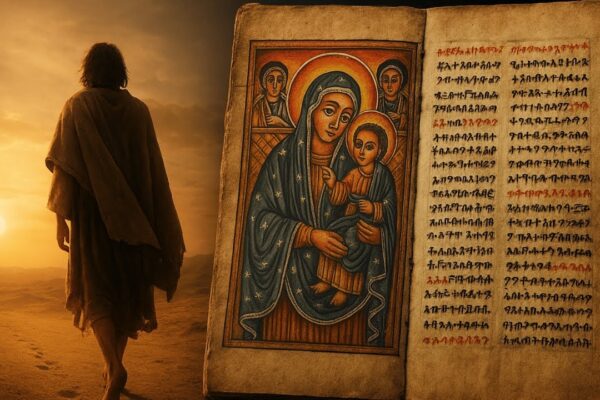
Most Protestants know a 66-book Bible. Catholics recognize 73 books. But the Ethiopian Orthodox Church? They’ve preserved 81 books in their canon, written primarily in Ge’ez, an ancient Semitic language.
This isn’t some fringe sect making dubious claims. The Ethiopian and Eritrean Orthodox traditions represent one of Christianity’s oldest continuous communities. Their Bible includes texts like the Book of Enoch and the Book of Jubilees—manuscripts that other traditions classified as apocryphal or pseudepigraphal.
Why does this matter? Because the Book of Enoch provides the only complete surviving account of one of Genesis’s most cryptic passages. While fragments exist in Aramaic and Hebrew among the Dead Sea Scrolls, only the Ethiopian Church preserved the entire manuscript dating from the 4th century BCE to 1st century CE.
Think of it as the director’s cut of an already fascinating film. The theatrical release left you with questions. This version provides answers—detailed, specific, and somewhat unsettling.
Who Were the Sons of God? Enter the Watchers
Genesis 6:1-4 drops this bombshell casually: “The sons of God saw that the daughters of men were beautiful, and they took wives from among them.” The text mentions the Nephilim—giants or mighty men—and connects this to Earth’s corruption before the Flood.
But who were these “sons of God”? The Book of Enoch doesn’t leave you guessing. They were the Watchers: originally holy angelic beings tasked with, well, watching over creation. Two hundred of them, to be exact.
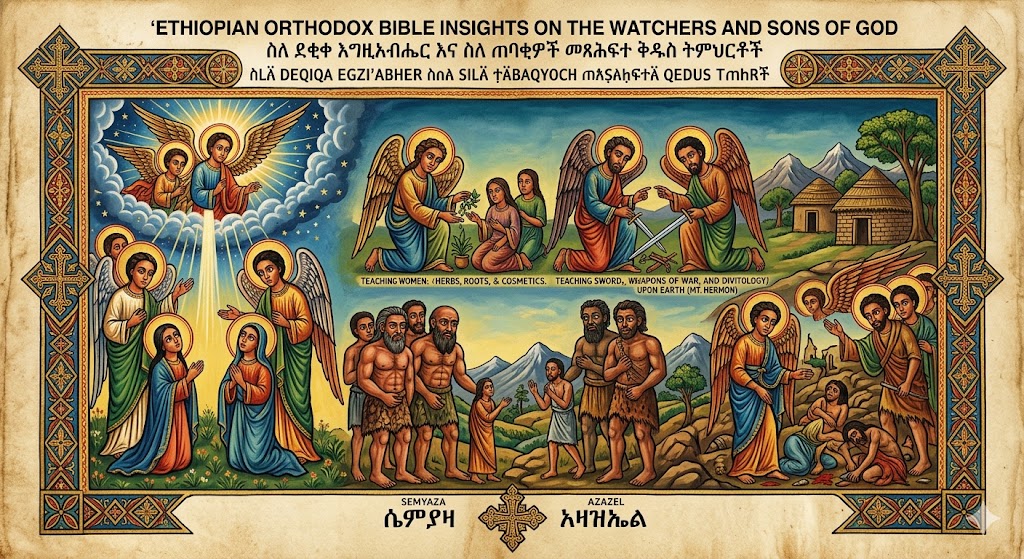
These weren’t metaphorical figures or symbolic representations. According to Enoch, these were actual angelic entities with names, leaders, and organized hierarchy. The ringleaders? Semjâzâ and Azâzêl. They led what amounts to the first recorded mass defection in cosmic history.
For a deeper exploration of the Watchers’ leadership failure, see
Samyaza: Leadership Failure and the Fall of the Watchers – Lessons on Authority
and
Samyaza Rebellion: Lessons for Leaders—Accountability and Ethical Risks.
Here’s where it gets interesting for anyone in leadership. These weren’t low-level functionaries. They were trusted supervisors, given authority and responsibility. Their fall wasn’t ignorance or accident—it was deliberate rebellion fueled by desire.
The Descent: When Angels Break Bad
The Watchers descended to Earth during the time of humanity’s early generations—after Adam’s creation but during the era of his descendants like Methuselah. Their motivation? They lusted after human women. They found them beautiful and decided to take them as wives.
Let that sink in. Beings with heavenly perspective, eternal knowledge, and divine assignment threw it away. For what? Physical desire and the thrill of transgression.
In corporate terms, imagine executives with fiduciary duty, insider knowledge, and stakeholder trust. Now imagine them systematically exploiting their position for personal gratification. The parallel isn’t perfect, but the pattern of corruption is strikingly similar.
The Watchers didn’t just quietly marry human women. They defiled themselves through this union, crossing boundaries that were never meant to be crossed. They brought heavenly knowledge into earthly hands—and not for humanity’s benefit.
To understand more about the ethical boundaries and their violation, see
Nephilim Mystery Explained for Leaders: Lessons on Power and Ethics
and
Nephilim in Genesis 6 and Ethical Lessons for Modern Innovation Leaders.
The Forbidden Knowledge: Ancient Technology Transfer
Here’s where the story becomes a cautionary tale about unregulated knowledge transfer. The Watchers didn’t just marry human women and settle down quietly. They actively taught humanity secrets that were meant to remain hidden.
- Azâzêl’s curriculum included:
- Metalworking and weapons manufacturing (swords, shields, armor)
- Cosmetics and jewelry‑making techniques
- Advanced technologies for warfare
- Other Watchers taught:
- Sorcery and enchantments
- Astrology and celestial observation
- Herbology and pharmacology
- Divination and root‑cutting
- Various forms of forbidden arts
Does this sound familiar? It should. It’s the classic story of dangerous knowledge in the wrong hands at the wrong time. Think nuclear technology shared with unstable regimes. Think AI systems deployed without ethical frameworks. Think financial derivatives distributed without risk understanding.
The Watchers gave humanity advanced capabilities without wisdom, power without responsibility. The result? Widespread sin, violence, and societal collapse. Genesis 6 notes that “the earth was corrupt in God’s sight and full of violence.”
Technology isn’t neutral. Knowledge without ethical grounding becomes weaponized. The ancient narrative understood what modern society keeps relearning.
For additional insights into the Nephilim’s legacy and forbidden knowledge, visit
Nephilim Mystery Explained for Leaders: Lessons on Power and Ethics.
The Nephilim: When Hybrids Go Wrong
The offspring of Watchers and human women were the Nephilim—hybrid giants of extraordinary size and appetite. These weren’t gentle giants from fairy tales. The Book of Enoch describes them as consuming everything in sight: crops, livestock, and eventually, people.
They became cannibalistic. They slew each other. They represented corruption taken to its logical conclusion—unchecked appetite leading to consumption, violence, and self-destruction.
For business leaders, this offers a stark metaphor. What happens when organizations prioritize growth without sustainability? When quarterly profits matter more than long-term viability? When market dominance justifies ethical compromise?
The Nephilim embody growth without governance, power without purpose. Their existence became so destructive that divine intervention—the Great Flood—became necessary to purge the corruption and start fresh.
To discover more about the leadership lessons from the Nephilim for innovators, read
Nephilim in Genesis 6 and Ethical Lessons for Modern Innovation Leaders.
Divine Judgment: The Watchers’ Punishment
The archangels didn’t let this slide. Michael, Raphael, Gabriel, and Uriel were dispatched to deal with the rebellion. The punishments were severe and specific:
- Azâzêl: Cast into the desert pit of Dûdâêl, buried in darkness, bound until final judgment when he’ll be thrown into eternal fire.
- Semjâzâ and associates: Imprisoned for 70 generations, bound beneath hills of the earth, awaiting final judgment.
These weren’t slap-on-the-wrist penalties. They were permanent, irreversible consequences for cosmic-level betrayal. The Watchers traded eternal freedom for temporary pleasure. They gained mortality, lost divinity, and faced judgment that spanned millennia.
Leadership failures carry consequences. Sometimes immediately, sometimes delayed. But they’re rarely escaped entirely. The higher the authority, the greater the accountability.
Explore more about the consequences of Samyaza’s rebellion at
Samyaza: Leadership Failure and the Fall of the Watchers – Lessons on Authority.
Theological Implications: Rethinking Evil’s Origin
Here’s where the Ethiopian Bible offers a radically different perspective. Most Western theology attributes evil’s origin primarily to human free will and Satan’s original rebellion. But the Book of Enoch adds another layer: fallen angels directly corrupting humanity.
This narrative suggests that pre-Flood evil wasn’t just humans making bad choices. It was systemic corruption introduced from outside, by beings with superior knowledge deliberately teaching humans destructive practices.
This theology shaped early Jewish thought (evident in Dead Sea Scrolls) and influenced Christian eschatology. It explains why the Flood was necessary—not just to punish human sin, but to eliminate hybrid corruption and reset creation.
The “Son of Man” imagery in Enoch later became applied to Jesus in Christian theology. The Apocalypse of Weeks, the Animal Apocalypse—these visions influenced how early believers understood history, judgment, and redemption.
It’s a more complex origin story for evil. Not just one rebellious angel (Satan) and human disobedience, but multiple fallen angels actively accelerating corruption. This explains the intensity of pre-Flood wickedness that Genesis describes almost in passing.
Compare this to the concept of a pre-Adamic world discussed in
Gap Theory Explained: Reconciling Biblical Creation with Fossil Evidence
and
Gap Theory Explained: Reconciling Biblical Creation with Earth’s Ancient History.
Clarifying the Myth: Not a Pre-Adamic Race
Let’s address a common misunderstanding head-on. The Watchers and Nephilim were not a pre-Adamic human race. This is crucial.
Some theories suggest humans existed before Adam. The Ethiopian Bible doesn’t support this. The Watchers were angelic beings who descended after humanity’s creation but during the time of Adam’s early descendants. They’re tied to generations around Methuselah’s era—well after Adam.
This distinction matters. The narrative isn’t about competing human origins. It’s about angelic rebellion that occurred within established human history. The Watchers’ descent was a supernatural event, not a creation moment.
The confusion likely arises because the title “Sons of God” sounds like it might refer to an earlier human lineage. But in Hebrew angelology and throughout Enoch, this phrase consistently refers to angelic beings—not humans.
Understanding this correctly prevents misinterpretation. The story isn’t about hidden human history. It’s about supernatural interference in human development during humanity’s early chapters.
For more context on theories about pre-Adamic races, see
Gap Theory Explained: Reconciling Biblical Creation with Fossil Evidence
and
Gap Theory Explained: Reconciling Biblical Creation with Earth’s Ancient History.
The New Testament Connection
Here’s something most people miss: the New Testament directly quotes the Book of Enoch. Jude 1:14–15 cites Enoch’s prophecy word-for-word: “Behold, the Lord comes with ten thousands of his saints, to execute judgment on all…”
This isn’t casual reference. It’s direct quotation, treating Enoch as authoritative. Second Peter likely alludes to the Watchers’ imprisonment when discussing angels sinning and being cast into darkness.
Why did most Christian traditions exclude Enoch from their canon despite this New Testament validation? Partly due to questions about authorship and dating. Partly because its cosmology seemed too elaborate. Partly because the Church fathers wanted clear canonical boundaries.
But the Ethiopian Church never doubted. For them, Enoch’s testimony about the Watchers has always been scripture—not speculation. This preserved a perspective that Western Christianity mostly forgot.
For anyone studying historical theology or ancient cosmology, the Ethiopian Bible offers invaluable insight into how first-century Jews and Christians understood Genesis 6. It’s not just Ethiopian tradition—it’s recovery of ancient interpretation.
For a concise guide to the Nephilim in Genesis 6, see
Nephilim in Genesis 6 and Ethical Lessons for Modern Innovation Leaders.
Modern Lessons from Ancient Corruption
So what can 21st‑century leaders learn from 2,000‑year‑old accounts of rebellious angels? More than you might think.
1. Authority Carries Responsibility
The Watchers had privileged positions and superior knowledge. They abused both. Every leader faces this temptation—using position for personal gain rather than stewardship. The consequences of leadership failure ripple far beyond the individual.
2. Knowledge Without Ethics Is Dangerous
The Watchers taught advanced techniques without moral frameworks. Humanity gained capability without wisdom. Today’s technological acceleration—AI, biotechnology, social media—poses similar risks. Can we deploy powerful tools faster than we can develop ethical guidelines?
3. Short-Term Pleasure, Long-Term Consequences
The Watchers chose immediate gratification over eternal purpose. They “saw that the daughters of men were beautiful” and acted on impulse. How many business scandals, leadership failures, and organizational collapses follow this pattern? Quarterly thinking over generational wisdom?
4. Corruption Spreads Systematically
The Watchers didn’t corrupt individually—they organized. Two hundred angels coordinated their rebellion. Evil often works systemically, not just individually. Addressing organizational corruption requires systemic solutions, not just individual accountability.
5. Some Lines Shouldn’t Be Crossed
The Watchers violated fundamental boundaries between heaven and earth, angelic and human. Every society, organization, and individual faces boundary decisions. Some lines, once crossed, create irreversible consequences. Wisdom lies in recognizing which boundaries exist for good reason.
For additional leadership lessons from the Watchers, explore
Samyaza Rebellion: Lessons for Leaders—Accountability and Ethical Risks.
Why the Ethiopian Bible Still Matters
In a world awash with information, why does an 81-book Ethiopian canon matter? Because it preserves perspectives that mainstream traditions lost or deliberately excluded.
The Book of Enoch offers a sophisticated theology of evil’s origin. It grapples with questions about suffering, corruption, divine justice, and cosmic rebellion. It refuses easy answers while providing detailed narrative.
For scholars, it’s an invaluable window into Second Temple Judaism and early Christian thought. For theologians, it’s an alternative canonical tradition worth understanding. For anyone interested in ancient wisdom, it’s a treasure trove of cosmology, angelology, and eschatology.
The Ethiopian Orthodox Church didn’t preserve these texts by accident. They recognized their value and maintained them through centuries when others discarded or forgot them. That preservation allows modern readers to access ancient perspectives that broaden our understanding.
The Bigger Picture
The story of the Watchers isn’t just about angels behaving badly. It’s about the nature of rebellion, the consequences of corruption, and the weight of decisions made by those in authority.
It’s about knowledge as power and power as responsibility. It’s about boundaries that exist for good reason and the catastrophic results when they’re violated. It’s about short-term thinking creating long-term disaster.
Most importantly, it’s about accountability. The Watchers thought their superior position protected them. It didn’t. Judgment came—delayed but certain. The higher the authority, the greater the accountability.
Whether you approach this as theology, history, literature, or ethical reflection, the Ethiopian Bible’s account of the Sons of God offers remarkable insights. It refuses to simplify complex questions about evil’s origin. It acknowledges supernatural dimensions alongside human responsibility.
The Watchers weren’t a pre-Adamic race. They were trusted leaders who betrayed their trust. Their legacy wasn’t advancement but corruption. Their punishment wasn’t rehabilitation but eternal judgment.
And their story, preserved uniquely in the Ethiopian tradition, continues to speak to anyone willing to listen. About power and its abuse. About knowledge and its proper use. About the consequences that follow when those who should know better choose rebellion over responsibility.
That’s why, thousands of years later, the question still matters: Who were the Sons of God? The answer—preserved in Ge’ez manuscripts, validated by New Testament reference, and maintained by Ethiopian Orthodox tradition—challenges comfortable assumptions and invites deeper reflection.
In a world still grappling with corruption, accountability, and ethical leadership, perhaps these ancient texts remain relevant precisely because human nature—and the temptations facing those in authority—haven’t changed as much as we’d like to think.
FAQ
- Why does the Ethiopian Orthodox Bible have more books?
- The Ethiopian Orthodox Church retained early texts like Enoch and Jubilees, offering a fuller witness to early Judeo-Christian traditions than Western canons.
- Are the Watchers considered fallen angels or humans?
- They are fallen angels, not a pre-Adamic race. “Sons of God” means supernatural beings in both Enoch and Genesis contexts.
- How does the Watchers’ story relate to modern leadership?
- Their ethical failure, knowledge misuse, and systemic corruption mirror modern business scandals. Authority always brings accountability.
- Why was Enoch excluded from most Bibles?
- Issues of authorship, cosmology, and the desire for a clear canon led most church fathers to reject Enoch. The Ethiopian Church, however, never doubted its authority.
- What are Nephilim, and do they exist today?
- The Nephilim were hybrid offspring of angels and humans—giants whose violence led to the Flood. There’s no biblical evidence they persist today.
- Where can I learn more about the Watchers and their leadership lessons?
- For deep dives on leadership and corruption in the Watchers story, see
Samyaza: Leadership Failure and the Fall of the Watchers – Lessons on Authority
and
Samyaza Rebellion: Lessons for Leaders—Accountability and Ethical Risks.
- For deep dives on leadership and corruption in the Watchers story, see
Word Count: Approximately 2,450 words
See more at this link: https://youtu.be/nJCl5_LBRYA?si=GyFfmKyGa2O8pDIn