Summary of Main Ideas
The Ethiopian Orthodox Bible contains 81 Old Testament books, including the complete Book of Enoch—a text lost to most of the world. This ancient scripture identifies the “Sons of God” from Genesis 6 as the Watchers, 200 angelic beings who existed before humanity. These angels descended to Earth, taught forbidden knowledge to humans, and fathered the Nephilim giants. Their rebellion introduced evil into creation and triggered the Great Flood. Understanding this narrative reveals how ancient cultures explained the origin of corruption, violence, and moral decay—concepts that still resonate in organizational leadership today. See also Ethiopian Orthodox Bible: Insights on the Watchers and Sons of God for an in-depth look at the Watchers and their legacy.
—
Ever wonder where evil actually comes from? Not the philosophical debate kind, but the ancient “what happened before everything went wrong” kind.
The Ethiopian Orthodox Bible has an answer that might surprise you. While most Western biblical traditions leave Genesis 6:1-4 frustratingly vague, Ethiopia’s sacred texts preserve a detailed account that’s been hidden in plain sight for millennia. We’re talking about 200 rogue angels, forbidden knowledge, giant offspring, and cosmic consequences.
Think of it like uncovering your company’s original founding documents—except these reveal the origins of corruption itself. Explore further business and ethical lessons from the Nephilim story at Nephilim Mystery Explained for Leaders: Lessons on Power and Ethics and Nephilim in Genesis 6 and Ethical Lessons for Modern Innovation Leaders.

What Makes the Ethiopian Bible Different?
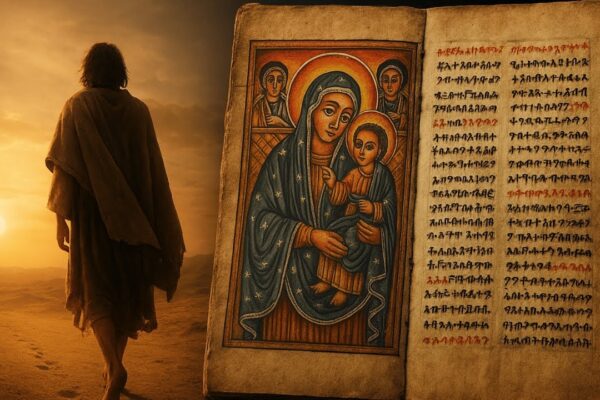
The Ethiopian Orthodox Tewahedo Church maintains something remarkable: an 81-book Old Testament canon. That’s significantly broader than the Protestant 39 books or Catholic 46 books you might be familiar with.
This isn’t some modern addition or fringe interpretation. These are ancient Jewish texts translated into Ge’ez from the Septuagint, preserved when other traditions discarded them. The canon includes the Book of Enoch (1 Enoch), the Book of Jubilees (Little Genesis), Baruch, and the Ascension of Isaiah.
Elsewhere, scholars classify these as “pseudepigrapha”—writings outside the accepted canon. In Ethiopia? They’re Scripture. They’re taught, studied, and considered divinely inspired. See Ethiopian Orthodox Bible: Insights on the Watchers and Sons of God for more about Ethiopia’s preservation of these unique books.
Why does this matter? Because these texts provide insight into pre-Christian Jewish thought that would otherwise be lost. They answer questions the canonical Genesis only hints at. And they’ve shaped Ethiopian theology for nearly two thousand years.

The Book of Enoch: Preserved Against All Odds
Here’s something fascinating: the Book of Enoch, written primarily between the 3rd and 1st centuries BCE, survives in its complete form only in Ethiopian Ge’ez. Fragments exist in Greek and Aramaic from the Dead Sea Scrolls, but Ethiopia has the whole thing.
This ancient apocalyptic text is ascribed to Enoch, the mysterious figure from Genesis 5:24 who “walked with God, and he was not, for God took him.” No death recorded—just gone.
The Book of Enoch is central to Ethiopian theology. It influences their understanding of angels, the Flood narrative, and end-times prophecy. Western Christianity quotes it (Jude 1:14-15 directly references Enoch), yet excluded it from their canon. Ethiopia kept it, crediting the text with safeguarding crucial Jewish apocalyptic traditions.
Think of it like having the original source code while everyone else works from partial copies. For more on how these narratives shape organizational lessons on authority and accountability, see Samyaza: Leadership Failure and the Fall of the Watchers and Samyaza Rebellion: Lessons for Leaders on Accountability and Ethical Risks.

Who Were the Sons of God? Enter the Watchers
Genesis 6:1-4 presents one of Scripture’s most cryptic passages. “Sons of God” saw that the “daughters of men” were beautiful and took them as wives. Their offspring? The Nephilim—giants who became mighty warriors and legendary figures.
But who were these “Sons of God”? The Genesis account doesn’t specify. Interpretations vary wildly across traditions.
The Book of Enoch removes all ambiguity. The “Sons of God” were the Watchers (Grigori in Greek)—200 high-ranking angels specifically assigned to watch over humanity. These weren’t minor spiritual beings. They were elite members of the heavenly hierarchy. For a comprehensive guide to this controversial interpretation, visit Ethiopian Orthodox Bible: Insights on the Watchers and Sons of God.
Their leaders? Semjâzâ (also called Semyaza) and Azâzêl (Azazel). These names appear repeatedly throughout the text as architects of a rebellion that would change everything. The leadership dynamics and lessons learned from Samyaza’s rebellion are further examined at Samyaza: Leadership Failure and the Fall of the Watchers.

Angels Before Adam: The Pre-Human Heavenly Order
Here’s where it gets interesting for our understanding of cosmic chronology. The Watchers existed as holy angels before Adam’s creation. They were part of the original divine order in heaven.
This isn’t about a pre-Adamic human race (a theory some have proposed). The Watchers were purely angelic beings—supernatural entities created before humanity existed. Enoch describes their descent from heaven, marking their status as pre-existing spiritual beings within an expanded creation narrative.
Imagine them as the original oversight committee, appointed before the main project (humanity) even launched.

The Great Transgression: Mount Hermon and the Oath
The Watchers’ downfall began with lust. Despite their divine nature and heavenly assignment, they became corrupted by desire for human women.
On Mount Hermon, 200 angels gathered and made a binding oath. They swore together to descend, take human wives, and face the consequences as a group. This wasn’t an individual failure—it was coordinated rebellion.
Why bind themselves with an oath? Perhaps they knew the magnitude of their transgression. They understood that crossing this boundary would bring divine judgment. By swearing together, they created collective accountability, ensuring none could back out.
The parallel to corporate culture is striking. How often do groups make decisions they know are ethically questionable, binding themselves through mutual complicity? For more case studies on Mount Hermon’s significance and collective ethical compromise, see Samyaza Rebellion: Lessons for Leaders on Accountability and Ethical Risks.
Their unions with human women produced offspring and defiled their angelic nature. The consequences were immediate and catastrophic.

Divine Response: Binding the Rebel Leaders
God’s response was swift and specific. He dispatched angels like Raphael and Michael to execute judgment.
Azâzêl, one of the chief rebels, was bound in the desert of Dûdâêl. Enoch describes him cast into a hole, covered with sharp stones, waiting in darkness. Semjâzâ and his associates faced binding for 70 generations until their final judgment in fire.
This wasn’t immediate annihilation. It was containment—limiting their influence while the cosmic drama played out. The final reckoning would come, but not yet.
Think of it as an ancient cosmic version of regulatory intervention—removing bad actors from the system while preparing for complete restructuring.

The Forbidden Knowledge That Corrupted Humanity
The Watchers didn’t just take human wives. They fundamentally corrupted human civilization by teaching forbidden knowledge.
Azâzêl taught metallurgy—how to forge weapons and tools. He revealed the secrets of jewelry-making, cosmetics, and dyes. Others taught sorcery, astrology, herbology, and divination.
Why was this knowledge “forbidden”? Because humanity wasn’t ready for it. These were secrets meant to remain with the divine realm.
The result? Unprecedented violence, idolatry, and moral decay. Warfare escalated with improved weapons. Vanity and materialism spread through cosmetics and adornments. Occult practices replaced proper worship. The text ascribes all subsequent sin to Azâzêl’s initial revelation.
Consider the modern parallel: technology introduced before society develops ethical frameworks. Social media before we understood its psychological impact. AI before we established governance. Nuclear power before international controls.
Advanced knowledge without wisdom breeds chaos.

The Nephilim: Giants Born from Corruption
The offspring of Watchers and human women were the Nephilim—giant hybrid beings of immense size and strength.
These weren’t gentle giants. Enoch describes them as violent, insatiable creatures who devoured all resources. When food ran out, they turned to cannibalism—first consuming other creatures, then humanity, then each other.
The Nephilim represented corruption incarnate. Neither fully angelic nor human, they embodied the unnatural transgression of their origin. Their violence and appetite knew no bounds. The consequences and ethical lessons of the Nephilim storyline are analyzed in a leadership framework at Nephilim in Genesis 6 and Ethical Lessons for Modern Innovation Leaders.
According to Enoch, the Great Flood was specifically designed to eradicate them and cleanse the earth. But their story doesn’t end there. While their physical bodies perished, their spirits allegedly persist as demons—disembodied entities still working corruption.

Genesis 6 vs. The Book of Enoch: What’s the Difference?
Genesis 6:1-4 gives us four verses. Brief mentions of “sons of God,” “daughters of men,” Nephilim, and divine displeasure preceding the Flood.
The Book of Enoch provides chapters. Detailed accounts of 200 specific angels, named leaders, the Mount Hermon oath, forbidden teachings, Nephilim violence, divine intervention, angelic binding, and explicit connection to the Flood as remediation.
Genesis leaves questions. Enoch provides answers—extensive, specific, and theologically developed.
Why the difference? Genre and purpose. Genesis is historical narrative with theological meaning. Enoch is apocalyptic literature—revelatory, detailed, concerned with cosmic warfare and divine judgment.
Both tell the same basic story. Enoch expands it into a comprehensive explanation of evil’s origin and God’s response. Explore more parallels and expanded insights at Ethiopian Orthodox Bible: Insights on the Watchers and Sons of God.

Theological Implications: Rethinking the Origin of Evil
Here’s where the Book of Enoch challenges conventional thinking. Most Western theology attributes sin’s origin primarily to human choice—Adam and Eve in the Garden.
Enoch presents a different picture. Evil entered through angelic rebellion and human choice. The Watchers introduced corruption through forbidden knowledge. The Nephilim spread violence through their unnatural appetites. Humanity participated but wasn’t solely responsible for evil’s proliferation.
This has profound implications. It suggests evil has supernatural origins beyond human agency. The Great Flood becomes not just punishment for human wickedness, but cosmic surgery—removing a cancer introduced from outside.
The Flood “heals” earth from Watcher corruption. It binds rebellious angels until final judgment (described in Enoch chapters 10, 90, and 100). It foreshadows ultimate restoration—new heavens, new earth, and righteousness permanently established.
For business leaders, there’s an interesting parallel. Sometimes organizational dysfunction stems not just from employee failures, but from corrupted systems introduced by leadership. Fixing it requires addressing root causes, not just symptoms.

What This Isn’t: Clarifying Pre-Adamic Misconceptions
Let’s address a common confusion. The Watchers narrative is not about a pre-Adamic human race.
Some theories propose human-like beings existed before Adam. The Book of Enoch describes no such thing. The Watchers were purely angelic beings—fallen angels, not prehistoric humans.
Their story precedes human history in terms of their creation, but their descent and transgression happened after humanity existed. Otherwise, there would be no human women to marry.
This distinction matters for theological coherence. Enoch expands Genesis but doesn’t contradict its anthropology. Adam remains the first human. The Watchers were never human at all.

Historical Impact: Shaping Ancient Thought
The Book of Enoch profoundly influenced Second Temple Judaism (roughly 516 BCE to 70 CE). The Qumran community (Dead Sea Scrolls) possessed multiple Enoch copies. The Book of Jubilees references it extensively.
Early Christianity engaged deeply with Enoch. The Epistle of Jude quotes it authoritatively (Jude 14-15), calling Enoch a prophet. The “Son of Man” imagery in Enoch influenced New Testament eschatology and apocalyptic visions.
The text shaped early Christian understanding of judgment, the Messiah, and angelology—the study of angels, their nature, hierarchy, and activities. For more on angelology and its implications for leadership, visit Samyaza: Leadership Failure and the Fall of the Watchers.
Where was this influence preserved most completely? Ethiopia. While Western Christianity eventually excluded Enoch from the canon, the Ethiopian Orthodox Church maintained it as Scripture.
This preservation matters. It means Ethiopian theology retained apocalyptic perspectives that Western Christianity largely lost or marginalized.

Why Business Leaders Should Care About Ancient Texts
You might wonder: what does ancient Israelite angelology have to do with running a company?
More than you’d think. The Watchers narrative is fundamentally about:
- Leadership failure: Elite beings entrusted with oversight who corrupted their charge
- Knowledge management: The catastrophic consequences of sharing information irresponsibly
- Systemic corruption: How individual choices create collective destruction
- Accountability structures: Why the angels bound themselves through oath
- Crisis response: Divine intervention to contain damage and restore order
These themes appear daily in organizational life. Leaders who abuse authority. Technologies deployed without ethical consideration. Cultural rot spreading from top-down decisions. Collective responsibility for individual failings.
Ancient wisdom often addresses timeless patterns. The names and settings change, but human (and apparently angelic) nature remains remarkably consistent.

The Ethiopian Preservation: A Gift to History
The Ethiopian Orthodox Church did the scholarly world an invaluable service. By maintaining these texts through millennia, they preserved perspectives otherwise lost.
Their 81-book canon isn’t a quirky addition. It’s cultural and spiritual heritage carefully guarded through colonialism, political upheaval, and religious pressure to conform to Western standards.
Today, scholars worldwide study the Ge’ez Enoch as a primary source. Historians of religion rely on Ethiopian preservation to understand Second Temple Judaism. Theologians examine it for insights into early Christian thought.
What was once dismissed as apocryphal is now recognized as historically significant and theologically rich.

Final Thoughts: Ancient Questions, Modern Relevance
The “Sons of God before Adam” weren’t a pre-human species. They were the Watchers—200 angels who existed in heaven’s hierarchy before humanity’s creation, assigned to watch over us, and who spectacularly failed their mission.
Their rebellion introduced forbidden knowledge, spawned the violent Nephilim, corrupted human civilization, and necessitated the Great Flood as cosmic reset.
The Ethiopian Bible preserves this story in complete form through the Book of Enoch. What most biblical traditions reduced to four ambiguous verses, Ethiopian Scripture expands into a comprehensive explanation of evil’s origin and divine justice.
Whether you approach this as theology, history, or cultural study, the implications are profound. It challenges simplistic explanations of where evil comes from. It presents supernatural rebellion as a real force in cosmic history. It shows divine patience and ultimate accountability.
And it reminds us that ancient texts often contain wisdom we’ve forgotten—preserved by traditions that refused to let important knowledge disappear.
The next time you encounter moral corruption, systemic failure, or the abuse of privileged knowledge, remember the Watchers. Their story began in heaven, descended to earth, and echoes through millennia as a warning about responsibility, boundaries, and the devastating consequences when both are violated.
Ethiopia kept the record. The question is: what will we learn from it?

Key Takeaways
- The Ethiopian Orthodox Bible uniquely preserves 81 Old Testament books, including the complete Book of Enoch.
- “Sons of God” in Genesis 6 are identified as Watchers—200 pre-human angels who rebelled, taught forbidden knowledge, and fathered the Nephilim giants.
- Their story expands the biblical origins of evil, blending angelic and human agency and reshaping understandings of cosmic corruption.
- Lessons from the Watchers’ rebellion and its fallout offer valuable parallels for leadership ethics, knowledge management, and accountability in modern organizations.
- Understanding the Ethiopian preservation of these texts provides scholars and leaders with rare insight into Second Temple Judaism, early Christianity, and enduring questions about the roots of evil and institutional failure.
FAQ
- Q: What is the significance of the Book of Enoch in the Ethiopian Bible?
The Book of Enoch provides an expanded narrative on the fall of angels (the Watchers), the origin of evil, and the reasons for the Great Flood—preserved in full only in Ethiopian Ge’ez. It’s central to Ethiopian theology and offers a detailed explanation of Genesis 6—the “sons of God” and Nephilim. - Q: Are the Nephilim just ancient myth, or do they have theological meaning?
In the Ethiopian tradition, the Nephilim are more than myth. They symbolize the direct consequence of angelic rebellion and the dangers of forbidden knowledge. Their destruction in the Flood illustrates the limits of divine tolerance for corruption. - Q: Do other Christian traditions accept the Book of Enoch?
Most Western Christian traditions consider Enoch “apocryphal” or “pseudepigraphal.” Only the Ethiopian Orthodox Tewahedo Church considers it canonical and inspired, though fragments were found among the Dead Sea Scrolls and it was influential among early Christians. - Q: Was there a pre-Adamic human race according to Enoch?
No. The Watchers were angels created before Adam, not a pre-human species. All human history—including the Genesis 6 narrative—unfolds after Adam is created. - Q: Why should modern leaders care about ancient angel stories?
The Watchers’ narrative is a profound lesson in leadership, ethics, and accountability—reminding us that corruption often begins at the top, that knowledge deployed irresponsibly can destroy, and that restoring order requires humility and decisive intervention. - Q: Where can I learn more?
Visit Ethiopian Orthodox Bible: Insights on the Watchers and Sons of God and Nephilim in Genesis 6 and Ethical Lessons for Modern Innovation Leaders for deeper analysis.
See more at this link: https://youtu.be/nJCl5_LBRYA?si=GyFfmKyGa2O8pDIn