Key Takeaways
- The Ethiopian Orthodox Bible contains 81 books and preserves the Book of Enoch.
- Enoch tells a bold story of a “hidden war” before the Flood.
- The Watchers break ranks, share forbidden knowledge, and spark systemic chaos.
- Their actions produce unintended consequences, symbolized by the Nephilim.
- Archangels respond with binding, containment, and long-term judgment.
- The contrast with Revelation reveals two different threat horizons.
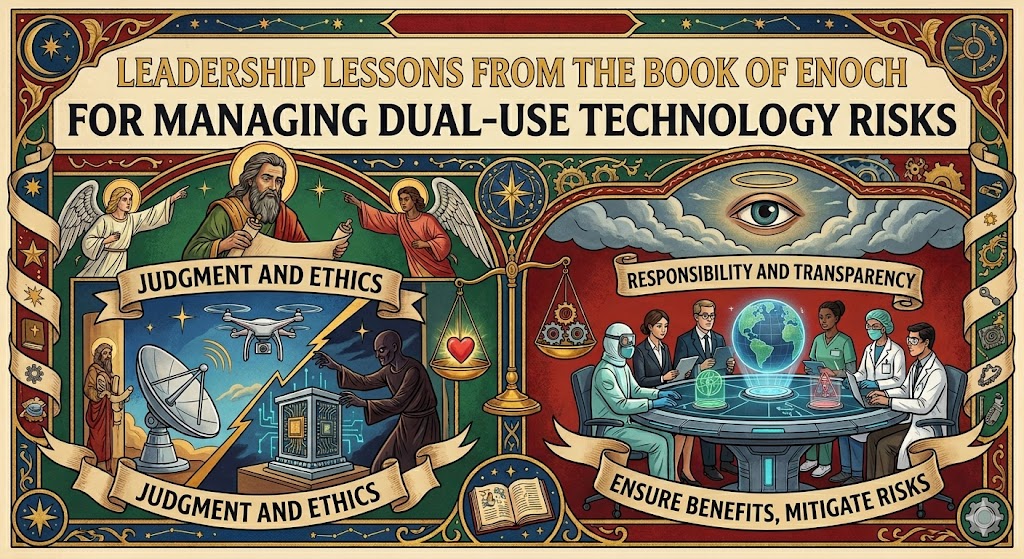
- For leaders, this maps to innovation ethics, governance, and risk controls.
- Use these lessons to manage dual-use tech, AI, and organizational culture.
- Build oversight, reduce single points of failure, and rehearse crisis response.
- Treat knowledge as power, but govern its use with humility and restraint.
Why a 2,000-Year-Old Story Matters in Your Boardroom
What happens when your smartest people decide the rules don’t apply to them? That is the core tension inside the Book of Enoch. It sits within the Ethiopian Orthodox Bible, a canon that dares to keep hard questions intact.
For modern leaders, the tale of the Watchers reads like a case study in risk. It shows how knowledge without governance becomes a liability. It shows how ambition mutates into systemic harm, and how late action drives catastrophic costs. For a deeper exploration of these leadership dynamics and the origin of the Watchers in the Ethiopian tradition, see here.

What Makes the Ethiopian Bible Different
The Ethiopian Orthodox Bible includes 81 books, preserved in the ancient Ge’ez language. It is one of the most complete biblical canons still in use. Unlike Protestant (66 books) or Catholic (73 books) canons, it includes the Book of Enoch and the Book of Jubilees.
These texts were excluded from most Western canons in late antiquity. Reasons include the apocalyptic style, non-apostolic authorship, and a theology that leans into angelic rebellion. Ethiopia preserved them through its own ancient tradition. To understand more about how this unique canon has impacted our modern understanding of the Watchers and origin of evil, visit here.
The “Hidden War in Heaven” at a Glance
The Book of Enoch opens with a dramatic descent. Two hundred angels, called Watchers (Grigori), make a pact on Mount Hermon. Their leaders—Semjaza and Azazel—promise to take human wives and teach humanity secret arts. (Interested in leadership failure at Mount Hermon and its modern lessons? See here.)
They deliver powerful, alluring knowledge:
- Metallurgy for weapons.
- Sorcery and incantations.
- Cosmetics and adornment.
- Astrology, constellations, and divination.
The immediate impact is dazzling and destabilizing. Society gains capability but loses restraint. Their unions with humans produce the Nephilim—giants who devour resources and feed violence. As corruption spreads, the earth cries out. For ethical and leadership implications of the Nephilim, read here.
The response is severe and structured. Archangel Michael binds Semjaza and the Watchers. Gabriel sparks internal conflict among the giants. Raphael imprisons Azazel. Uriel warns Noah about the coming Flood. The cleansing is both surgical and sweeping.
This is the “hidden war”: a pre-Flood rebellion that weaponizes knowledge. It is not the end-times war of Revelation. It is the primordial crisis that explains how evil permeated the world so quickly.
Leaders and Lessons: A Quick Orientation
- Semjaza (chief oath-taker): Charismatic leadership can be catastrophic without checks.
- Azazel (teacher of warfare and adornment): Dual-use tech needs strict boundaries.
- Watchers (200 angels): High-talent cohorts still require oversight and duty.
- Nephilim (giant hybrids): Unintended consequences scale faster than intent. (See more Nephilim lessons for innovation and responsible leadership here.)
- Michael, Gabriel, Raphael, Uriel (archangels): Crisis response needs roles and lanes.
From Forbidden Knowledge to Ethical Innovation
Enoch frames knowledge as both gift and hazard. The Watchers teach what humans could not access on their own. Some of it seems helpful. Much of it is misused at scale.
Modern parallels are direct:
- AI can accelerate research and optimize operations. It can also power deepfakes and fraud.
- Cryptography and cybersecurity tools protect data. They also enable sophisticated ransomware.
- Biotech promises cures. It also presents dual-use concerns around bioengineering.
The lesson is not to fear knowledge. It is to govern it. The Book of Enoch warns that capability without character invites collapse. Your role is to architect both capability and constraint.
Think of three lines of defense:
- Policy: Define what is allowed, restricted, and red-teamed by default.
- Process: Require approvals, audits, and separation of duties for dual-use tools.
- People: Build a culture where curiosity meets conscience, not shortcuts.
The Oath on Mount Hermon: Governance Gone Wrong
The Watchers bind themselves with an oath. It is a shadow version of corporate charters and partnership agreements. The difference is purpose. Their pledge formalizes collective misconduct and mutual protection.
Leaders should ask:
- Are there informal oaths inside my company that prioritize speed over safety?
- Do elite teams treat policy as optional because they deliver results?
- Have we built incentives that reward outcomes regardless of method?
When culture normalizes shortcuts, governance is already failing. The cure is visible accountability. Senior leaders must model the rules, not just write them. Tone at the top becomes guardrail at the edge.
Unintended Consequences: The Nephilim Effect
Every leader has seen a Nephilim effect. You launch a feature to improve engagement. It drives addiction and harms well-being. You ship a model for productivity. It enables fraud at scale.
Enoch makes this vivid by personifying consequences as giants. They do not obey their makers. They consume their makers. That is what runaway externalities do to brands and balance sheets.
Practical moves:
- Scenario testing: Ask what happens if the best user becomes the worst actor.
- Kill switches: Build rollback levers for models, features, and access rights.
- Containment: Sandbox sensitive capabilities; limit who can compose them.
- Monitoring: Instrument for negative externalities, not just growth metrics.
Crisis Response: Bind, Contain, Warn
The archangels show three distinct responses:
- Michael binds the ringleaders. Neutralize the source, not just the symptoms.
- Gabriel turns the giants against each other. Reduce blast radius and momentum.
- Raphael imprisons Azazel. Segregate high-risk actors from the system.
- Uriel warns Noah. Communicate early and equip those at risk.
Your playbook should mirror this structure:
- Identification: Who or what is driving the breach or harm?
- Containment: How do we isolate systems, privileges, and data paths?
- Countermeasures: How do we redirect or degrade the attack surface?
- Communication: Who needs to know now, and with what protective guidance?
- Remediation: What structural fixes prevent recurrence?
Past vs Future: Enoch and Revelation as Horizon Planning
Enoch’s crisis is pre-Flood and systemic. It shows how a system collapses from internal corruption. Revelation’s conflict is eschatological and cosmic. It looks ahead to a final purging of evil.
In business terms, this is horizon planning:
- Horizon 1 (Enoch-like): Current operations and near-term risks. Think model misuse, insider threats, compliance gaps.
- Horizon 2 (transition): Coming shifts that change your category. Think new regulations, platform changes, disruptive entrants.
- Horizon 3 (Revelation-like): Transformations that redefine your market. Think AGI-level disruption, quantum breaks in cryptography, or paradigm shifts in energy.
Leaders need dashboards that measure all three. Do not prepare only for long-term “dragon” moments. Most companies fall because they missed the near-term rot.
The WATCHER Framework for Responsible Innovation
Use the story to make your process memorable. Try this six-step model:
- Watch: Instrument early-warning signals for misuse and drift.
- Assess: Score dual-use potential before green-lighting capabilities.
- Train: Build ethics-by-design into product and data teams.
- Contain: Gate, sandbox, and rate-limit high-risk functions.
- Harden: Add audits, approvals, and least-privilege access.
- Engage: Invite red teams, regulators, and user councils early.
- Rehearse: Run crisis drills and post-mortems like safety orgs.
Apply it to three common domains:
- AI/ML: Pre-release red-teaming, guardrails, and usage analytics. Restrict system prompts and data exfiltration pathways. Document model cards with clear risk notes.
- Fintech: Transaction anomaly detection, limits, and stepped-up verification. Run staged rollouts with fraud breakpoints and manual review queues.
- Health tech: IRB-style ethics oversight for data capture and algorithmic triage. Protect against bias with representative datasets and fairness audits.
Information Policy: Knowledge Is Power, but Not Everyone Should Hold It
Enoch warns that opening the vault too widely can harm the world. The Watchers shared advanced knowledge without context, maturity, or limits. The fallout was immediate. (For an in-depth look at forbidden knowledge, see here.)
Modern companies need information tiers:
- Public: Shareable externally with no harm.
- Internal: Useful for teams, safe for broad employees.
- Sensitive: Limited to designated roles, tracked access.
- Restricted: Strictly need-to-know, monitored and encrypted.
- Sacred: Keys, signing certs, crown-jewel models, and admin consoles.
Add two practices:
- Just-in-time access: Grant privileges when needed, revoke by default.
- Two-party integrity: Require multi-person approvals for critical actions.
Ethics of Charisma: When Star Performers Become Watchers
Every org has star performers who bend rules. Their results are strong. Their influence is stronger. Over time, processes form around them instead of around principles.
Signals to watch:
- Process exceptions follow a person more than a plan.
- “We’ve always done it this way” blocks audits and upgrades.
- Senior leaders avoid challenging a charismatic owner-operator.
Interventions that work:
- Rotate stewardship of sensitive systems to reduce capture risk.
- Pair metrics with methods in performance reviews.
- Celebrate whistleblowing and good-faith dissent.
- Separate architectural authority from operational speed.
Suppression and Selection: Why Enoch Was Sidelined
Enoch did not vanish because it lacked power. It was set aside because communities chose a different center. Western canons moved toward texts grounded in apostolic witness and Torah continuity. Enoch’s intense angelology and apocalyptic style sat outside that lane.
Organizations make similar choices. You cannot foreground every narrative. You must decide what stories will shape culture. Choose stories that elevate responsible power, transparent governance, and shared accountability. Keep the hard stories in your archives so you remember what happens when talent outruns conscience.
Use Cases for Leaders: Three Scenarios and What to Do
- Deploying generative AI across customer service
Risk: Hallucinations, data leakage, and brand-damaging responses.
Moves: Tiered knowledge bases, retrieval-augmented generation with guardrails, and human-in-the-loop for high-stakes replies. Establish clear escalation paths when the model is uncertain. - Rolling out instant payments in a fintech app
Risk: Fraud rings exploit speed and social engineering.
Moves: Velocity limits, device fingerprinting, multi-factor prompts on anomalies, and staged account trust-building. Use adversarial simulations and stress-test your thresholds. - Launching a health triage algorithm for clinics
Risk: Bias against underrepresented groups and missed critical cases.
Moves: Diverse training data, bias testing across protected classes, and periodic outcome reviews. Provide clinician override and clear explainability pathways.
Your 30–60–90 Day Action Plan
Days 1–30: Baseline and align
- Inventory dual-use capabilities across products and data.
- Map access privileges and identify crown-jewel systems.
- Establish a cross-functional risk council (product, legal, security, compliance).
- Define a red-team charter and schedule the first exercise.
- Publish a short “responsible innovation” memo signed by the CEO.
Days 31–60: Build and test
- Implement just-in-time access and least privilege in sensitive systems.
- Add pre-release risk assessments to the product lifecycle.
- Instrument misuse telemetry and build dashboards for exec review.
- Pilot a kill-switch workflow with staged rehearsals.
- Run a tabletop exercise simulating a misuse incident and brand response.
Days 61–90: Harden and scale
- Formalize the WATCHER framework in policy and training.
- Launch ethics-by-design modules for engineers and PMs.
- Establish a user advisory council for early feedback on risky features.
- Conduct a post-mortem on at least one near-miss and publish lessons.
- Tie executive compensation to risk reduction and safety milestones.
Metrics That Matter
- Time-to-detect and time-to-contain for misuse incidents.
- Percentage of dual-use launches with documented risk assessments.
- Coverage of least-privilege across admin roles and service accounts.
- Frequency and severity of red-team findings over time.
- Employee confidence in whistleblower protections and response quality.
- Model or feature rollback frequency and cause categories.
Communicating Like Uriel: Warn Early, Clearly, and Constructively
Good crisis communication is not spin. It is stewardship. Tell stakeholders what happened, what you are doing, and how you will prevent recurrence. Use plain language, not legal fog.
Build templates for:
- Customer notices when a feature is paused or changed.
- Regulator updates with concrete mitigations and timelines.
- Internal briefings that align teams and prevent rumor spirals.
Rehearse these communications like you rehearse your incident response. When the moment comes, your clarity will build trust.
Board Questions to Ask This Quarter
- Which of our capabilities are most likely to become “forbidden” in the wrong hands?
- Where are our informal oaths—unwritten rules—that bypass governance?
- Do we have a containment plan for our top three dual-use risks?
- How do we detect and reward principled dissent before harm scales?
- What would it take to bind a modern Semjaza inside our org? (On the rise and fall of Semjaza and implications for authority, see here.)
Two Final Contrasts Worth Remembering
- Enoch’s focus is internal corruption breaking the world from within. Govern your own house first. Most crises begin at home.
- Revelation’s focus is a final, decisive purge of evil at the end. Prepare for paradigm shifts, but do not neglect daily safeguards.
If you address Horizon 1 rot, you buy time to prepare for Horizon 3. If you ignore Horizon 1, Horizon 3 may arrive too late to matter.
A Short Glossary for Busy Leaders
- Ethiopian Orthodox Bible: A canon of 81 books, including Enoch and Jubilees.
- Book of Enoch: An ancient text describing a pre-Flood rebellion of angels.
- Watchers: Angels who shared forbidden knowledge and broke divine order.
- Nephilim: Hybrid giants, symbols of unintended and uncontrollable consequences.
- Archangels: Michael, Gabriel, Raphael, Uriel—models for crisis roles and responses.
What This Means for You Now
Your organization is full of knowledge. Some of it is powerful enough to help the world or harm it. That duality is not an accident. It is the condition of leadership.
The Book of Enoch is not a quaint curiosity. It is a map to the cliff edge. It shows what happens when capability escapes conscience and when speed outruns structure. It also shows how disciplined, role-based intervention can still save what matters.
Treat your innovators with honor and your guardrails with reverence. Build cultures where talent is matched by trustworthiness. And when you find your own Mount Hermon moments—those pacts of convenience that trade ethics for speed—break them before they bind you.
In a world racing to master AI, data, and automation, the hidden war is not out there. It is in our calendars, our roadmaps, and our incentives. Lead like an archangel. Watch, assess, train, contain, harden, engage, and rehearse. That is how you keep giants from eating your garden—and how you turn dangerous knowledge into durable advantage.
FAQ
Why does the Ethiopian Orthodox Bible include books like Enoch?
Unlike Western canons, the Ethiopian Orthodox Bible preserved these writings due to its unique tradition and language continuity. The Book of Enoch and Jubilees were valued for their teachings on angels, evil, and divine judgment. Western churches excluded them over time for their apocalyptic and non-apostolic focus, but Ethiopia maintained them as part of its religious heritage.
How does the Book of Enoch connect with modern leadership challenges?
The Enoch story mirrors the dilemmas of dual-use technology: when specialized knowledge gets shared and misused, organizations face destabilizing risks. The Watchers’ tale is a metaphor for governance gaps, oversight failures, and the dangers of charismatic rule. Leaders today can use its lessons for handling AI, information security, and fast-growth innovation.
What are “forbidden knowledge” and “dual-use” risks for organizations?
Forbidden knowledge refers to information or capability that, if widely shared or used without guardrails, can cause systemic harm. Dual-use risk captures tools or ideas that can help or hurt, depending on the user’s ethics. The Book of Enoch dramatizes how talent and ambition, when ungoverned, create unintended, destructive outcomes.
What’s the difference between the Book of Enoch’s crisis and Revelation’s end-times battle?
Enoch deals with early, internal collapse—chaos growing from within as leaders break the rules. Revelation is about an external, final confrontation with evil at history’s close. For business, this means handling everyday rot and emerging corruption, while also preparing for transformational challenges on the horizon.
Can you explain the “WATCHER” framework in plain terms?
WATCHER stands for Watch, Assess, Train, Contain, Harden, Engage, and Rehearse. It’s a mnemonic to help leaders systematize responsible innovation: anticipate risks, evaluate for misuse, create ethics training, restrict high-risk systems, build tough oversight, include diverse perspectives, and run drills so you’re ready for trouble.
Why was the Book of Enoch excluded from most Bibles?
The Book of Enoch was sidelined primarily due to its uncertain authorship, mystical content, and detailed angelic cosmology. Western religious leaders favored texts with direct apostolic tradition or Mosaic foundation, finding Enoch’s supernatural emphasis and rebellious angel stories less fitting for the main canon.
How do I apply Enoch’s lessons to AI, fintech, or health tech projects?
Build in three lines of defense: strong policies on access and use, clear approval processes for sensitive launches, and an ethical culture that prizes conscience as much as curiosity. Scenario test for worst-case uses, impose tiered access, and set up fast crisis response. Let the Enoch narrative remind you not to chase progress without parallel focus on controls.
Where can I learn more about the Watchers and ethical innovation?
To explore these themes in greater detail and see contemporary applications, check out resources like this leadership guide to Enoch and forbidden knowledge.
See more at this link: https://youtu.be/1j4hwcN0wJI?si=M4WcXJazlDDoMXlt