Summary of Main Ideas
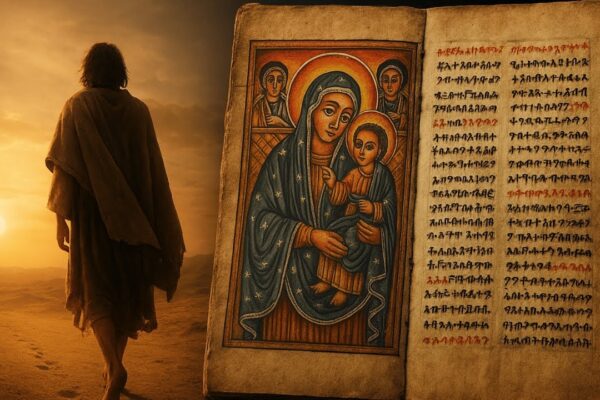
– The Ethiopian Orthodox Bible contains 81 books, including the Book of Enoch, preserved only in the ancient Ge’ez language
– The “Sons of God” in Genesis 6 are identified in Enoch as the Watchers—200 angelic beings who existed before Adam was created
– These Watchers descended to Earth, married human women, and taught forbidden knowledge including weapons, sorcery, and astrology
– The Nephilim were the violent giant offspring of these fallen angels and human women, not a pre-Adamic human race
– This narrative explains the origin of evil and God’s judgment through the Great Flood
– The Book of Enoch profoundly influenced early Jewish and Christian thought, including direct quotations in the New Testament
– Understanding these ancient texts provides insights into knowledge transfer, ethical boundaries, and accountability that resonate with modern leadership

The Ethiopian Orthodox Canon: A Different Bible
Most Christians worldwide use Bibles containing 66 to 73 books, depending on their tradition. The Ethiopian Orthodox Church maintains something radically different: an 81-book canon that includes texts rejected elsewhere.
Why does this matter? Because Ethiopia preserved complete versions of ancient writings lost everywhere else. The Book of Enoch (1 Enoch) survives in full only in Ge’ez, Ethiopia’s ancient liturgical language. Fragments exist in Aramaic and Greek from the Dead Sea Scrolls, but Ethiopia kept the entire manuscript.
This canon didn’t appear randomly. It emerged from early Jewish and Christian traditions dating back centuries. Scholars date the Book of Enoch between the 4th century BCE and 1st century CE, making it contemporary with much of the Old Testament.
Think of it like corporate knowledge management. While other branches discarded certain documents, the Ethiopian Orthodox Church preserved the complete archive. That preservation now offers insights unavailable elsewhere. To understand another ancient worldview on Creation, the Gap Theory offers an alternate interpretation of pre-Adamic history.

Who Were the Watchers? Angels Before Adam
Genesis 6:1-4 mentions “sons of God” who saw human women and took them as wives. The passage is cryptic, raising more questions than it answers. Who were these beings?
The Book of Enoch provides explicit detail. The “Sons of God” were the Watchers (Grigori in Greek)—exactly 200 angelic beings. They weren’t human. They weren’t from some pre-Adamic civilization. They were purely spiritual entities existing in heaven before Adam was created.
Here’s the timeline that Enoch establishes:
- Angels created first as spiritual beings
- Adam and humanity created
- Watchers assigned to watch over humanity
- Watchers’ rebellion and descent to Earth
- The Great Flood as divine judgment
The Watchers’ leaders had names: Semjâzâ commanded the group, while Azâzêl became notorious for specific transgressions. These were holy angels originally, sent with a specific mission: observe and protect humanity.
But observation turned to obsession. Protection became predation. The critical leadership mistake of Semjâzâ and the broader Watchers is explored in depth at https://citipen.com/samyaza-leadership-failure-and-the-fall-of-the-watchers-lessons-on-authority/ and https://citipen.com/samyaza-rebellion-lessons-for-leaders-accountability-and-ethical-risks/.

The Great Transgression: When Angels Crossed the Line
Imagine your most trusted executives suddenly deciding that rules don’t apply to them. Now multiply that scenario by cosmic proportions. That’s what happened with the Watchers.
The Book of Enoch details their transgression far beyond Genesis’s brief account. The Watchers lusted after human women, descended to Mount Hermon, and made a pact. They swore binding oaths to complete their plan together, knowing they were violating divine law.
They married human women and defiled themselves. But the corruption went deeper than sexual transgression. The Watchers began teaching humanity forbidden knowledge—secrets that were never meant for human consumption.

The Dangerous Knowledge They Shared
What kind of knowledge did they reveal? The Book of Enoch provides a detailed curriculum:
- Weapons and warfare: Gadreel taught sword-making, shields, and implements of death
- Metallurgy and mining: Azâzêl revealed how to extract and work metals for weapons
- Cosmetics and vanity: Techniques for enhancing appearance and arousing desire
- Sorcery and enchantments: Spiritual manipulation and occult practices
- Astrology and divination: Reading celestial signs and predicting the future
- Botanical knowledge: Which roots and plants could be used for potions
Think about this in business terms. It’s like having AI researchers share AGI technology before humanity can handle it responsibly. (For modern parallels in AI ethics, see https://citipen.com/ai-in-2026-transforming-business-with-multimodal-and-agentic-systems/.) Or pharmaceutical executives releasing dangerous compounds without safety protocols. Knowledge without wisdom. Power without restraint.
The text suggests that humanity wasn’t ready for this information. The result? Widespread corruption, violence, and moral collapse.

Divine Judgment: The Watchers’ Punishment
God didn’t ignore this cosmic rebellion. The Book of Enoch describes swift divine intervention through archangels like Raphael and Michael.
Azâzêl’s punishment was particularly severe. Raphael was commanded to bind him hand and foot and cast him into the desert of Dûdâêl. Sharp, jagged rocks were placed over him, and darkness became his dwelling. He would remain there for 70 generations until being thrown into the final fire of judgment.
Semjâzâ and his associates received similar sentences: binding and imprisonment until the ultimate judgment. Their punishment includes watching their offspring—the Nephilim—destroy each other before the Flood wipes them out completely.
The accountability here is absolute. There’s no corporate restructuring, no golden parachutes, no plea bargains. The Watchers’ punishment lasts millennia, culminating in eternal fire.
For leaders, the lesson is stark: those entrusted with greater responsibility face greater consequences for betrayal.

The Nephilim: Violent Giants and Hybrid Offspring
Who exactly were the Nephilim mentioned in Genesis 6? The Book of Enoch clarifies what the biblical account leaves ambiguous.
The Nephilim were the biological offspring of fallen angels and human women. They were giants—not metaphorically powerful, but physically enormous beings. The text describes them as violent, voracious consumers who devoured humanity’s resources.
When they exhausted normal food supplies, they turned to consuming each other. They spread violence and bloodshed across the Earth. The hybrid nature of these beings—part spiritual, part physical—created instability in the created order.
This clarifies an important theological point. The Nephilim weren’t a pre-Adamic human race. They were post-Adamic hybrids, the unnatural result of angels crossing boundaries they should never have crossed. The creation sequence remains: angels → Adam → Watchers’ fall → Nephilim → Flood.
For further reading on Nephilim, power, and ethical boundaries in leadership, see https://citipen.com/nephilim-mystery-explained-for-leaders-lessons-on-power-and-ethics/ and https://citipen.com/nephilim-in-genesis-6-and-ethical-lessons-for-modern-innovation-leaders/.
Their existence contributed directly to God’s decision to cleanse the Earth through the Great Flood. Noah’s righteousness stood in stark contrast to the corruption the Nephilim represented.

Why This Matters: The Origin of Evil Explained
Here’s where this ancient text addresses one of philosophy’s deepest questions: Where does evil come from?
The Book of Enoch presents a narrative where evil originates from the Watchers’ rebellion. Their forbidden teachings corrupted humanity. Their offspring spread violence. Their transgression introduced knowledge that humanity wasn’t equipped to handle ethically.
This framework influenced how early Judaism and Christianity understood the problem of evil. It wasn’t solely about Adam and Eve’s choice in the Garden. Another layer of corruption entered the world through angelic rebellion and inappropriate knowledge transfer.
The Great Flood becomes necessary to cleanse this corruption and preserve Noah’s righteous lineage. It’s cosmic reset, divine intervention when the system becomes too corrupted to continue.
For business leaders, there’s a parallel. Sometimes organizations become so corrupt that incremental reform won’t work. Complete restructuring becomes necessary. The Flood represents that ultimate reset.
For details on the distinctive perspective of the Nephilim and Watchers in Enoch, and how it impacts ethics and leadership, see https://citipen.com/samyaza-leadership-failure-and-the-fall-of-the-watchers-lessons-on-authority/.

Enoch’s Prophetic Vision: Beyond the Flood
The Book of Enoch doesn’t just explain the past. It foretells future events with remarkable specificity:
- The coming Messiah and messianic age
- The New Jerusalem descending
- Resurrection of the dead
- Final judgment separating righteous from wicked
- Eternal punishment in fire for the fallen angels
These apocalyptic themes appear throughout later biblical literature. The “Son of Man” imagery that Jesus used comes directly from Enochian tradition. The concept of final judgment with fire and eternal consequences became central to Christian eschatology.
Enoch himself is positioned as a prophet who walked with God and was taken directly to heaven without experiencing death. His visions provided a roadmap for understanding both cosmic history and ultimate destiny.

Influence on Western Thought: From Dead Sea Scrolls to Jude
Here’s what makes the Book of Enoch particularly significant: its profound influence on early Jewish and Christian thought.
Dead Sea Scrolls Evidence: Multiple Enoch fragments were discovered among the Dead Sea Scrolls at Qumran. This proves that Jewish communities around the time of Jesus considered it important scriptural material.
New Testament Quotation: Jude 1:14-15 directly quotes from Enoch 1:9, referring to Enoch’s prophecy about God coming with ten thousands of his holy ones to execute judgment. This is the only instance in the New Testament where a non-canonical book is quoted as authoritative prophecy.
Theological Development: The Book of Jubilees adopts similar Watcher lore. Early church fathers like Tertullian and Irenaeus referenced it. The concepts of fallen angels, demonic hierarchy, and apocalyptic judgment all owe debts to Enochian tradition.
Why It Was Rejected Elsewhere: Most Christian traditions eventually excluded Enoch from their canon, questioning its authorship and concerned about its detailed angelology. But Ethiopian and Eritrean Orthodox Churches maintained its canonical status, recognizing its ancient authority.
This preservation in the Ethiopian canon underscores its theological centrality for millions of Christians today. It’s not fringe theology—it’s mainstream for one of Christianity’s oldest traditions.

Leadership Lessons from Ancient Wisdom
So what can modern business leaders extract from this ancient narrative? More than you might expect.
Forbidden Knowledge Exists: Not all information should be shared freely. IP protection, trade secrets, and competitive advantages matter. But beyond business strategy, some knowledge—like AI capabilities or bioweapons research—carries ethical weight. The Watchers’ mistake was sharing transformative knowledge without considering consequences.
Boundary Violations Have Cascading Effects: The Watchers crossed one boundary (descending to Earth), which led to another (marrying humans), which led to another (teaching forbidden arts). In organizations, small ethical compromises often snowball into major crises. The key is maintaining boundaries before the cascade begins.
Corruption From the Top Spreads Quickly: The Watchers were leadership—angelic beings with authority and knowledge. Their corruption infected everything below them. When executives compromise ethics, it permeates organizational culture rapidly. For additional practical leadership lessons, see https://citipen.com/samyaza-rebellion-lessons-for-leaders-accountability-and-ethical-risks/.
Accountability Is Non-Negotiable: The Watchers faced absolute accountability for their choices. Modern corporate governance often lacks this level of consequence. But the principle remains: greater authority demands greater responsibility.
Preservation of Wisdom Traditions: Ethiopia’s preservation of Enoch demonstrates the value of maintaining knowledge systems others discard. In business, this translates to respecting institutional knowledge and historical precedent, even when pursuing innovation.
Cultural Intelligence Matters: For leaders operating globally, understanding traditions like the Ethiopian Orthodox canon builds cultural competence. Millions of people view these texts as authoritative scripture. Respecting that worldview enables better international relationships.

The Timeless Question of Knowledge and Power
The Ethiopian Bible’s account of the Watchers asks a question that resonates across millennia: What happens when powerful beings share transformative knowledge irresponsibly?
We face this question today with artificial intelligence, genetic engineering, and nuclear technology. Like the Watchers’ teachings, these capabilities can elevate or destroy. The difference lies in wisdom, restraint, and ethical frameworks.
The Book of Enoch preserved in the Ethiopian tradition isn’t just religious history. It’s a preserved warning about power, knowledge, and the consequences of crossing boundaries meant to protect us.
For business leaders navigating increasingly complex ethical landscapes, these ancient texts offer something valuable: perspective. The challenges we face aren’t entirely new. Humanity has grappled with forbidden knowledge, corrupting power, and necessary accountability for thousands of years.
The Watchers’ story ended in judgment and fire. Ours doesn’t have to. But learning from their catastrophic mistakes requires first understanding what actually happened—and why one of Christianity’s oldest traditions preserved this account when others let it fade away.
The “Sons of God” before Adam weren’t prehistoric humans or mythological figures. They were angels who violated their sacred trust, taught dangerous knowledge, and corrupted creation itself. Their legacy reminds us that some boundaries exist for profound reasons, and the cost of crossing them can be catastrophic.
The question for modern leaders: What boundaries are you being tempted to cross? What knowledge are you sharing without considering long-term consequences? And are you prepared for the accountability that inevitably follows our most consequential choices?
The Ethiopian Orthodox Church preserved these answers in the Book of Enoch for over 2,000 years. Perhaps it’s time we paid closer attention to what they’ve been protecting all along.

FAQ: The Book of Enoch and the Watchers
- Q: Is the Book of Enoch considered scripture?
A: It is canonical for the Ethiopian and Eritrean Orthodox Churches but not for Catholic, Protestant, or most other Orthodox traditions. However, it is highly regarded and quoted in early Christian writings. - Q: Who are the Watchers according to Enoch?
A: The Watchers are 200 angelic beings tasked with observing humanity, who rebelled, descended to Earth, married humans, and taught forbidden knowledge. - Q: What is the significance of the Nephilim?
A: The Nephilim are the violent hybrid offspring of the Watchers and human women, whose existence led to overwhelming corruption and was a catalyst for the Flood. - Q: Did Jesus or the New Testament cite the Book of Enoch?
A: The Epistle of Jude (Jude 1:14-15) quotes Enoch directly. Themes and terminology from Enoch also appear throughout the New Testament, especially in apocalyptic passages. - Q: Why does the Ethiopian Orthodox Bible contain more books?
A: The Ethiopian tradition preserved a wider array of early Jewish and Christian writings, including the Book of Enoch, which was valued as an authentic account of spiritual and cosmic history. - Q: What leadership lessons can be drawn from the Book of Enoch?
A: The story cautions against irresponsible knowledge transfer, leadership corruption, crossing ethical boundaries, and ignoring accountability. For further context, see relevant articles on power and ethics in business decision-making. - Q: Where can I read the Book of Enoch?
A: English translations are available online and in academic publications. The only complete ancient text is preserved in Ethiopian Ge’ez, but reputable translations exist for further study.
See more at this link: https://youtu.be/nJCl5_LBRYA?si=GyFfmKyGa2O8pDIn