Summary of Main Ideas
– Four prophecies from the Book of Daniel are interpreted by many scholars as pointing to imminent global events, connecting ancient predictions to modern geopolitical shifts, Middle East restructuring, and emerging global systems.
– Daniel’s historical track record is remarkably precise—four empires (Babylon, Persia, Greece, Rome) rose and fell exactly as prophesied, and the 69 weeks prophecy pinpointed Jesus’ triumphal entry to the exact day (483 years from decree to fulfillment).
– The four key prophecies focus on: a revived Roman Empire as a final world system, the rise of a charismatic global leader (Antichrist), a seven-year covenant involving Israel and Temple reconstruction, and a northern coalition’s invasion of Israel.
– Current global events show alignment with these ancient predictions, including Israel’s return to the land after 2,000 years, Temple Mount control, Middle East peace treaties, and regional restructuring.
– Theological interpretations vary significantly—premillennialists see literal future fulfillment, while amillennialists view much as symbolic or historically fulfilled, reminding us that pattern recognition requires discernment and intellectual humility.

Introduction
What if the most accurate forecasting model in history wasn’t built by data scientists, but written 2,600 years ago?
As business leaders, we live and breathe predictive analytics. We study market trends, analyze geopolitical risks, and build scenario-planning frameworks. We know that pattern recognition separates exceptional strategists from reactive managers. Yet most executives overlook one of history’s most precise predictive documents—the Book of Daniel.
Here’s what makes Daniel fascinating from a strategic perspective: verifiable accuracy. When an ancient text correctly predicts the rise and fall of four successive empires, calculates a timeline that pinpoints a historical event to the exact day (483 years in advance), and describes governmental structures that wouldn’t exist for centuries, you’re looking at something worth studying—regardless of your faith perspective.
Today, biblical scholars and prophecy experts identify four prophecies from Daniel’s writings that they believe are converging right now. These predictions connect to observable global trends: Middle East restructuring, emerging transnational governance systems, and geopolitical shifts that any CEO tracking international markets would recognize.
Let’s examine these four prophecies with the same analytical rigor we’d apply to any strategic forecast.

Why Daniel’s Track Record Matters
Before diving into what’s predicted, let’s establish credibility. Daniel’s prophecies aren’t vague fortune-cookie statements. They’re specific, measurable, and historically verifiable.
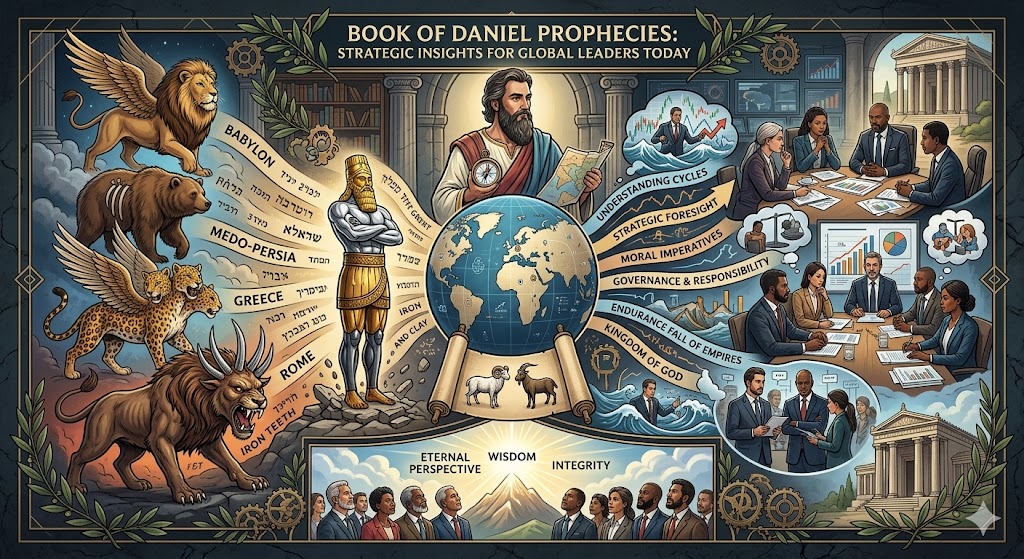
Consider the succession of empires. Daniel 2 describes a statue representing four kingdoms: Babylon (gold head), Persia (silver chest), Greece (bronze thighs), and Rome (iron legs). Daniel 7 parallels this with four beasts. History confirms this exact sequence. Babylon conquered the known world, fell to Persia, which fell to Alexander’s Greece, which fragmented into territories eventually absorbed by Rome.
The precision gets more impressive. Daniel 9 contains the “70 weeks prophecy”—a mathematical timeline predicting 69 weeks of years (483 years) from a specific decree to the coming of the Messiah. Scholars trace this from King Artaxerxes’ decree in 445 BC to rebuild Jerusalem. Counting forward 483 years using the prophetic calendar lands on April 6, 32 AD—Palm Sunday, Jesus’ triumphal entry into Jerusalem.
That’s not approximate. That’s hitting a date centuries in advance.
This track record gives Daniel’s remaining unfulfilled prophecies serious weight. If someone correctly predicted your last four quarterly earnings to the decimal point, you’d pay attention to their next forecast.

Prophecy One: The Final World Empire (The Revived Roman System)
The Prediction: Daniel’s visions point to a final global kingdom emerging from the legacy of Rome—a ten-region system led by a coalition of rulers, from which one dominant leader emerges.
In Daniel 2, the statue’s iron legs (Rome) transition to feet “partly of iron and partly of clay”—strong yet fragmented, unified yet unstable. Daniel 7 describes this as a ten-horned beast, representing ten kings or regions. From among them, a “little horn” arises, subduing three others and consolidating power.
The Business Context: Think of this as a geopolitical merger and acquisition. A fragmented system reorganizes into a unified bloc, and a charismatic leader emerges through strategic consolidation.
Current Alignment: We’re watching real-time restructuring of global governance. The European Union represents Rome’s geographical heartland reorganizing after 1,500 years of fragmentation. Regional blocs are forming worldwide—economic unions, military alliances, trade partnerships that transcend traditional nation-states. International treaties increasingly supersede national sovereignty.
For business leaders, this matters because corporate strategy now operates in a multi-polar world trending toward bloc economics. Trade agreements like USMCA, RCEP, and the EU Single Market represent exactly the kind of regional consolidation Daniel described—separate entities functioning as unified systems.
The “little horn” element—one leader gaining disproportionate influence—mirrors how charismatic figures increasingly dominate global politics, consolidating power through populism, crisis management, or strategic positioning.
For a deeper look at how modern Jerusalem’s geopolitics, Temple Mount significance, and regional alliances align with prophetic forecasts—especially regarding the revived Roman system and regional power struggles—see Jerusalem Prophecy and Geopolitics: Risks and Insights for Business Leaders.

Prophecy Two: The Rise of the Charismatic Global Leader
The Prediction: A figure emerges from the revived Roman system, gaining authority over “every tribe, people, language, and nation.” This leader demands allegiance, implements a control system, and initially appears as a peacemaker before revealing authoritarian intentions.
Daniel 7:24-25 describes him as speaking “against the Most High” and attempting to “change set times and laws.” Daniel 11 portrays him as a master negotiator who gains power through intrigue, not military conquest. Revelation 13 (linked to Daniel’s prophecies) describes a global economic control system—the infamous “mark of the beast”—without which no one can buy or sell.
The Business Context: This resembles a hostile takeover followed by market monopolization. The leader offers solutions during crisis, gains trust, then leverages that position to control economic systems.
Current Alignment: We’re seeing technology enable the kind of centralized control that would have seemed impossible even 50 years ago. Digital currencies, biometric identification, social credit systems, and centralized payment platforms create infrastructure for unprecedented economic surveillance and control.
China’s social credit system demonstrates how technology can link behavior to economic access. Central Bank Digital Currencies (CBDCs) under development worldwide could theoretically enable transaction-level control. Combine that with AI-driven surveillance, and you have the technical capability for the control system Daniel and Revelation describe.
I’m not saying these technologies are inherently evil—they’re tools. But they create the possibility for what seemed like science fiction when Daniel wrote. For CEOs, this represents both opportunity and risk: efficiency gains versus concentration of power, innovation versus loss of economic freedom.
The “charismatic leader” element connects to our era’s personality-driven politics. Modern communication technology amplifies individual influence in ways unprecedented in history. One person with the right message, timing, and platform can mobilize millions globally within hours.
For context on how economic, technological, and theological factors are converging in Jerusalem and Israel—especially as it relates to charismatic leaders and messianic expectations—read Messianic Movements in Jerusalem 2026: What Business Leaders Should Know.

Prophecy Three: The Seven-Year Covenant and Temple Reconstruction
The Prediction: Daniel 9’s “70th week” describes a seven-year period initiated by a covenant or treaty. This agreement allows Israel to rebuild the Temple and resume ancient practices. Midway through (3.5 years), the leader breaks the treaty, stops Temple sacrifices, and commits the “Abomination of Desolation”—desecrating the holy site.
The Mathematics: The 70 weeks (490 years) were divided into three segments: 7 weeks (49 years) for Jerusalem’s rebuilding, 62 weeks (434 years) until the Messiah, then a gap before the final week. The first 69 weeks (483 years) have been precisely fulfilled. The final “week” (seven years) remains unfulfilled according to premillennial interpretation.
The Business Context: Think of this as a contract with a built-in breach clause. The agreement creates temporary stability and enables a major project (Temple reconstruction), then the party who brokered the deal violates its core terms at the midpoint.
Current Alignment: Israel’s existence after 2,000 years of dispersion is itself remarkable—no other ancient people maintained identity through millennia without a homeland. Israel’s 1948 establishment and 1967 capture of Jerusalem’s Temple Mount created the possibility for Temple reconstruction.
For this prophecy to unfold, Israel needs sufficient political stability and regional acceptance to undertake such a controversial project. Recent Abraham Accords and normalization treaties between Israel and Arab nations represent exactly the kind of diplomatic reshuffling that could enable this.
Some analysts point to specific years—2026 has been speculated based on prophetic calendar calculations—but there’s no consensus. What’s observable is the diplomatic groundwork that would make such a covenant plausible.
See also: how Third Temple debates, regional stability, and Jerusalem’s Golden Gate figure into ongoing business and geopolitical risk calculations in Jerusalem 2026: Ancient Archaeological Discoveries and Unexplained Phenomena.
For business leaders tracking Middle East markets, this matters immensely. A peace covenant stabilizing the region would unlock massive economic development. A subsequent breach would trigger instability affecting global energy markets, trade routes, and geopolitical alliances.

Prophecy Four: The Northern Coalition’s Invasion
The Prediction: Daniel 11 describes a complex series of conflicts culminating in a northern coalition invading Israel during the tribulation period. This triggers the final sequence of events leading to divine intervention.
The Historical Pattern: Daniel 11 contains stunningly accurate historical predictions about conflicts between the Seleucid Empire (Syria—”King of the North”) and Ptolemaic Empire (Egypt—”King of the South”). Scholars have verified these prophecies down to specific kings and battles. The chapter’s later verses transition from verified history to future events, maintaining the same detailed style.
The Business Context: This represents supply chain disruption on a civilizational scale—a major military conflict in one of the world’s most strategic regions, affecting everything from energy supplies to shipping lanes.
Current Alignment: The geopolitical pieces are positioning. Russia maintains strong influence in Syria (directly north of Israel). Turkey, Iran, and various regional players form shifting alliances. We’ve seen proxy conflicts, power vacuums, and strategic positioning that mirror the coalition-building Daniel described.
Zechariah 13:8, linked to this prophecy, predicts two-thirds of Israel’s population perishing—a catastrophic scenario that would destabilize the entire region. The culmination, according to these prophecies, is divine intervention with Christ’s return to the Mount of Olives, defeating the invading forces and establishing a millennial kingdom.
For further exploration of Middle East prophetic tensions, including the spiritual, strategic, and business implications of messianic and apocalyptic fervor, consult Messianic Fervor in Jerusalem Insights for Business and Geopolitics.
For executives, the takeaway is risk assessment. Even without accepting the theological framework, tracking Middle East coalition-building and conflict potential is basic geopolitical due diligence. The region’s instability affects oil markets, shipping (Suez Canal), trade routes, and global security.

The Interpretive Landscape: Different Perspectives
Intellectual honesty requires acknowledging that scholars don’t universally agree on these interpretations. The dominant view in the sources provided is premillennial dispensationalism—the belief that these prophecies will be literally fulfilled in a future seven-year tribulation period before Christ’s physical return.
However, other theological perspectives exist:
Amillennialism interprets much of this symbolically, seeing fulfillment in church history rather than future literal events. The “beast” might represent oppressive governmental systems throughout history, not one specific future empire.
Historicism sees these prophecies as a roadmap of church history from Daniel’s time through the present, with most already fulfilled.
Preterism views the prophecies as primarily fulfilled in the first century AD, particularly in Rome’s destruction of Jerusalem in 70 AD.
Why does this matter for business leaders? Because pattern recognition requires humility. We can observe trends aligning with ancient predictions without claiming absolute certainty about their fulfillment. Smart strategists maintain multiple scenarios, assign probabilities, and update their models as events unfold.
The fact that Daniel’s historical predictions proved accurate doesn’t guarantee that current interpretations of his unfulfilled prophecies are correct. It means they warrant serious consideration in any comprehensive geopolitical risk assessment.
For an organizational perspective on the dangers of spiritual and organizational “falling away” before prophetic fulfillment (closely tied to Daniel and related end-times passages), see Great Apostasy: Recognizing and Combating Internal Spiritual and Organizational Threats.

What This Means for Strategic Leaders
You don’t need to accept the theological framework to extract value from this analysis. Here’s what business leaders should take away:
First, pattern recognition matters. The same skills you use analyzing market cycles, consumer behavior, and competitive dynamics apply to geopolitical forecasting. Ancient texts that demonstrated accuracy deserve analysis alongside modern intelligence reports.
Second, scenario planning is essential. Whether these specific prophecies unfold literally or not, Middle East instability, global governance shifts, and technological control systems are real trends affecting business strategy. Building contingency plans for regional conflict, economic disruption, or shifting power blocs is prudent leadership.
Third, technological capability creates new possibilities. The control systems Daniel and Revelation describe weren’t technically feasible until recently. Now they are. Understanding how digital identity, CBDCs, and surveillance technology could be leveraged—for good or ill—is critical for any enterprise navigating the digital economy.
Fourth, timing remains uncertain. Even scholars who see current events aligning with Daniel’s prophecies acknowledge they can’t pinpoint exact dates. The 2026 speculation lacks consensus. Prudent leaders prepare without panic, monitor without obsession, and maintain strategic flexibility.
Fifth, historical literacy provides competitive advantage. Most executives focus exclusively on current data and short-term forecasts. Those who understand historical patterns—whether from ancient texts, previous economic cycles, or past geopolitical shifts—spot trends others miss.

The Forecast Continues
Daniel’s prophecies have maintained relevance for 2,600 years because they address fundamental patterns of power, empire, and human governance. Whether you view them as divinely inspired predictions or remarkably insightful political analysis, their historical accuracy demands respect.
The four prophecies examined here—the revived Roman system, the charismatic global leader, the seven-year covenant, and the northern invasion—connect to observable global trends. Regional blocs are consolidating. Technology enables centralized control. Middle East diplomacy is shifting. Coalition building continues.
For business leaders, the question isn’t whether to take ancient prophecy seriously—it’s whether to ignore patterns that have proven accurate before. Smart strategists consider every reliable data source when building forecasts. Daniel’s track record suggests his unfulfilled prophecies warrant a place in that analysis.
As you plan for the next quarter, the next year, or the next decade, consider expanding your information sources. The most valuable insights sometimes come from the most unexpected places—including a 2,600-year-old text written by a Jewish exile in Babylon who somehow knew how empires would rise and fall millennia before they existed.
That’s not mysticism. That’s exceptional forecasting.
And in an uncertain world, exceptional forecasting is the ultimate competitive advantage.

FAQ
-
- Q: Are these Daniel prophecies only relevant to Christians?
No. While Christians emphasize future fulfillment, Daniel has fascinated secular historians for its track record of specific predictions. Jewish and Islamic traditions also reference his prophecies.
- Q: Are these Daniel prophecies only relevant to Christians?
-
- Q: What is the significance of the “69 weeks” timeline?
Daniel’s 483-year prediction is among the most precise in ancient literature, aligning King Artaxerxes’ 445 BC decree to Jesus’ triumphal entry in 32 AD with uncanny accuracy, as confirmed by historians and mathematicians.
- Q: What is the significance of the “69 weeks” timeline?
-
- Q: How does this impact business risk assessment?
Leaders who ignore high probability risk scenarios—especially when historical precedent exists—expose their organization to strategic blind spots. Awareness, scenario planning, and historical pattern recognition are competitive advantages.
- Q: How does this impact business risk assessment?
-
- Q: What are Central Bank Digital Currencies (CBDCs) and why do they matter in prophecy?
CBDCs are state-backed digital currencies that could allow granular transaction monitoring. In prophecy analysis, they’re seen as infrastructure enabling “buy/sell” control as described in Revelation 13.
- Q: What are Central Bank Digital Currencies (CBDCs) and why do they matter in prophecy?
-
- Q: Do all scholars believe we are living in the era of final fulfillment?
No. Interpretations vary widely—from already-fulfilled (preterism/historicism), to symbolic (amillennialism), to literal imminent fulfillment (premillennialism).
- Q: Do all scholars believe we are living in the era of final fulfillment?
- Q: How should I incorporate this information into my own strategic analysis?
Treat Daniel’s record as another validated data source. Weigh possibilities, assign probabilities, and update scenarios as global events unfold.
See more at this link: https://youtu.be/sChiINgMoWU?si=3jerJ3Y-8sfW-3KI