Summary of Main Ideas
– Poor air quality stems from human emissions (vehicles, industry, agriculture), wildfires intensified by climate change, and secondary pollutants like ground-level ozone
– PM2.5 and ozone are the two most dangerous pollutants, causing over 4.5 million premature deaths annually and reducing crop yields by up to 15%
– Weather conditions like temperature inversions and extreme heat trap pollutants and accelerate ozone formation
– 46% of Americans (156 million people) live in areas with failing air quality grades, with increasing risks for businesses and workforces
– The Air Quality Index (AQI) measures pollution on a 0-500 scale; readings above 100 indicate unhealthy conditions for sensitive groups
– Business impacts include workforce productivity losses, supply chain disruptions, increased healthcare costs, and regulatory compliance challenges
– Short-term solutions: monitor AQI, adjust operations, protect employees; long-term: emission controls, clean energy adoption, strategic planning

Introduction
Ever checked your phone’s weather app and noticed that hazy orange alert warning you about air quality? You’re not imagining things. The air outside your office window isn’t just “a little foggy” anymore. And for business leaders, this isn’t just an environmental concern—it’s a bottom-line issue that’s costing companies billions in lost productivity, healthcare expenses, and operational disruptions.
Let’s cut through the smog and understand exactly what’s happening in our atmosphere today. More importantly, let’s explore what it means for your business operations and what you can do about it.

The Real Culprits Behind Today’s Poor Air Quality
Think of air pollution like a recipe gone wrong. Multiple ingredients combine to create the toxic mix we’re breathing today.
Human activities are the primary chef in this disaster kitchen. Transportation networks pump out exhaust fumes 24/7. Industrial facilities release countless tons of pollutants. Agriculture contributes through fertilizers, pesticides, and that infamous practice of stubble burning. All of these are anthropogenic emissions—fancy speak for “we did this to ourselves.”
But here’s where it gets interesting for business leaders. These aren’t just abstract environmental issues. They’re supply chain disruptors, workforce health hazards, and regulatory landmines all rolled into one.
Wildfires have become the wild card nobody saw coming. Climate change has turned what used to be seasonal events into year-round catastrophes. North America and Chile experienced exceptional wildfire activity between 2023-2025. These fires don’t just destroy forests—they inject massive amounts of particulate matter into the atmosphere. The smoke travels thousands of miles, turning city skylines across entire continents into apocalyptic orange nightmares.
For businesses in agriculture or food production, here’s a sobering stat: these wildfires contributed to crop yield reductions of up to 15%. That’s not a rounding error. That’s a business emergency.
Secondary pollutants are the sneaky troublemakers. Ground-level ozone forms when sunlight and heat trigger chemical reactions between nitrogen oxides and volatile organic compounds. It’s like a chemical experiment happening in real-time above your headquarters. The warmer it gets, the more ozone we create—a vicious cycle that’s accelerating with climate change.

Meet the Two Pollutants Wrecking Everyone’s Day

PM2.5: The Invisible Assassin
Particulate Matter 2.5 refers to fine particles smaller than 2.5 micrometers in diameter. How small is that? Thirty times smaller than a human hair. These microscopic particles penetrate deep into your lungs and even enter your bloodstream.
Where does PM2.5 come from? The usual suspects include:
- Wildfire smoke (increasingly the biggest contributor)
- Vehicle exhaust, especially from diesel engines
- Coal-fired power plants
- Industrial emissions
- Agricultural activities like stubble burning and dust from tilling
- Desert dust storms whipped up by wind
Here’s the business angle: PM2.5 contributes to over 4.5 million premature deaths annually worldwide. Your workforce isn’t immune. Employees exposed to high PM2.5 levels experience more respiratory issues, more sick days, and reduced cognitive performance. Studies show that when PM2.5 levels spike, worker productivity measurably declines.
The equity issue matters for your business too. Data shows that low-income communities and communities of color face 2-3 times higher exposure to PM2.5. If your workforce or customer base includes these populations, you’re looking at disproportionate health impacts and associated costs.

Ground-Level Ozone: The Summer Menace
Unlike the protective ozone layer high in the stratosphere, ground-level ozone is a pollutant. It forms through chemical reactions involving vehicle exhaust, industrial emissions, and sunlight. Think of it as atmospheric sunburn for your lungs.
Why should CEOs care about ozone? Currently, 37% of the U.S. population lives in areas with dangerous ozone levels. If you’re running a business, there’s a good chance your facilities or employees are in affected zones.
Ozone causes asthma attacks, coughing, lung damage, and that distinctive chest-tightening sensation. For businesses with outdoor workers or operations requiring physical labor, high ozone days translate directly to reduced performance and safety risks.
Here’s the kicker: despite reductions in sulfur dioxide and nitrogen oxide emissions, ozone levels are actually rising. Why? Global warming. Higher temperatures supercharge ozone formation. It’s a problem that gets worse as the planet heats up.

Weather’s Role in Trapping Pollution
Ever wonder why some days feel exceptionally bad for air quality? Weather patterns play a crucial role in either dispersing or concentrating pollutants.
Temperature inversions are pollution’s best friend. Normally, warm air rises and carries pollutants away. But during an inversion, a layer of warm air sits on top of cooler air near the ground. This acts like a lid on a pot, trapping pollutants close to the surface where we breathe them.
For businesses in valleys or basins, this is particularly problematic. Cities like Los Angeles, Salt Lake City, and Denver frequently experience inversions that turn manageable pollution into hazardous conditions.
Extreme heat accelerates the problem. High temperatures boost ozone formation and increase wildfire intensity. It’s a feedback loop: heat creates more pollution, pollution contributes to climate change, climate change creates more heat. Business leaders planning five-year strategies need to factor this escalating cycle into their risk assessments.
Stagnant air conditions—those days without wind—allow pollutants to accumulate rather than disperse. Winter fog, prolonged droughts, and seasonal weather patterns all influence whether today’s air quality is manageable or dangerous.

Understanding the Air Quality Index: Your Business Planning Tool
The Air Quality Index (AQI) translates complex pollutant measurements into a simple 0-500 scale. Think of it as a weather forecast, but for the air you’re asking employees and customers to breathe.
Here’s how the scale breaks down:
- 0-50: Green (Good)
- 51-100: Yellow (Moderate)
- 101-150: Orange (Unhealthy for sensitive groups)
- 151-200: Red (Unhealthy for everyone)
- 201-300: Purple (Very unhealthy)
- 301-500: Maroon (Hazardous)
When the AQI hits 100 or above, it’s time for businesses to act. This isn’t alarmism—it’s risk management. Vulnerable groups include children, elderly people, and anyone with asthma or heart conditions. If you employ these populations, you have both an ethical and legal responsibility to respond.
Smart companies use AQI data for operational planning. Should you postpone that outdoor team-building event? Should warehouse workers get additional breaks? Should you run air purifiers in the office? The AQI gives you objective data to make these calls.

Current Trends: The Numbers Don’t Lie
Let’s talk about where things stand today, because the news isn’t encouraging for business continuity planning.
In the United States, 46% of the population—156 million people—live in areas that received failing grades for ozone or PM2.5 pollution. This data covers 2021-2023 and represents an increase driven primarily by extreme heat and wildfires. If you’re running a multi-location business, chances are significant that several of your facilities are in affected zones.
The 2023-2025 period saw PM2.5 levels significantly above the 2003-2023 baseline averages. North America experienced particularly dramatic spikes due to wildfire activity. Ozone levels worsened in central U.S. states.
Global patterns vary but trend negative overall. India is seeing increasing ozone and PM2.5 from industrial and human sources. China and Europe have achieved some improvements through strict regulations—a playbook that forward-thinking businesses should study. There are solutions that work, but they require commitment and investment.

The Business Case for Caring About Air Quality
Let’s be blunt: poor air quality is expensive. It’s not just an HR issue or a compliance checkbox. It’s a strategic business risk.
Workforce impacts are measurable and significant. When air quality deteriorates:
- Employees take more sick days
- Cognitive performance declines (bad news for knowledge workers)
- Physical performance decreases (critical for manufacturing, logistics, construction)
- Healthcare costs increase for employer-sponsored insurance plans
- Recruiting and retention become harder in heavily polluted areas
Supply chain disruptions follow air quality crises. When wildfires blanket regions in smoke, transportation networks slow down. Agricultural yields drop. Manufacturing facilities may need to curtail operations. These aren’t hypothetical scenarios—they happened across North America repeatedly during the 2023-2025 wildfire seasons.
Regulatory compliance is tightening. As air quality worsens, governments respond with stricter regulations. Businesses that proactively address their emissions now will find themselves ahead of the curve. Those that wait face costly retrofits, fines, and competitive disadvantages.
Real estate and facility planning require new calculus. Where you locate your next office, distribution center, or manufacturing plant matters more than ever. Areas with consistently poor air quality face:
- Higher healthcare costs
- Difficulty attracting talent
- Increased insurance premiums
- Potential operational restrictions during high-pollution events

Practical Solutions for Business Leaders
Enough doom and gloom. What can you actually do about this?

Short-Term Actions (Implement Now)
Monitor AQI daily and adjust operations accordingly. Make this part of your operational routine, just like checking weather forecasts. Assign someone responsibility for tracking AQI and communicating with relevant departments.
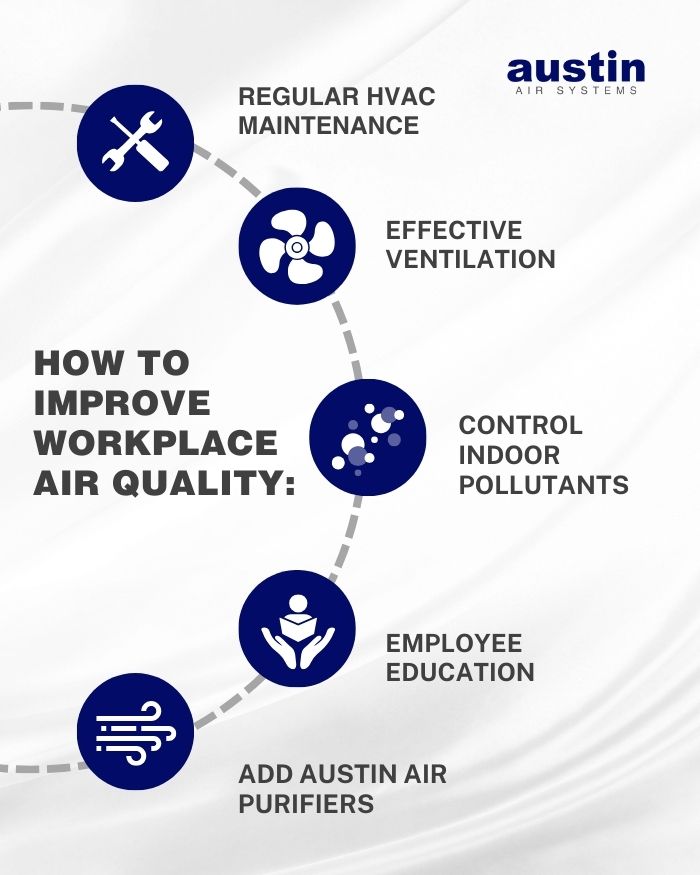
Protect your workforce on high-pollution days. Provide masks (N95 or better for PM2.5), allow remote work when possible, add breaks for outdoor workers, run air filtration in facilities, and postpone non-essential outdoor activities.
Communicate proactively with employees. Don’t wait for people to ask. Send alerts when AQI exceeds 100. Provide education about symptoms and protective measures. Show that leadership takes this seriously.

Long-Term Strategic Planning
Audit and reduce your emissions footprint. This isn’t just good PR—it’s risk mitigation. Transition fleet vehicles to electric, upgrade facilities to cleaner energy sources, and optimize logistics to reduce transportation emissions. Your actions today determine your regulatory compliance headaches tomorrow.
Incorporate air quality into site selection and real estate decisions. When evaluating locations for new facilities, analyze historical AQI data. Areas with consistently poor ratings represent hidden costs that will eat into your profitability through higher healthcare, insurance, and operational expenses.
Invest in facility infrastructure. HVAC upgrades, air filtration systems, and building envelope improvements provide immediate ROI through reduced health impacts and improved productivity. These investments also prepare you for increasingly common high-pollution events.
Consider tree planting and green infrastructure. Trees act as natural particulate matter barriers and carbon sequestration systems. Businesses with campuses or outdoor facilities can create healthier microclimates while generating positive community relations.
Engage with policy and regulatory developments. Air quality regulations are evolving rapidly. Companies that participate in the conversation shape rules in practical ways. Those that ignore policy developments get blindsided by compliance requirements.

Integrate Climate and Air Quality into Business Strategy
Here’s the uncomfortable truth: air quality and climate change are intertwined. You can’t address one without considering the other. Businesses developing climate strategies need air quality components, and vice versa.
Forward-thinking companies are already acting. They’re setting emission reduction targets, investing in clean technology, redesigning supply chains, and building resilience into their operations. These aren’t feel-good initiatives—they’re competitive advantages.
The businesses that thrive over the next decade will be those that recognize air quality as a strategic issue requiring C-suite attention, not a facilities management afterthought.

The Bottom Line
Today’s poor air quality stems from a perfect storm of human emissions, climate-intensified wildfires, heat-driven ozone formation, and weather patterns that trap pollutants. The problem is real, growing, and expensive.
For business leaders, ignoring air quality is no longer viable. The impacts on workforce health, productivity, supply chains, and regulatory compliance are too significant. The good news? Solutions exist, and early adopters gain competitive advantages.
Start by monitoring AQI and implementing protective measures for your workforce. Then move to strategic planning: audit emissions, factor air quality into facility decisions, and invest in infrastructure improvements. Finally, engage with the bigger picture through climate-integrated business strategies.
The air quality outside your window today is a warning signal. Smart leaders are already responding. The question is: will you be among them?

Key Takeaways
- Poor air quality is being driven by a mix of anthropogenic emissions, climate-fueled wildfires, and heat-driven secondary pollutants like ozone.
- PM2.5 and ground-level ozone have severe health and business impacts, from premature deaths to crop losses and productivity declines.
- Weather patterns can aggravate or alleviate pollution, so understanding local meteorology is critical for risk planning.
- Monitoring the AQI and integrating air quality into business strategy—and site selection—is no longer optional for forward-thinking organizations.
- Short-term protections and long-term emission reductions both pay off for the health of workforces, communities, and the bottom line.
Frequently Asked Questions (FAQ)
- Q: What is PM2.5 and why should I care?
A: PM2.5 stands for particulate matter with diameters of 2.5 micrometers or less. Its small size allows it to penetrate deep into the lungs and bloodstream, increasing health and productivity risks for your workforce. - Q: How does the AQI affect business decisions?
A: The Air Quality Index translates daily pollution levels into actionable numbers. A high AQI signals when to adjust operations to safeguard employee health, reduce risk, and avoid potential liabilities. - Q: What are realistic steps my company can take now?
A: Start by monitoring AQI where you operate and rapidly communicating risks. Provide PPE as needed, enable remote work, and invest in air filtration for high-risk locations. These are immediate, tangible actions. - Q: How can businesses reduce their long-term exposure and risk?
A: Proactively reduce emissions, select sites with lower air pollution, and invest in strong building systems and green infrastructure. Stay engaged with evolving regulations to remain compliant and competitive. - Q: Is this only an issue in the U.S.?
A: No. While U.S. wildfires and heatwaves have dominated recent headlines, air quality challenges are rising globally, especially in rapidly industrializing regions. It’s a worldwide, multi-sector business risk.