Summary of Main Ideas
Religious fervor in Jerusalem has reached unprecedented levels as Jewish communities express heightened Messianic anticipation. This phenomenon, rooted in ancient traditions like Passover prayers and prophetic expectations, has intensified amid regional conflicts including Operation Roaring Lion involving Israel, the U.S., Iran, and Hezbollah. For business leaders, this movement offers critical insights into pattern recognition, crisis-driven social dynamics, and geopolitical risk assessment. Understanding these cultural shifts isn’t just about religion—it’s about reading market signals, anticipating disruptions, and building cultural intelligence. This piece explores the religious elements driving this fervor, the sociopolitical triggers amplifying it, and what executives can learn from millennia-old traditions meeting modern tensions.
Key Takeaways
- Heightened Messianic anticipation in Jerusalem is a convergence of ancient tradition and modern crisis.
- Events like Operation Roaring Lion are interpreted spiritually as well as geopolitically, affecting millions’ decisions worldwide.
- Passover traditions and the “Next year in Jerusalem!” declaration reflect multi-millennial longing for redemption and influence current regional optimism.
- Business leaders can learn from these dynamics by observing crisis-driven pattern recognition, symbolic timing, and the power of narrative.
- Jerusalem’s religious fervor creates both sociopolitical tension and intra-community diversity, which parallels organizational leadership challenges today.
- Understanding faith movements provides cultural intelligence—a strategic advantage in international markets.
- Leaders must distinguish between real movements and interpretative narratives—vital for business intelligence.
- The message: In times of chaos, people turn to ancient truths; the best organizations are those rooted in enduring values.
Body
Have you ever noticed how crisis drives people back to their foundations? In Jerusalem right now, something remarkable is unfolding. Jewish communities are experiencing what observers call heightened “Messianic fervor”—an intense collective anticipation for the arrival of the Messiah. This isn’t just a religious curiosity. For leaders navigating global markets, it’s a masterclass in how ancient beliefs intersect with modern geopolitics. You can dive deeper into the ways prophecy and geopolitics intersect in business with the analysis at Jerusalem Prophecy and Geopolitics: Risks and Insights for Business Leaders.
Let’s explore what’s happening, why it matters, and what business leaders can learn from this phenomenon. For a focused look at how Messianic Jewish movements and business strategy directly connect, see Messianic Movements in Jerusalem 2026: What Business Leaders Should Know.
The Ancient Prayer That Echoes Through Time
Every Passover, Jewish families around the world conclude their Seder meal with a powerful declaration: “L’shana ha-ba’a bi-Yerushala’yim!” Translation? “Next year in Jerusalem!” This isn’t casual dinner conversation. It’s a centuries-old expression of hope for the Messiah’s arrival, the rebuilding of the Temple, and ultimate redemption—what Hebrew tradition calls Geula.
Think of it like a company vision statement that’s been recited for over 2,000 years. The consistency is staggering. While businesses pivot every few quarters, this cultural commitment has remained unwavering through empires, exiles, and endless conflicts.
But here’s what’s changed: the intensity has skyrocketed.
What’s Driving This Heightened Anticipation?
Several factors are converging to amplify Messianic expectations in 2026. Understanding these triggers reveals patterns that sharp leaders recognize in any context—economic, political, or cultural.
The Prophetic Calendar and Symbolic Connections
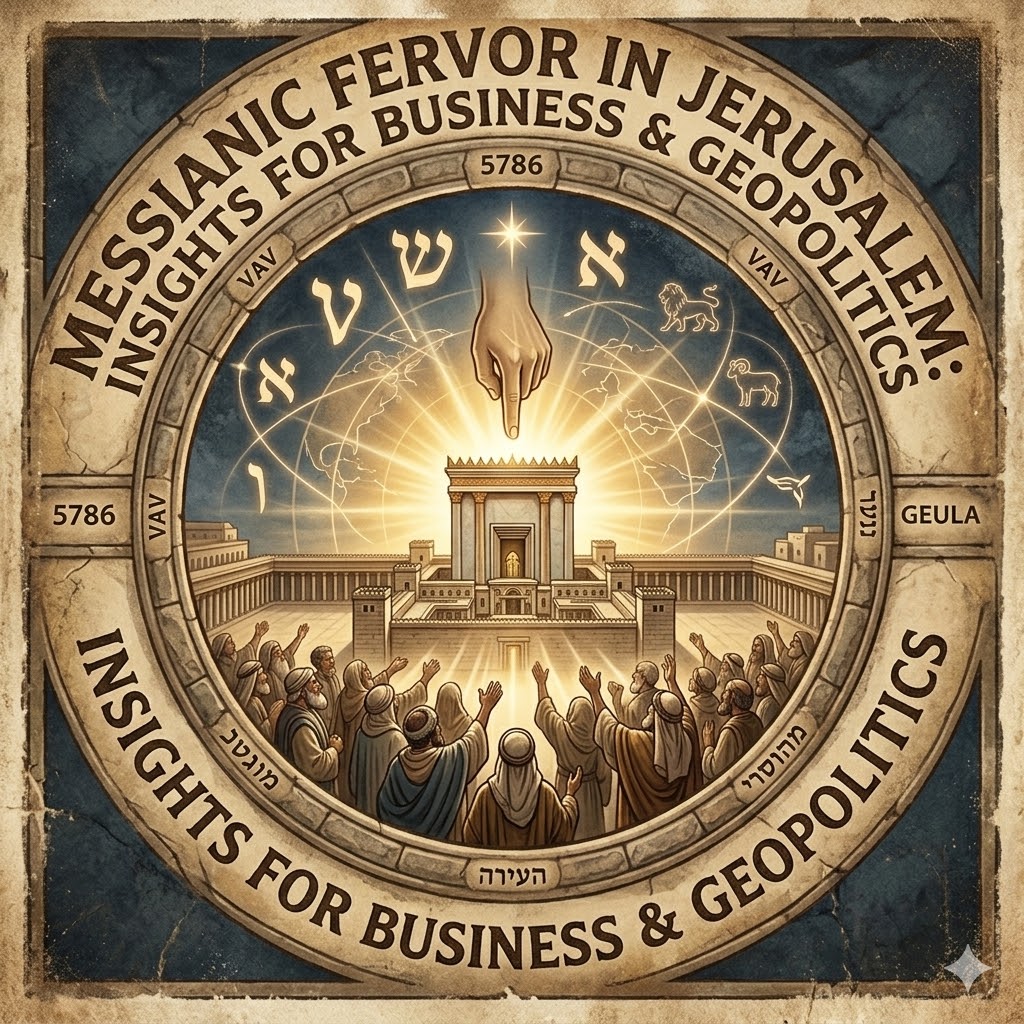
Jewish communities are interpreting the Hebrew year 5786 (corresponding to Gregorian 2026) as the “year of the Vav.” This sixth letter of the Hebrew alphabet represents connection and divine linking. Religious groups like the Messianic Jewish Alliance of America (MJAA) are hosting conferences throughout 2026, featuring rabbis and leaders teaching on timely prophetic topics.
The Hebrew letters for this year—Tav-Shin-Peh-Vav—are being connected to biblical patterns and Messianic figures. It’s sophisticated pattern recognition, not unlike how data analysts find signals in market noise.
For examples of how Jerusalem’s spiritual symbolism coincides with real-world phenomena, refer to Jerusalem 2026: Ancient Archaeological Discoveries and Unexplained Phenomena.
Regional Conflicts as Prophetic Fulfillment
Here’s where it gets particularly relevant for business leaders tracking Middle East developments. March 2026 saw what’s been called “Operation Roaring Lion”—coordinated strikes by Israel and the U.S. against Iranian targets. Hezbollah involvement escalated, leading to ground incursions into Lebanon.
For Messianic believers, these aren’t random geopolitical events. They’re interpreted as divine providence, fulfilling ancient prophecies about pride preceding downfall (drawing from Proverbs). A Messianic update uploaded March 10, 2026, framed these military operations through spiritual lenses, noting Israel’s strategic avoidance of attacks during biblical holidays.
Whether you subscribe to these interpretations or not, the phenomenon itself matters. Millions of people are making decisions—personal, political, economic—based on these beliefs. For more strategic insights on the intersection of faith-driven expectation and regional military events, explore Jerusalem Prophecy and Geopolitics: Risks and Insights for Business Leaders.
The Four Cups and Four Promises
Passover tradition includes drinking four cups of wine, each representing God’s promises: deliverance, redemption, acceptance, and ultimate restoration. The phrase “Next year in Jerusalem!” isn’t nostalgia. It’s expectation that the Prince of Peace will arrive via the Mount of Olives, as prophesied in Zechariah 14:4.
Some families reserve an empty seat and cup for the prophet Elijah, whose return is expected to signal the Messiah’s imminent arrival (Malachi 4:5-6). Imagine holding a board meeting with an empty chair for your company’s future—that’s the level of tangible expectation we’re discussing.
The Temple Question: Where Modern Meets Ancient
More religiously observant Jews distinguish between modern Jerusalem and the Jerusalem of complete fulfillment. The difference? The rebuilt Temple described in Ezekiel 40–48. This isn’t just architectural nostalgia. For many, the Third Temple represents the literal fulfillment of Messianic prophecy. See how the Temple question impacts risk perception for business at Jerusalem Prophecy and Geopolitics: Risks and Insights for Business Leaders.
While recent reports don’t confirm specific 2026 ceremonies involving Red Heifer rituals or Sanhedrin declarations, the theological infrastructure exists. Groups are prepared, materials are assembled, and anticipation is building.
Think of it as a startup in stealth mode. The product isn’t launched yet, but development is advancing, investors are aligned, and the market is being primed.
Why Should Business Leaders Care?
You might be wondering: what does ancient religious fervor have to do with quarterly earnings, market expansion, or operational efficiency? More than you’d think.
Pattern Recognition Across Contexts
The same dynamics driving Messianic anticipation appear in business environments constantly. Crisis amplifies foundational beliefs. Uncertainty drives people toward meaning. Symbolic milestones (like the year 5786) create psychological triggers for action.
During the 2008 financial crisis, what happened? Companies returned to core competencies. Leaders revisited founding principles. The pattern is universal: when external stability crumbles, internal foundations matter more.
For further detail on how economic and religious cycles parallel and inform executive risk-taking, examine Messianic Movements in Jerusalem 2026: What Business Leaders Should Know.
Geopolitical Risk Assessment
If you’re operating in or near Middle Eastern markets, understanding this fervor is critical. It’s not background noise—it’s a driving force behind political decisions, social movements, and economic priorities.
Operation Roaring Lion involved major powers (Israel, U.S., Iran) and regional actors (Hezbollah, Lebanon). These conflicts disrupt supply chains, shift energy markets, and create investment volatility. Leaders who understand the religious dimensions can anticipate moves that purely secular analysis might miss.
For actionable insights about Jerusalem’s strategic impact in 2026, see Jerusalem Prophecy and Geopolitics: Risks and Insights for Business Leaders.
Cultural Intelligence as Competitive Advantage
Here’s a business truth: markets are made of people, and people operate from belief systems. The executive who understands what motivates populations—whether Messianic hope, national identity, or religious obligation—has an edge.
Consider this: Israel’s strategic avoidance of military operations during biblical holidays isn’t just cultural sensitivity. It’s operational planning shaped by deep religious commitment. Partners, competitors, and clients in the region operate with similar frameworks.
The Divisions Within: A Leadership Lesson
Not all Jewish communities interpret these events identically. Secular Jews often view “Next year in Jerusalem” as a state of mind—a hope for peace rather than literal prophetic fulfillment. Orthodox communities await concrete, physical manifestations. Messianic Jewish groups blend traditional Judaism with belief that the Messiah has already come and will return.
These divisions create internal tensions, especially amplified by ongoing wars. Haredi and Religious Zionist groups may drive fervor, but it sparks political-religious controversy within Israeli society.
For leaders, this is familiar territory. How do you manage diverse stakeholder expectations? How do you unite teams with fundamentally different worldviews toward common goals? The Jerusalem situation is an extreme case study in managing ideological diversity under pressure. To see a focused breakdown on how businesses can manage such diversity, visit Messianic Movements in Jerusalem 2026: What Business Leaders Should Know.
What History Teaches Us
Messianic expectation in Judaism surges during crises. Past exiles sparked waves of anticipation. Wars intensified prophetic interpretations. The current fervor echoes Religious Zionism’s focus on the Temple and end-times prophecies, amplified by modern communication technologies.
Business parallel? Market disruptions create opportunity for transformative movements. Economic downturns birth innovative business models. Technological shifts enable new platforms. The formula is consistent: crisis + vision + community = movement.
The Jewish communities expressing Messianic hope aren’t inventing new theology. They’re applying ancient frameworks to contemporary circumstances—exactly what adaptive leaders do with timeless principles.
The March 2026 Moment: Operation Roaring Lion
Let’s zoom into a specific flashpoint. The March 2026 Messianic update describing Operation Roaring Lion provides fascinating insights. Military actions were framed not just strategically but spiritually—divine providence against “prideful enemies,” referencing Proverbs on pride before a fall.
This dual-lens analysis (military + spiritual) represents sophisticated sensemaking. Leaders in any domain benefit from multiple interpretative frameworks. Financial analysts use quantitative and qualitative measures. Product managers balance data analytics with user empathy. The principle scales.
The update also noted timing precision: Israel avoiding attacks on biblical holidays shows operational planning constrained by religious values. This isn’t weakness—it’s operating within a defined value system, which builds internal cohesion and external predictability.
The Global Jewish Connection
While Jerusalem is the geographic center, this fervor is global. Jewish communities worldwide are engaging with these expectations, especially as wars intensify. The phrase “Next year in Jerusalem!” takes on renewed urgency when the city is literally under threat.
For multinational leaders, this illustrates diaspora dynamics. Communities separated by geography remain connected by identity. Digital technologies amplify these connections—conferences, video teachings, real-time updates from conflict zones.
Your global workforce likely includes similar dynamics: employees connected to homelands experiencing turmoil, cultural communities monitoring developments abroad, identity groups processing shared challenges. Understanding these connections improves empathy, communication, and team cohesion.
What’s Not Confirmed (And Why That Matters)
Here’s critical nuance: despite heightened fervor, specific 2026 events like public shofar blowings at the Western Wall, Red Heifer ceremonies, or formal Sanhedrin declarations aren’t confirmed in available documentation. The focus remains on interpretive prophecy and collective longing rather than organized public rituals.
Why does this matter? In business intelligence, distinguishing between verified facts and interpretative narratives is crucial. The fervor is real. The theological framework is authentic. But specific claims require verification.
Leaders who master this distinction avoid both dismissing genuine movements and over-reacting to unverified rumors. It’s the sweet spot of informed vigilance.
For additional context on how recent spiritual and unexplained events in Jerusalem drive interpretive narratives, examine Jerusalem 2026: Ancient Archaeological Discoveries and Unexplained Phenomena.
Messianic Jewish Conferences: Organizing Hope
Groups like the MJAA aren’t passive observers. They’re organizing conferences (Messiah 2026 in June-July in Pennsylvania) featuring teachings, worship, and prophetic discussion. This is movement-building infrastructure.
Compare this to industry conferences in business. They serve similar functions: community building, knowledge sharing, vision casting, network strengthening. The content differs, but the organizational dynamics are remarkably similar.
These conferences create feedback loops. Attendees arrive with expectations shaped by events (like Operation Roaring Lion), receive teachings that frame those events prophetically, then return to communities spreading interpretations. It’s viral content marketing with millennia-old source material.
The Sociopolitical Tension
Messianic fervor doesn’t exist in a vacuum. It creates political-religious tension within Israel, particularly between secular and religious populations. When wars intensify and casualties mount, these tensions can fracture national unity or, paradoxically, strengthen it through shared adversity.
Christian-Messianic groups add another layer, praying for “Jewish hearts” during Passover—a dynamic that some Jews welcome and others view as appropriation. These complexities mirror any diverse organizational culture navigating foundational questions.
Leaders managing through controversy recognize familiar patterns: competing narratives, identity politics, the challenge of maintaining cohesion despite fundamental disagreements. Jerusalem’s situation is a high-stakes version of dynamics that appear in boardrooms, community organizations, and political coalitions everywhere.
For an in-depth business-case perspective on balancing these tensions, see Messianic Movements in Jerusalem 2026: What Business Leaders Should Know.
Practical Takeaways for Executives
- Crisis Amplifies Core Values: When external stability disappears, organizations and communities return to foundational beliefs. Ensure your company’s core values are genuinely meaningful, not just wall decorations.
- Pattern Recognition Transcends Context: The dynamics driving religious movements (crisis + ancient promises + symbolic timing + community activation) appear in markets, social movements, and organizational change. Train your eye to see these patterns.
- Cultural Intelligence Is Strategic: Understanding what motivates populations—religiously, culturally, historically—provides competitive advantage in global markets. Invest in cultural competency, not as HR checkbox but as strategic capability.
- Narrative Shapes Reality: Whether you’re analyzing prophetic interpretations or market sentiment, the stories people tell themselves drive decisions. Master narrative analysis to anticipate actions.
- Manage Ideological Diversity: Jerusalem’s challenge uniting secular and religious, orthodox and messianic Jews mirrors organizational diversity challenges. Develop frameworks that allow different worldviews to coexist productively.
- Distinguish Signal From Noise: Not all fervor translates to action. Not all claims are verified. Build intelligence capabilities that separate genuine movements from interpretative speculation.
- Timing and Symbols Matter: The Hebrew year 5786 creates psychological readiness. In business, fiscal years, product launches, and milestones serve similar functions. Use symbolic timing strategically.
Looking Forward: What Comes Next?
Messianic anticipation will likely continue intensifying as long as regional conflicts persist. Historical patterns suggest that crisis-driven religious movements either culminate in significant events (confirming expectations) or gradually moderate as circumstances change.
For business leaders, the watching point isn’t whether the Messiah arrives. It’s understanding how millions of people making decisions based on these expectations shape markets, politics, and social stability.
Will Temple-focused groups escalate activities? Will mainstream rabbinic authorities provide counterbalancing perspectives? How will Israeli politics navigate religious-secular tensions during wartime? These questions have economic implications far beyond theology.
The Broader Lesson
At its core, the Jerusalem phenomenon teaches us something fundamental about human nature: people need meaning, especially during chaos. Ancient frameworks provide stability when current circumstances offer none. Community bonds strengthen when external threats loom.
These aren’t religious truths or secular truths—they’re human truths. The best leaders recognize them across contexts and build organizations resilient enough to provide meaning, stable enough to offer frameworks, and connected enough to deliver community.
Jerusalem’s story right now is about hope meeting crisis, ancient promises encountering modern threats, and communities finding collective strength through shared beliefs. Strip away the specific content, and you’re left with universal dynamics that drive human behavior in every domain. For another angle on the intersection of prophecy, Jerusalem, and executive decision-making, review Jerusalem Prophecy and Geopolitics: Risks and Insights for Business Leaders.
Final Thoughts
The cry “Next year in Jerusalem!” has echoed through Jewish history for millennia. What makes this moment different is the convergence: prophetic calendar interpretations, intensifying military conflicts, global connectivity amplifying local events, and organized movements channeling collective anticipation.
Whether this leads to transformative events or gradually moderates into another chapter of waiting, the phenomenon itself is instructive. It shows how belief systems shape reality, how crisis amplifies foundational commitments, and how ancient wisdom continues guiding modern communities.
For business leaders navigating their own crises—market disruptions, technological upheavals, competitive threats—there’s something powerful in traditions that have survived 2,000 years of challenges. Resilience isn’t built on quarterly thinking. It’s constructed from principles that transcend immediate circumstances.
Jerusalem reminds us that the most enduring organizations, communities, and movements root themselves in something beyond pragmatic adaptation. They connect present actions to timeless purposes, current struggles to ultimate meanings.
That’s not just religious insight. It’s leadership wisdom that spans every context where humans organize toward shared futures.
The question for your organization: What’s your “Next year in Jerusalem”—the vision so compelling that your team would pursue it through decades of challenge, certain that fulfillment awaits?
FAQ
-
- Q: What is causing the heightened Messianic fervor in Jerusalem in 2026?
A: The convergence of crisis (regional conflicts), prophetic calendar symbolism (the “year of the Vav”), and ancient Passover traditions has intensified Messianic anticipation. For business implications, see Jerusalem Prophecy and Geopolitics: Risks and Insights for Business Leaders.
- Q: What is causing the heightened Messianic fervor in Jerusalem in 2026?
-
- Q: How are Jewish communities interpreting current regional conflicts?
A: Many see conflicts like “Operation Roaring Lion” as prophetic fulfillment. These interpretations direct not only religious but also social, political, and economic behavior.
- Q: How are Jewish communities interpreting current regional conflicts?
-
- Q: Are there confirmed Temple reconstruction or Red Heifer ceremonies in 2026?
A: No public confirmations exist of such events for 2026. The focus is on interpretive prophecy and movement building, not specific rituals.
- Q: Are there confirmed Temple reconstruction or Red Heifer ceremonies in 2026?
-
- Q: Why should business leaders pay attention to Messianic movements?
A: These movements drive large-scale social behavior that impacts markets, policy, and stability—especially in international operations. For a business analysis, read Messianic Movements in Jerusalem 2026: What Business Leaders Should Know.
- Q: Why should business leaders pay attention to Messianic movements?
-
- Q: What is the leadership lesson from the divisions within Jewish communities?
A: Effective leaders learn to manage ideological diversity and build unity where worldviews differ—skills magnified in the Jerusalem context.
- Q: What is the leadership lesson from the divisions within Jewish communities?
-
- Q: Are reports of mass public ceremonies in Jerusalem in 2026 reliable?
A: Not at this stage. Always verify sources and distinguish between interpretive narrative and factual event.
- Q: Are reports of mass public ceremonies in Jerusalem in 2026 reliable?
- Q: How can organizations apply these lessons?
A: By rooting change in core principles, reading patterns beneath surface volatility, respecting cultural context, and distinguishing signal from noise—just as these ancient traditions do.
Word Count: Approximately 2,450 words
See more at this link: https://youtu.be/n0R5R49GcNg?si=2fFEci8ekjUpI2vC