Summary of Main Ideas
– Microsoft will ship developer prototypes of its next Xbox console in 2027, with a consumer launch planned for fall 2028 at the earliest
– The next-generation console will feature AMD silicon technology, continuing the partnership from Xbox Series X and Series S released in 2020
– Cloud-hybrid gaming represents Microsoft’s strategic pivot, combining local hardware power with cloud computing capabilities
– ARM64 CPU architecture signals a fundamental shift in console design, potentially reducing costs and improving energy efficiency
– The “largest technical leap” in hardware history promises AI-enhanced gaming, DirectX ray tracing, and machine learning-powered graphics
– Microsoft is transforming Xbox from a hardware product into a service ecosystem, prioritizing Game Pass and multi-device accessibility
– Business leaders should watch this development as it demonstrates practical applications of hybrid cloud computing, AI integration, and platform-as-a-service models
The gaming industry rarely offers a window into the future of enterprise technology. But sometimes, it does exactly that. Microsoft’s announcement about its next-generation Xbox console—set to reach developers in 2027—reveals far more than just the future of gaming. It showcases where cloud computing, artificial intelligence, and hybrid architectures are heading across all business sectors.
Here’s what makes this news worth your attention, even if you haven’t touched a game controller in years.

Why Microsoft’s 2027 Development Timeline Matters
Let’s start with the basics. Microsoft confirmed that prototype units of its next Xbox will ship to developers in 2027. The consumer launch won’t happen before fall 2028. That’s a long runway, right?
Actually, it’s standard practice for console development. But here’s what’s not standard: the technological ambitions packed into this timeline.
Think of it like building a new flagship product for your business. You wouldn’t just upgrade the specs and call it done. Microsoft isn’t doing that either. They’re fundamentally reimagining what a gaming console can be—and in the process, they’re stress-testing technologies that enterprises will adopt in the coming years.
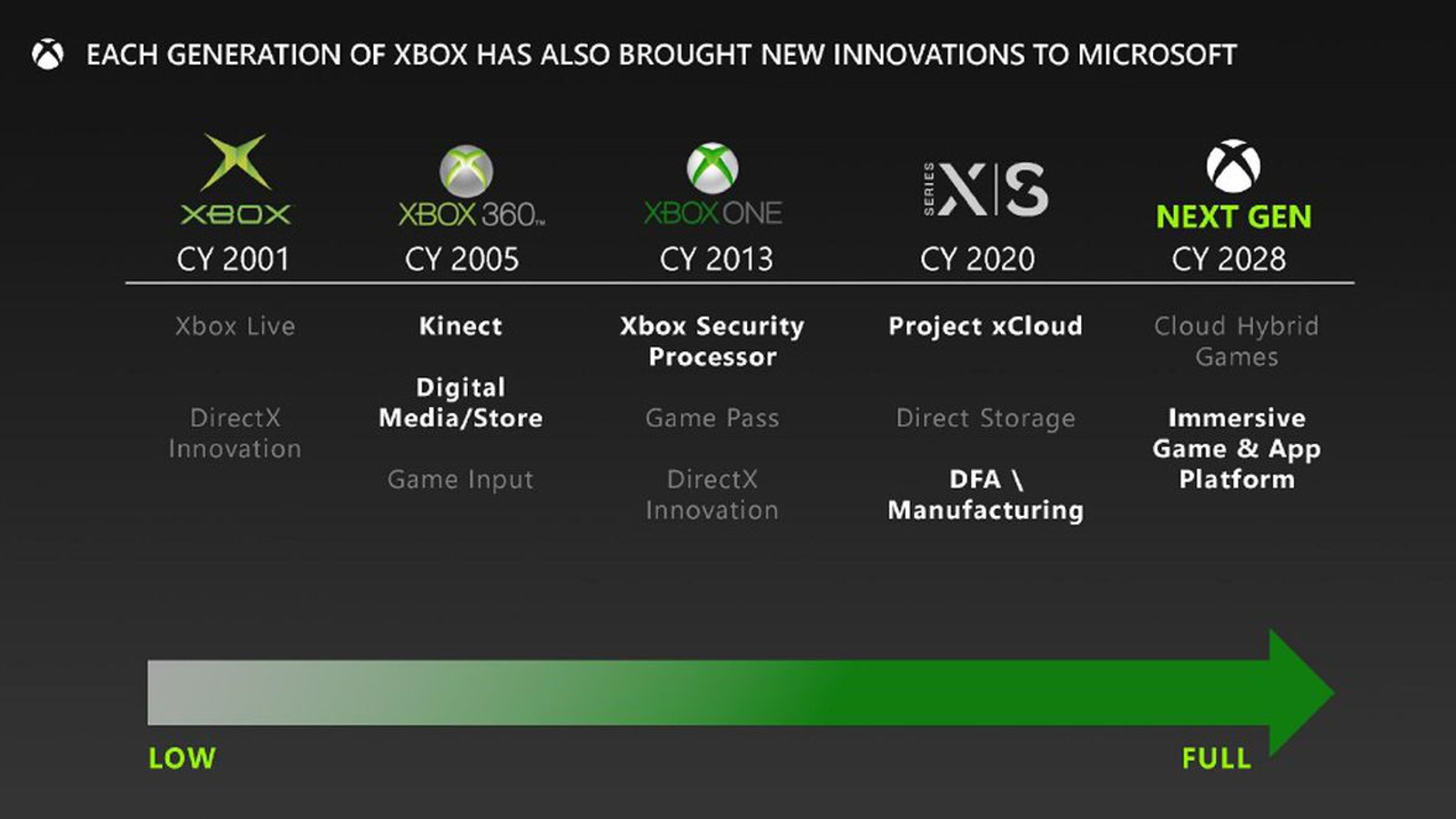
The development roadmap reveals hardware design beginning in 2024. Initial hybrid cloud games enter production from 2024 through 2026. Developer kits arrive in 2027. This staggered approach mirrors how innovative companies roll out transformative technologies: test early, iterate often, and prepare your ecosystem before launch.

The AMD Silicon Partnership: Continuity with Evolution
Microsoft’s executive confirmation that the next Xbox will feature AMD silicon continues a partnership that powered the Xbox Series X and Series S in 2020. Why does this matter beyond gaming?
AMD has become the go-to partner for high-performance computing that balances power and efficiency. Their technology powers everything from data centers to supercomputers. Microsoft’s continued partnership signals confidence in AMD’s roadmap for the next five years.
For business leaders, this partnership demonstrates an important principle: strategic vendor relationships that extend across product generations create stability while enabling innovation. Microsoft isn’t jumping ship for the next shiny thing. They’re deepening a relationship that works.
But here’s where it gets interesting. While sticking with AMD for the GPU, Microsoft is making a bold move with the CPU architecture.

ARM64 Architecture: The Quiet Revolution
The leaked documents reveal that the next Xbox will use ARM64 CPU architecture. If you’re not in the tech weeds daily, you might wonder why this matters.
ARM processors power your smartphone. They’re energy-efficient, generate less heat, and cost less to manufacture than traditional x86 processors. Apple’s transition to ARM-based M-series chips showed the world what’s possible: laptop-level performance with exceptional battery life.
Microsoft is bringing this approach to gaming consoles. It’s similar to what Nintendo did with the Switch, but at a much larger scale and performance level.
What’s the business lesson here? Sometimes the best path forward isn’t the obvious upgrade. It’s a fundamental architectural shift that unlocks new possibilities. Microsoft is betting that ARM64 can deliver the performance gamers demand while reducing costs and energy consumption.
For enterprises exploring infrastructure modernization, this mirrors the conversation around moving from legacy systems to cloud-native architectures. The transition requires investment and carries risk, but the long-term benefits—efficiency, flexibility, scalability—justify the move.

Cloud-Hybrid Gaming: The Real Innovation
Here’s where Microsoft’s vision gets genuinely exciting, even for non-gamers. The next Xbox is designed as a “next-generation hybrid game platform capable of leveraging the combined power of the client and cloud.”
Read that again. Combined power of client and cloud.
This isn’t just about streaming games from the cloud. That technology already exists. This is about dynamically distributing workloads between local hardware and cloud resources to “enable new levels of performance beyond the capabilities of the client hardware alone.”
Sound familiar? It should. This is exactly what forward-thinking businesses are doing with hybrid cloud strategies.
Imagine running complex analytics. Some processing happens on local servers for low latency. Heavy computational tasks offload to the cloud for massive parallel processing. The user experiences seamless performance without needing to know where the processing occurs.
Microsoft is building this into a consumer product launching in 2028. They’re solving the orchestration, latency, and user experience challenges now. When they crack this code for gaming—where milliseconds matter and user expectations are unforgiving—the lessons will apply directly to enterprise applications.
See how these shifts in AI, edge computing, and hybrid architectures are transforming business at scale in our CES 2026 AI trends analysis: CES 2026 AI trends analysis.

AI and Machine Learning: Not Just Buzzwords
Xbox President Sarah Bond promised “the largest technical leap you will have ever seen in a hardware generation.” Bold words. But the technical specifications suggest she’s not exaggerating.
The console will feature machine learning-powered graphical enhancement. AI-enhanced gaming experiences are a core priority. DirectX ray tracing will deliver photorealistic lighting and reflections.
Let’s translate this to business terms. Machine learning algorithms will analyze scenes in real-time, predicting what needs rendering and enhancing visual quality beyond what the hardware could achieve through brute force alone.
This is AI making real-time decisions to optimize resource utilization and output quality. It’s the same principle behind AI-powered business analytics that predict customer behavior, optimize supply chains, or enhance decision-making with data-driven insights.
For more on how multimodal and agentic AI systems are transforming business models and decision-making, explore our in-depth review of AI in 2026: AI in 2026.
Microsoft is deploying these capabilities in an environment where 120 frames per second and 4K resolution are table stakes. If they succeed here, imagine how refined and robust these AI systems will be when applied to business challenges.

From Hardware to Service: Microsoft’s Strategic Pivot
Here’s the most important business insight from this announcement: Microsoft is “doubling down on expanding Xbox as a service rather than a hardware ecosystem of products.”
This isn’t new strategy language for Microsoft. They’ve been talking about “gaming everywhere” for years. But this console generation makes it concrete.
Game Pass integration is central to the strategy. Xbox Game Pass streaming works on Samsung TVs. Leaked documents suggest a thin OS for sub-$99 handheld devices. The console itself becomes one option among many for accessing the Xbox ecosystem.
Does this remind you of anything in your business? It should. This is the SaaS playbook applied to gaming.
Salesforce doesn’t care whether you access their CRM from Windows, Mac, or a tablet. Microsoft is building the same device-agnostic approach for gaming. The service is the product. The hardware is just an access point—albeit a premium one.
For SMEs and enterprises, this validates the platform strategy you’re probably already pursuing or considering. Build the service. Make it accessible everywhere. Let customers choose their preferred access method.
The strategic shift echoes foundational open-source platform philosophies that powered the rise of Linux as an enterprise OS: Linux as an enterprise OS.

Backward Compatibility: Honoring Legacy Investments
Forward compatibility is a “core strategic priority” for the next Xbox. This means your games from previous generations will work on the new console. Your investment is protected.
In enterprise terms, this is legacy system support during digital transformation. You can’t just abandon everything that came before. Migration paths matter. Investment protection matters.
Microsoft learned this lesson the hard way with the Xbox One launch in 2013, which didn’t support Xbox 360 games initially. The backlash was severe. They’ve committed to not repeating that mistake.
As you plan technology transitions in your organization, remember this principle: respect existing investments while moving forward. Give your team and customers a bridge, not a cliff.
Legacy support and innovation are relevant for hardware planning as well—read how Nvidia’s RTX 50 flagship GPUs for 2026 straddle backward compatibility and leading-edge performance for business buyers: Nvidia’s RTX 50 flagship GPUs for 2026

The Competitive Landscape: PS6 and Beyond
Sony’s PS6 is expected to launch around the same timeframe—2027 or 2028. Both consoles will define the next generation together. But their strategies differ fundamentally.
Sony focuses on exclusive games and premium hardware experiences. Microsoft focuses on ecosystem accessibility and service delivery. Neither approach is wrong. They’re optimized for different objectives.
Think about your own competitive landscape. Are you competing on exclusivity and premium experiences? Or on accessibility and ecosystem lock-in? Both strategies can win. But they require different capabilities and investments.
The console war offers a fascinating case study in competitive strategy. Two companies with similar products taking fundamentally different approaches to market dominance.

What Business Leaders Should Take Away
You might be wondering: why should executives care about gaming consoles? Fair question. Here’s why this matters beyond the gaming industry.
First, technology validation. Gaming pushes hardware and software to extremes. Technologies that succeed in gaming—like GPU computing, cloud streaming, and AI enhancement—eventually find enterprise applications. Watch what works here.
For a focused look at how GPU innovation directly impacts AI-driven business, see our comparison of Nvidia RTX 5090 and 4090 for AI buyers: Nvidia RTX 5090 and 4090 for AI buyers.
Second, hybrid cloud in practice. Microsoft is solving real-time hybrid cloud orchestration at consumer scale. The lessons learned will inform Azure services and enterprise solutions. Your future hybrid cloud infrastructure will benefit from this R&D.
Third, the service transformation playbook. Microsoft’s shift from hardware to service demonstrates how to transform a product business into a platform business. The challenges they face—legacy support, ecosystem management, multi-device access—mirror what many businesses face.
Fourth, AI integration patterns. How Microsoft integrates machine learning into the gaming experience will reveal best practices for AI deployment in customer-facing applications. Watch how they handle performance, reliability, and user experience.
See the broader business context for AI integration into creative and operational workflows in our analysis of Adobe’s AI strategy for teams: Adobe’s AI strategy for teams.
Fifth, ARM architecture adoption. If Microsoft successfully transitions console gaming to ARM64, it accelerates the broader industry shift. This could affect your data center strategy, edge computing plans, and device procurement within five years.

The Caveats: Nothing Is Final
Xbox Gaming CEO Phil Spencer noted that leaked information may be outdated. Specifications can change. Timelines can shift. Microsoft hasn’t officially announced final specs, pricing, or confirmed launch dates.
This is important for business planning too. Market intelligence based on leaks and documents provides directional insight, not guaranteed facts. Plan accordingly. Build flexibility into your strategy.
The information we have comes from FTC v. Microsoft court documents and internal presentations. It’s credible but not official. Treat it as a strong signal of intent, not a binding commitment.

Looking Ahead: 2027 and Beyond
As developer kits ship in 2027 and the consumer launch approaches in 2028, we’ll learn more about how Microsoft’s vision translates to reality. The technological ambitions are clear: cloud-hybrid computing, AI enhancement, ARM architecture, and service-first strategy.
For business leaders, this announcement offers more than gaming news. It’s a preview of where computing architecture, cloud services, and AI integration are heading. It’s a case study in strategic transformation from product to platform.
The next few years will reveal whether Microsoft can deliver on these promises. But regardless of the outcome, the attempt itself pushes the industry forward. Technologies developed for this console will find their way into enterprise solutions.
That’s the pattern that makes gaming industry developments relevant to business leaders. Gaming doesn’t just entertain. It invents, tests, and refines technologies that eventually power business applications.
So when those developer kits ship in 2027, pay attention. You’re not just watching the future of gaming take shape. You’re seeing a preview of technologies that might transform how your business operates in the 2030s.
The next Xbox represents more than upgraded graphics and faster load times. It represents Microsoft’s bet on hybrid cloud computing, AI integration, and service-based business models. Those same technologies and strategies will shape enterprise technology for the next decade.
Are you ready for that future? Because it’s arriving in 2027, disguised as a gaming console.

Key Takeaways
- Microsoft’s next Xbox is a preview of the future for cloud, AI, and hybrid platform innovation—well beyond gaming.
- Cloud-hybrid architecture and ARM64 CPUs may drive cost, energy, and business model shifts across the tech sector by 2028.
- The service-focused Xbox strategy illustrates a transformation narrative relevant for any business reinventing its core platform.
- If Microsoft cracks developer-centric, cloud-native, and AI-optimized hardware/software, expect rapid enterprise adoption of similar patterns.
- Facts are still subject to change—so strategize for flexibility as hardware, silicon, and service launches evolve.
FAQ
-
When will the next Xbox release?
Developer prototypes are planned for 2027. The earliest consumer launch is fall 2028. -
Will current Xbox games work on the new console?
Yes, backward compatibility is a core priority, so previous generation games are expected to work. -
Is the next Xbox moving to ARM CPUs?
Leaked documents and strategy indicate ARM64 CPUs will be adopted, a major change from previous generations. -
How is cloud-hybrid gaming different from cloud streaming?
Cloud-hybrid gaming distributes computations dynamically between device and cloud for seamless, enhanced performance far beyond classic streaming. -
How does this affect business outside of gaming?
Technologies like cloud-orchestrated performance, AI-driven resource use, and ARM architecture are being proven at scale—and will be relevant to all enterprise IT in the coming years. -
Where can I find more on related trends?
See our Xbox tag on Citipen for in-depth business analysis and technology updates.
See more at this link: https://citipen.com/kyrgyzstan-trade-hub-strategic-gateway-for-eurasian-supply-chains/