Summary of Main Ideas
Adobe isn’t playing the AI game like everyone else—and that’s exactly why they might win. While competitors like Midjourney and Runway chase viral moments with standalone tools, Adobe is quietly embedding AI into the creative infrastructure that millions already depend on. Their strategy centers on deep ecosystem integration, not flashy features. Key insights include:
- Adobe leverages workflow continuity by integrating Firefly AI directly into Photoshop, Premiere Pro, and other Creative Cloud apps
- Partnership flexibility gives users access to multiple AI models (Gemini, ChatGPT, Flux 2.0) instead of betting on one
- Enterprise trust and governance position Adobe ahead as regulations tighten (see also how ‘AI in 2026’ envisions responsible governance for business transformation)
- Project Moonlight aims to orchestrate multiple Adobe apps through natural language commands
- GenStudio targets enterprise marketing teams with at-scale content automation
- Vulnerabilities remain around model quality competition and subscription fatigue
For decision-makers evaluating creative technology investments, Adobe’s approach represents a fundamental bet: that AI wins through integration, not isolation.

The creative software landscape is experiencing its most dramatic shift in decades.
Generative AI tools are proliferating faster than food trucks at a tech conference. But here’s the question keeping CTOs and creative directors awake: Will the future belong to nimble AI startups or established software giants?

The Ecosystem Play: Why Adobe Isn’t Worried About Standalone Tools
Think about your company’s creative workflow for a moment. How many times do your teams jump between applications? Design in one tool, edit in another, export to a third, then start over when changes arrive?
Adobe’s strategy exploits this painful reality. While competitors launch impressive standalone AI platforms, Adobe embeds AI directly into the tools your teams already use daily.
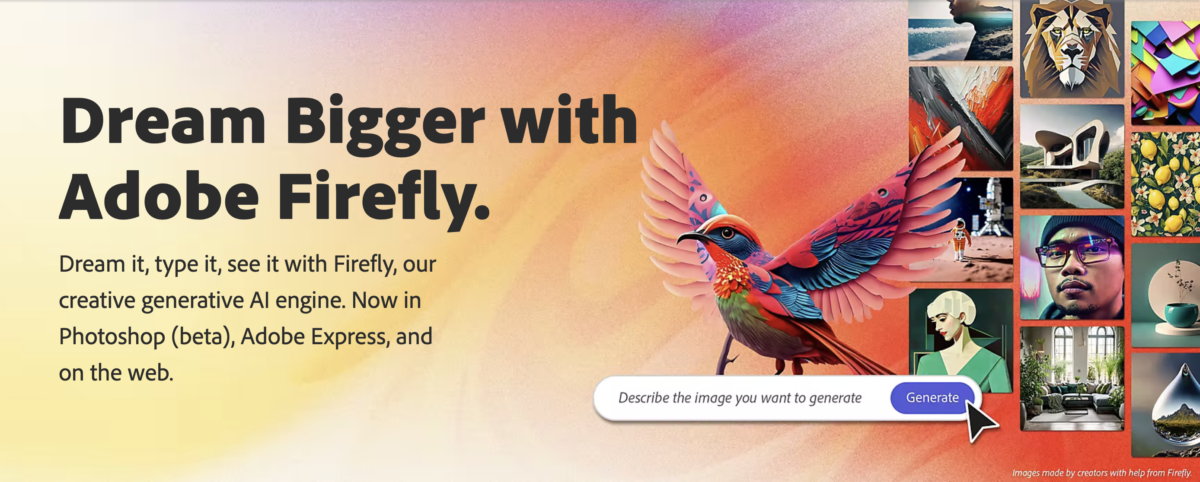
Firefly, Adobe’s generative AI engine, isn’t a separate destination. It lives inside Photoshop, Illustrator, Premiere Pro, and Adobe Express. Your designer doesn’t need to leave their workspace, export a file, prompt an external AI tool, then import the result back. The AI is already there, native and ready.
This isn’t just convenience—it’s competitive moat-building. Consider the friction involved in adopting a new tool. Training costs, workflow disruption, file compatibility headaches, license management. Adobe sidesteps all of this by delivering AI where your teams already work.
The switching costs become enormous. When an employee knows Photoshop and suddenly Photoshop has world-class AI built in, what’s the incentive to learn Midjourney? For SMEs and enterprises managing productivity at scale, this workflow continuity translates directly to ROI.

The Integration Advantage
Adobe controls an interconnected application ecosystem spanning the entire creative lifecycle. Firefly doesn’t exist in isolation—it’s woven throughout:
- Design applications: Photoshop and Illustrator for graphics and branding
- Video production: Premiere Pro with AI-powered editing and effects
- Marketing tools: Adobe Express for quick content creation
- Collaboration platforms: Firefly Boards for team ideation with real-time collaboration
- Enterprise intelligence: Adobe Sensei powers predictive analytics in Experience Cloud
This creates what economists call “network effects.” The more Adobe apps your organization uses, the more valuable AI integration becomes. A marketing manager using Express, a designer working in Illustrator, and a video editor in Premiere Pro all access the same AI capabilities with consistent results.
Compare this to the competitor model. Midjourney requires a Discord interface or web platform. Runway operates as a separate browser application. Stability AI offers APIs that require technical implementation. Each demands separate subscriptions, logins, and learning curves.
For a 50-person marketing agency or a corporate creative team, which model scales better?

The Partnership Model: Playing Switzerland
Here’s where Adobe gets clever. Rather than forcing customers to bet everything on Adobe’s proprietary AI, they offer access to multiple leading models.
Users can tap into:
- Google’s Gemini for certain tasks
- OpenAI’s ChatGPT for others
- Flux 2.0 and additional partner models as appropriate
This “model-agnostic” approach positions Adobe as a platform rather than a vendor. Think of it like this: Adobe becomes the creative operating system, and various AI models become apps that run on it.
Why does this matter for your business? AI models evolve rapidly. Today’s breakthrough becomes tomorrow’s baseline. By offering multiple models, Adobe reduces your dependency risk. If one model falls behind or faces ethical controversies, you’re not locked in.
For enterprise buyers responsible for multi-year technology strategies, this flexibility is invaluable. You’re buying the platform, not betting on a single AI horse.

Enterprise Trust and Responsible AI
Let’s talk about the unglamorous but critical factor: governance, security, and compliance.
Midjourney’s viral Discord bot is fun. It’s not necessarily compliant with your company’s data policies. When your creative team uploads brand assets to an external platform, where does that data go? Who owns it? What happens to it?
Adobe brings established enterprise infrastructure:
- Data governance frameworks for sensitive information
- Brand safety protocols ensuring outputs align with corporate standards
- Commercial use licensing that protects you legally
- Security certifications meeting enterprise IT requirements
As regulatory scrutiny on AI intensifies—think EU AI Act, copyright litigation, data privacy laws—Adobe’s responsible AI commitment becomes a competitive advantage. They’re building for a future where AI vendors face real accountability.
For CEOs and legal teams, this isn’t abstract. One viral AI-generated image that violates copyright could cost more than years of software licenses.

Project Moonlight: The AI Creative Director
Imagine describing your entire project in plain English: “Create a product launch campaign with hero images, social media variants, and a 30-second video, all using our brand guidelines.”
Then imagine the software figuring out which Adobe applications to use, in what sequence, to deliver exactly that.
That’s Project Moonlight. It’s an AI assistant designed to orchestrate multiple Adobe applications through natural language commands. Instead of optimizing individual tools, Adobe is automating end-to-end creative workflows.
For managers overseeing creative operations, this represents a productivity revolution. Junior team members could execute complex multi-application projects that currently require senior expertise. Turnaround times compress. Iteration costs plummet.
The competitive question: Can standalone AI tools match this cross-application intelligence?

GenStudio: Marketing at Machine Speed
Marketing teams face a brutal reality: more channels, more content demands, same budget, same headcount.
Adobe GenStudio directly addresses this pain point. It integrates Firefly with Creative Cloud and Experience Cloud, automating content production workflows specifically for marketers.
Picture this scenario: Your company launches a new product line. GenStudio generates:
- Email campaign variations for different segments
- Social media assets optimized for each platform
- Display ads in every required dimension
- Landing page graphics maintaining brand consistency
All from approved templates and brand guidelines, all at scale, all legally compliant.
This B2B2C approach targets enterprise marketing operations—a segment where Midjourney and Runway have minimal presence. Adobe isn’t just competing for individual creators; they’re positioning for departmental and enterprise-wide deployments.
The ROI case becomes compelling. If GenStudio saves your marketing team 20 hours per week on asset production, what’s that worth annually in salary costs alone? Now add faster time-to-market and increased campaign personalization.

Responsible AI as Competitive Differentiation
While competitors navigate copyright lawsuits and training data controversies, Adobe emphasizes ethical AI development.
Their approach includes:
- Training Firefly exclusively on licensed content and public domain materials
- Providing compensation frameworks for creators whose work trains the models
- Building output verification tools to detect potential issues
- Establishing clear commercial use rights for generated content
Is this defensive, or strategic? Both. As AI regulation tightens globally, Adobe’s infrastructure for compliance becomes harder for newer competitors to replicate.

Model Quality Wars
Here’s the uncomfortable truth: Midjourney’s image quality often exceeds Firefly’s. OpenAI’s video capabilities advance rapidly. Stability AI pushes research-grade model innovation.
If Adobe’s integrated AI produces noticeably inferior results, workflow convenience won’t matter. Creative professionals prioritize output quality above nearly everything else. An integrated mediocre AI loses to a standalone excellent one.
Adobe must maintain feature parity or leadership in generative quality. That requires continuous model improvement, substantial R&D investment, and possibly humbling partnerships where Adobe’s tech genuinely lags.

Subscription Fatigue and Pricing Pressure
Adobe’s business model relies on subscriptions and “Generative Credits” for AI features. As free alternatives proliferate and pricing competition intensifies, will customers accept premium pricing?
SMEs particularly feel this pressure. A $60/month Creative Cloud subscription plus AI credit costs versus a $10/month Midjourney subscription presents a stark comparison.
Adobe’s bet: integrated workflow value justifies premium pricing. But that only works if customers perceive sufficient differentiation. If AI commoditizes fast enough, Adobe faces margin pressure.

Niche Specialists and Vertical Competition
Runway focuses intensely on video AI. Stability AI targets researchers and developers. Specialized tools might deliver superior results for specific use cases.
A production company might choose Premiere Pro for editing but Runway for AI video generation. A research lab might standardize on Stability AI despite using Adobe for graphics.
Adobe’s ecosystem only matters if customers stay inside it. Every time a user exports to a specialized tool, Adobe’s integration advantage erodes.

Operating System vs. Application
Adobe’s fundamental bet is clear: they’re positioning as the creative operating system, not just another AI application.
- Controlling workflows across multiple use cases
- Creating high switching costs through familiarity and integration
- Offering a platform for multiple capabilities rather than a single feature
- Building developer and partner ecosystems that extend reach
This strategy has precedent. Microsoft didn’t build the best word processor, spreadsheet, or presentation tool individually. They won by bundling Office, integrating applications, and embedding themselves in enterprise workflows.

What This Means for Your Business
If you’re evaluating creative technology investments—as an SME, manager, or C-level executive—Adobe’s strategy creates both opportunities and considerations.
Advantages of staying in Adobe’s ecosystem:
- Lower training costs as AI capabilities deploy to existing tools
- Integrated workflow efficiency across creative production
- Enterprise-grade governance for compliance and risk management
- Future-proofing through Adobe’s multi-model partnership approach
Reasons to diversify or explore alternatives:
- Potential cost savings from specialized tools for specific needs
- Access to cutting-edge capabilities where competitors lead
- Flexibility to avoid vendor lock-in as the market evolves
- Opportunity to test emerging tools before full commitment
The pragmatic approach? Most organizations will adopt a hybrid model. Adobe serves as the core creative infrastructure, while specialized AI tools supplement for specific use cases where they excel.
Your creative team might use Photoshop with Firefly for 80% of image work, but still maintain a Midjourney subscription for exploratory concepts. Your video editors might rely on Premiere Pro but experiment with Runway for specific AI effects.
This isn’t disloyalty to Adobe—it’s smart technology management. The AI landscape changes monthly. Locking into any single vendor’s complete ecosystem carries risk.

The Verdict: Integration Beats Innovation (For Now)
Adobe’s competitive position in the AI race depends less on technological breakthrough and more on execution of ecosystem integration.
They don’t need to build the world’s best AI model. They need to deliver “good enough” AI that’s dramatically more convenient, trustworthy, and workflow-integrated than alternatives.
For standalone competitors, the challenge is formidable. How do you convince a Creative Cloud subscriber to switch tools, learn new interfaces, export files back and forth, and manage separate subscriptions—just for marginally better AI output?
For Adobe, the challenge is continuous delivery. They must maintain AI quality parity, manage subscription pricing carefully, and execute on ambitious projects like Moonlight and GenStudio.
The future likely belongs to whichever model users choose with their time and attention. Will creative professionals accept AI inside their existing tools? Or will AI capabilities become compelling enough that users gladly switch applications?
Adobe is betting billions that workflow continuity beats feature superiority. Based on enterprise technology history, that’s not a bad bet. But in the fast-moving AI market, yesterday’s advantage can become tomorrow’s legacy constraint.
The race isn’t over—it’s just moved from pure innovation to strategic execution. And in that arena, Adobe’s decades of enterprise experience might prove decisive.

FAQ
- Q: Can I use Adobe’s AI without a Creative Cloud subscription?
No. Adobe places its generative AI features primarily inside its Creative Cloud suite; thus, a subscription is generally required to access Firefly and related tools. - Q: Is Adobe’s Firefly as good as Midjourney?
In some scenarios, Firefly does not match the raw image quality or variety that Midjourney offers. However, for many business and branding purposes—especially where brand alignment and compliance are critical—Firefly’s output is more reliably controlled. - Q: How does Project Moonlight work?
Project Moonlight is still in development but aims to operate as a natural language interface that understands project goals and automatically sequences the relevant Adobe apps and creative steps, potentially eliminating manual cross-app workflows. - Q: Does Adobe AI store or use my creative files to train its models?
Adobe states that only licensed and public domain content is used to train Firefly. User content uploaded in enterprise contexts is protected under strong data governance and commercial agreements. - Q: How should businesses balance Adobe’s ecosystem with niche creative AI tools?
A hybrid approach is recommended: leverage Adobe’s AI for core workflow continuity and compliance, but allow selected niche tools (like Midjourney or Runway) where they offer clear creative or economic advantages. - Q: Will Adobe’s multi-model partnership model protect my investment as AI accelerates?
Yes, that’s the intention. By building compatibility with models like Gemini, ChatGPT, and Flux 2.0, Adobe reduces the risk that your workflow becomes obsolete if any single AI provider stumbles.